

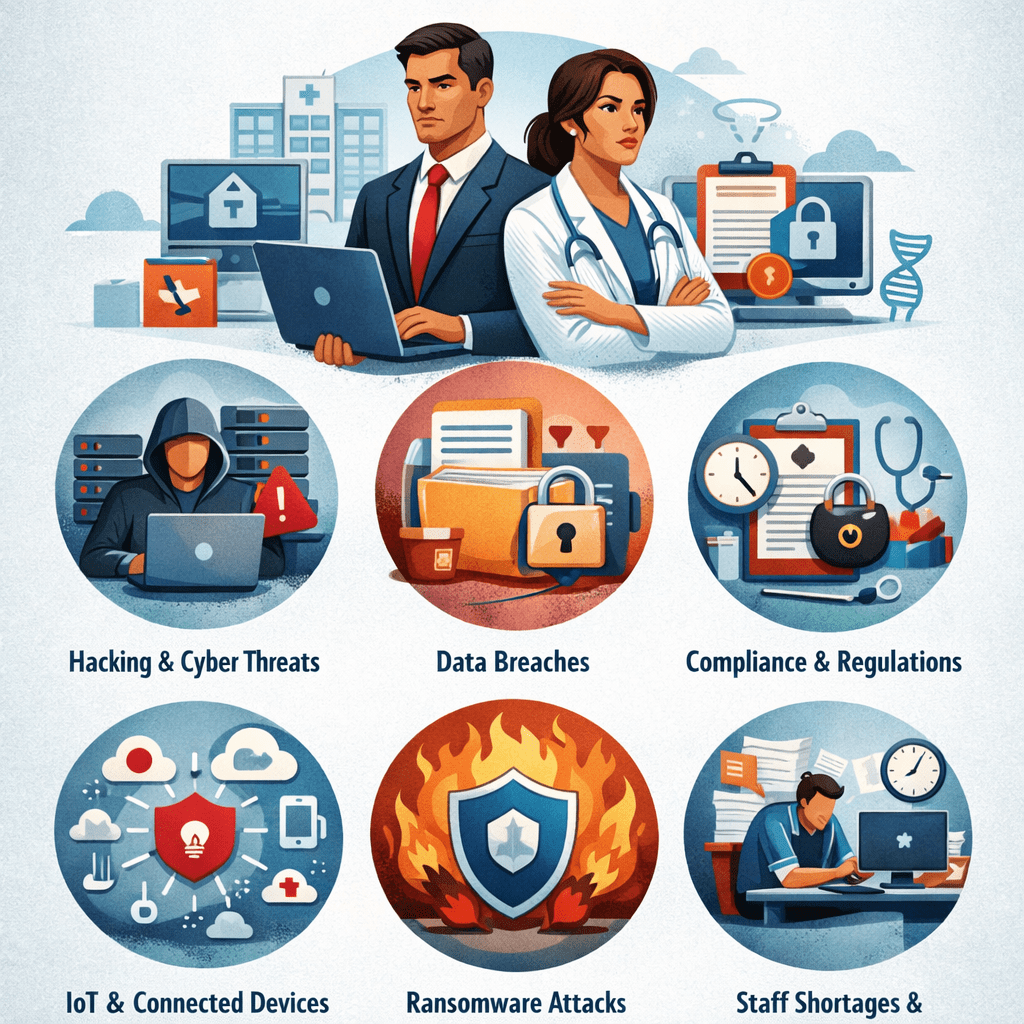
Healthcare CTOs and CIOs operate at the intersection of infrastructure complexity, regulatory scrutiny, workforce scalability, and executive accountability. They are responsible for ensuring uptime, safeguarding PHI, supporting hybrid cloud expansion, integrating new technologies, and maintaining audit defensibility, often simultaneously.
The broader executive framework for addressing these systemic challenges is introduced in Healthcare Executive Guide: Solving Critical Compliance and Security Pain Points, where leadership-level exposure is mapped to structural enforcement solutions.
For CTOs and CIOs, security pain points are not theoretical. They are operational, measurable, and persistent.
Pain Point 1: Identity Governance at Workforce Scale
Healthcare organizations with hundreds or thousands of users struggle to maintain identity discipline.
Common challenges include:
• Inconsistent MFA deployment across departments
Create authentication exposure gaps.
• Privilege creep over time
Expand unnecessary PHI access.
• Delayed access revocation after role changes
Produce orphaned credentials.
• Limited login anomaly monitoring
Delay breach detection.
Strategic response includes:
• Enterprise-wide phishing-resistant MFA enforcement
Reduce credential replay attacks.
• Automated Role-Based Access Control (RBAC)
Align access with job responsibilities.
• Privilege lifecycle automation
Eliminate orphaned accounts immediately.
Identity enforcement strategies are also reinforced in Professional Solutions for Healthcare Compliance Pain Points, where governance and architecture intersect.
Pain Point 2: Flat Network Architecture and Lateral Movement
CTOs and CIOs frequently inherit legacy network structures.
Indicators of risk:
• Clinical, administrative, and research systems share trust boundaries
Increase systemic vulnerability.
• Backup infrastructure accessible from production networks
Threaten recovery capability.
• Vendor VPN access overly broad
Expand exposure.
Modern response requires:
• Secure enclave segmentation for sensitive workloads
Limit breach blast radius.
• Backup isolation architecture
Protect recovery systems.
• Segmented vendor access zones
Restrict third-party visibility.
Architectural containment strategies align with executive modernization themes explored in Healthcare Compliance Challenges: Executive Solutions and Providers.
Pain Point 3: Monitoring Fragmentation Across Hybrid Environments
Healthcare IT ecosystems include on-prem, cloud, SaaS, imaging systems, and third-party integrations.
Monitoring challenges include:
• Logs dispersed across multiple platforms
Create blind spots.
• No unified SIEM integration
Reduce visibility consistency.
• Manual incident reporting workflows
Delay executive reporting.
Modern response includes:
• Centralized SIEM consolidation
Unify hybrid visibility.
• AI-driven anomaly detection engines
Detect abnormal file movement or configuration drift.
• Real-time executive dashboards
Improve governance transparency.
Visibility improvements support executive-level decision making described in How Healthcare Executives Address Critical Cybersecurity Challenges.
Pain Point 4: Vendor Risk Oversight Complexity
Vendor ecosystems expand quickly.
Common oversight gaps:
• Outdated Business Associate Agreements
Undermine compliance defensibility.
• Limited vendor session monitoring
Delay suspicious activity detection.
• No formal reassessment cycle
Miss evolving vulnerabilities.
Strategic vendor governance includes:
• Structured BAA validation processes
Maintain regulatory alignment.
• Continuous vendor activity monitoring
Detect abnormal behavior.
• Annual vendor risk reassessment cycles
Preserve oversight discipline.
Vendor risk management also strengthens executive confidence outlined in Professional Healthcare Solutions: Building Executive Confidence.
Pain Point 5: Audit Preparation and Documentation Burden
CTOs and CIOs often manage audit readiness stress directly.
Common operational strain:
• Spreadsheet-based evidence collection
Increase documentation inconsistency.
• Inconsistent encryption validation
Create safeguard gaps.
• Fragmented documentation repositories
Delay inspection readiness.
Modernization requires:
• Automated log retention enforcement
Preserve timestamp integrity.
• Centralized risk documentation management
Simplify audit preparation.
• Quarterly compliance reporting cycles
Institutionalize oversight rhythm.
Action-triggering leadership alignment is further explored in How to Trigger Action on Healthcare Security Challenges.
Pain Point 6: Balancing Innovation with Compliance
Healthcare IT leaders must adopt new technologies while maintaining regulatory discipline.
Challenges include:
• Rapid cloud expansion
Increase configuration risk.
• Telehealth scaling
Expand authentication exposure.
• EHR integrations
Create third-party risk.
Strategic balance requires:
• Structured segmentation before expansion
Prevent uncontrolled exposure.
• Identity governance enforcement prior to scaling
Reduce credential risk.
• Centralized monitoring before new integrations
Preserve visibility.
Governance alignment reinforces the enterprise-wide approach defined in Healthcare Executive Guide: Solving Critical Compliance and Security Pain Points.
Operational Outcomes for CTOs and CIOs
When modernization replaces legacy weaknesses, organizations observe:
• Reduced breach severity
• Faster anomaly detection
• Lower audit preparation strain
• Improved regulatory defensibility
• Clearer board-level reporting
• Increased operational stability
Infrastructure becomes resilient rather than reactive.
Key Takeaways
Healthcare CTOs and CIOs face systemic security pain points across identity governance scalability, flat network architecture, monitoring fragmentation, vendor oversight complexity, audit documentation strain, and innovation-driven exposure. Addressing these challenges requires structural containment, phishing-resistant authentication, centralized AI-driven monitoring, disciplined vendor governance, and automated compliance documentation aligned with executive oversight. When cybersecurity is embedded into enforceable infrastructure, healthcare IT leadership reduces uncertainty, strengthens defensibility, and supports sustainable enterprise modernization.

