

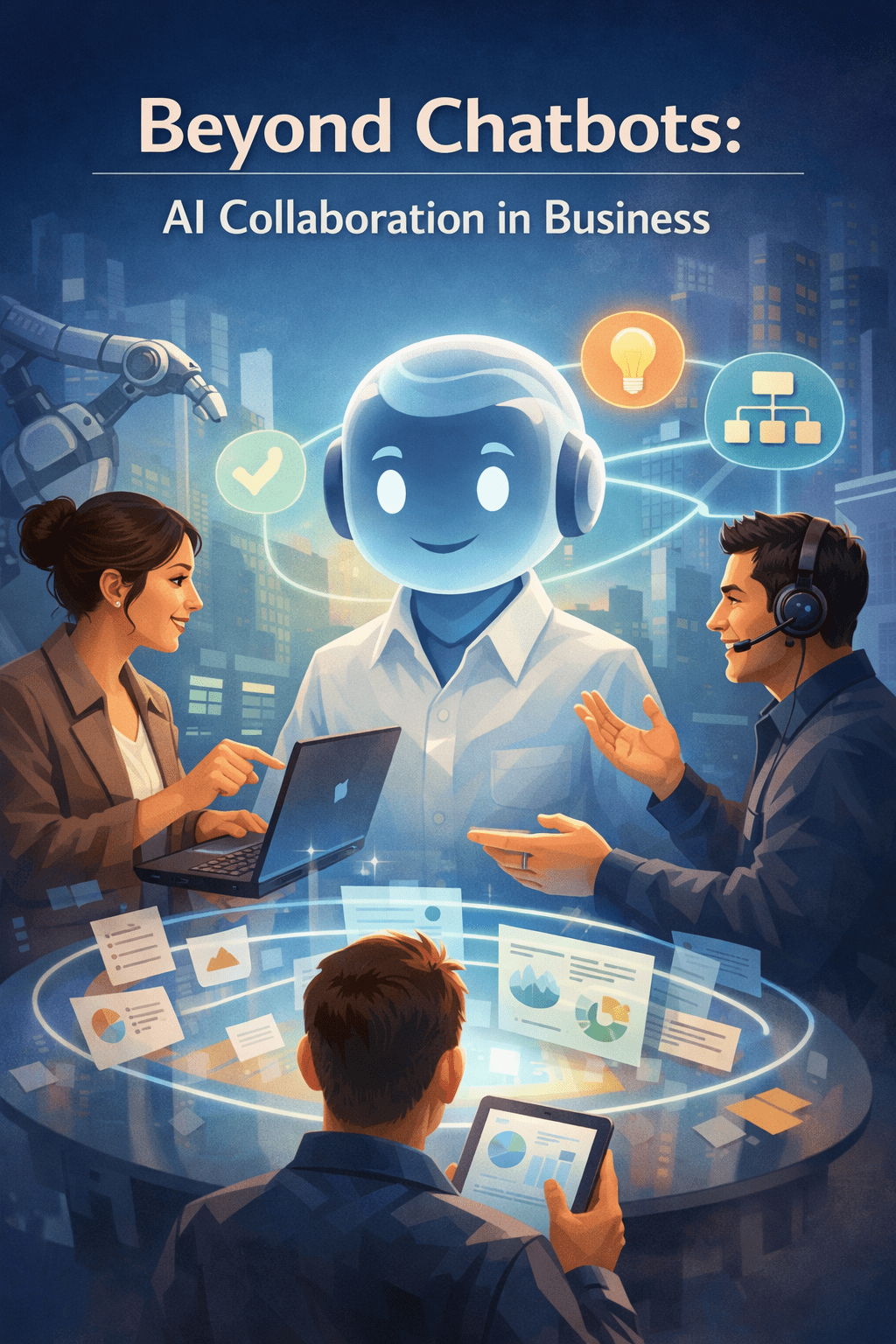
Chatbots answered questions. That was useful. It was not enough.
The next phase of enterprise AI is not a better chatbot. It is an AI that operates inside the work itself — managing files, executing tasks, and coordinating workflows without requiring a prompt for every action. Claude Cowork is built for that phase.
Most organizations are still in the chatbot era. They have AI access. They do not have AI integration. The gap between those two things is where productivity gains are being lost.
Overview
Enterprise AI adoption has stalled at the interface layer. Employees have access to AI assistants, but the work that consumes the most time — file handling, task coordination, repetitive operational execution — still runs manually. Claude Cowork closes that gap by operating as a desktop agent that automates file and task workflows for non-technical users, without developer dependencies or IT bottlenecks.
- AI collaboration means AI that works alongside employees, not one that waits to be asked
- Chatbots are input-output tools; Cowork is an execution layer embedded in daily operations
- Desktop-level access enables file, task, and system automation that browser-based tools cannot replicate
- Non-technical staff gain direct access to automation without engineering support
- The shift from AI assistant to AI collaborator is a structural change, not a feature upgrade
The 5 Why’s
- Why have chatbots failed to transform enterprise productivity at scale? They operate outside of workflows. Every interaction requires an employee to stop work, switch context, generate output, and manually integrate it back. The friction compounds across hundreds of daily interactions.
- Why does real AI collaboration require more than a chat interface? Collaboration means shared context, persistent awareness, and proactive execution. A chat window that resets every session and cannot touch local files is not a collaborator — it is a search engine with a text box.
- Why are operational teams the right focus for AI collaboration tools? They carry the highest volume of repetitive, high-frequency work — file organization, task updates, coordination handoffs. That is where automation produces the most immediate and measurable return.
- Why does desktop deployment matter for this use case? System-level access means Cowork can interact with local files, trigger task actions, and maintain context across sessions. A browser-based tool operates inside a sandboxed tab. A desktop agent operates inside the work environment.
- Why is the non-developer requirement critical for enterprise adoption? Automation tools that require engineering resources to configure and maintain will always serve a fraction of the workforce. Cowork’s plain-language setup means adoption scales without a technical bottleneck at every step.
What Separates AI Collaboration from AI Assistance
The distinction matters because it determines whether AI produces compounding value or marginal convenience.
AI assistance is reactive. An employee identifies a need, opens a tool, inputs a request, receives output, and returns to work. Each cycle is isolated. The AI has no memory of prior context, no awareness of what is on the desktop, and no ability to act without being asked. This describes every major chatbot product deployed in enterprise settings today.
AI collaboration is different in three specific ways:
- Persistent context — the agent maintains awareness of files, tasks, and work state across sessions without requiring re-briefing
- Proactive execution — workflows trigger automatically based on defined conditions, not manual prompts
- System-level reach — the agent interacts with the actual work environment, not a sandboxed interface separate from it
Claude Cowork operates in the second category. That is not a positioning statement — it is a technical and architectural distinction that determines what the tool can actually do inside a business.
Why Chatbots Hit a Productivity Ceiling
The productivity ceiling for chatbot-based AI is real and predictable. Output quality improves as models improve. But the fundamental structure — an employee asks, the AI answers, the employee integrates — does not scale. The bottleneck is not the AI’s capability. It is the number of times a person must manually bridge the gap between AI output and actual work execution.
Cowork removes that bridge. The automation runs. The file moves. The task updates. The employee’s attention stays on the work that requires judgment.
Why File and Task Automation Is the Right Entry Point
File management and task coordination are not glamorous problems. They are also not small ones. Across an enterprise, the cumulative time spent on manual file organization, task status updates, and coordination handoffs represents a significant and measurable productivity drain — one that compounds daily across every operational team.
These are also the tasks best suited for AI automation: high-frequency, rule-consistent, low-ambiguity. Cowork handles them at the system level, which means the gains are immediate and do not require behavior change from employees. The work gets done. It just no longer requires a person to do it manually.
Why Non-Technical Deployment Is a Strategic Advantage
Every enterprise has two automation realities running in parallel. Technical teams — developers, data engineers, IT staff — have tools and the skills to use them. Operational teams — project coordinators, administrative staff, operations managers — have the highest manual workload and the least access to automation. That asymmetry is not a technology problem. It is a deployment model problem.
Cowork resolves it by making automation configuration accessible to the people who need it most. No code. No IT ticket. No waiting for a developer to have bandwidth. The result is automation deployed at the point of highest operational volume — not just at the point of highest technical capability.
How Claude Cowork Changes Day-to-Day Business Operations
- Eliminates context switching — AI operates within the desktop environment, not alongside it in a separate tab
- Automates high-frequency low-complexity tasks — file sorting, renaming, organization, and task updates run without manual triggers
- Reduces coordination overhead — handoffs and status updates that previously required human follow-up execute automatically
- Scales individual output — one person with Cowork handles operational volume that previously required multiple manual touchpoints
- Standardizes execution — automated workflows run consistently, removing variation introduced by manual handling at scale
Where Claude Cowork Fits in the Enterprise AI Stack
- Complements Claude in Excel, PowerPoint, and Chrome — Cowork handles the desktop and file layer; other Claude products handle specific content types within their respective environments
- Not a replacement for Claude Code — engineering teams have purpose-built agentic coding tools; Cowork is designed for operational staff, not development workflows
- Not a standalone chat product — it does not require prompt engineering or session management to produce consistent, repeatable outputs
- Integrates with existing workflows — Cowork operates on top of current file structures and task systems without requiring platform migration
A Simple Collaboration Readiness Check
Your organization is still in the chatbot era if:
- Employees access AI in a separate tool and manually integrate outputs into their work
- File organization and task updates are still handled manually at scale
- Workflow automation requires an engineering or IT request to implement
- Operational teams have no direct access to AI-driven execution tools
- AI is used for generation tasks but not for operational task execution
These are deployment gaps. The capability already exists.
Final Takeaway
The chatbot era produced real value. It also established a ceiling — one defined by the manual effort required to bridge AI output and actual work execution. That ceiling is not a model limitation. It is a structural one, and it will not move until the deployment model changes.
Claude Cowork represents that change. A desktop agent that operates inside the work environment, executes file and task automation without developer dependencies, and gives operational teams direct access to AI collaboration — not just AI assistance.
The organizations that close the gap between AI access and AI integration first will not just be more productive. They will operate at a level their competitors cannot match with chatbot-era tools.
Bring AI Collaboration to Your Business With Mindcore Technologies
Mindcore Technologies helps enterprises move beyond chatbot-era AI into genuine workflow integration. From evaluating where Claude Cowork fits in your current operations to deploying automation that scales across non-technical teams, we handle the implementation so your organization captures the value immediately.
Talk to Mindcore Technologies About AI Collaboration →
Contact our team to find out where your current AI deployment is leaving productivity on the table — and what it takes to close that gap.

