

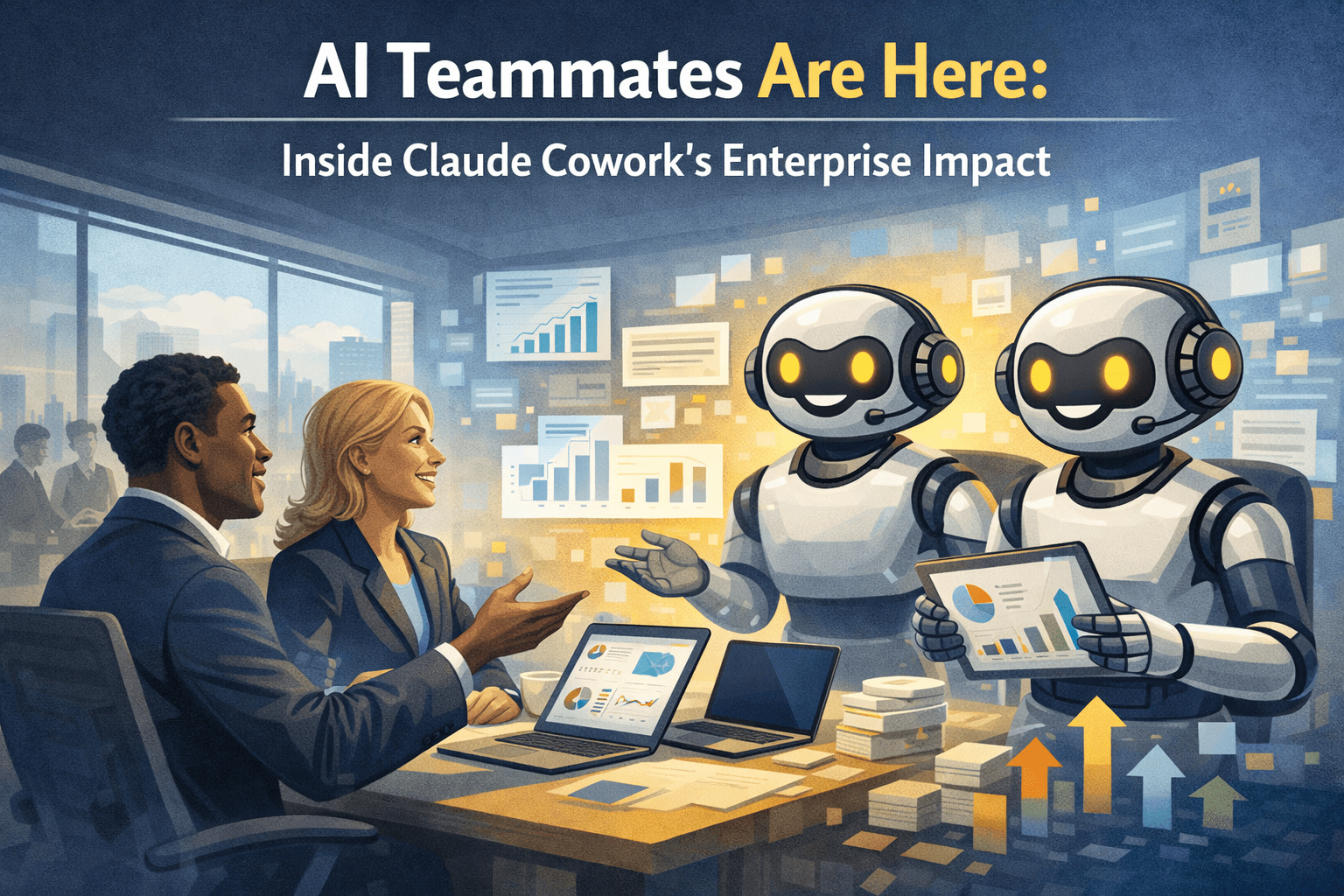
The AI teammate was supposed to be a future-state concept. A hypothetical — something to plan toward, not deploy today.
Claude Cowork makes it current. Not in a theoretical sense. In the sense that there is a desktop agent operating inside enterprise environments right now, automating file management and task workflows for non-technical staff, running persistently, and generating measurable output gains without a developer involved in the process.
The AI teammate has arrived. The question is whether your organization is using one.
Overview
The concept of an AI teammate differs from an AI tool in one critical way: a teammate operates with shared context, persistent awareness, and proactive execution. It does not wait for a prompt. It does not reset between sessions. It functions as a working member of the team — handling the operational work that has always been manual not because it required human judgment, but because no accessible automation tool existed at the desktop level to handle it.
- An AI teammate executes — it does not just respond
- Claude Cowork operates persistently at the desktop level, not session-by-session in a browser tab
- Enterprise impact is measurable at the operational layer: file handling, task coordination, execution consistency
- Non-technical staff access AI teammate capability without developer or IT dependency
- The shift from AI tool to AI teammate is already happening in enterprises that have deployed Cowork
The 5 Why’s
- Why has the “AI teammate” concept taken this long to materialize in enterprise environments? Most AI products were built as generation tools — they produce outputs when asked. A teammate requires execution capability, persistent context, and system-level access. Those capabilities require a desktop agent architecture, not a chat interface.
- Why does persistent context matter for enterprise teammate functionality? A tool that resets every session has no awareness of what happened yesterday, what files exist on the desktop, or what tasks are in progress. A teammate that maintains context across sessions operates with the same awareness a human colleague would — and executes accordingly.
- Why is enterprise impact concentrated at the operational layer? Knowledge workers have had AI assistance for generation and research tasks for years. The operational layer — file management, task coordination, repetitive execution — has remained manual. That is where the largest unaddressed volume of automatable work sits.
- Why can’t browser-based AI tools deliver AI teammate functionality? They operate in a sandboxed tab, separate from the local environment where operational work actually happens. File systems, task structures, and desktop workflows are unreachable from a browser-based interface. Teammate functionality requires system-level access.
- Why does non-technical accessibility determine whether AI teammate impact scales across an enterprise? A teammate that only technical staff can configure is not an enterprise teammate. It is a developer tool. For AI teammate capability to reach every operational employee — regardless of technical background — the setup must be accessible without code, scripts, or IT involvement.
What an AI Teammate Actually Does Inside an Enterprise
The AI teammate is not a metaphor for a helpful chatbot. It is a specific operational role: an agent that handles the work that does not require human judgment, runs persistently, and operates with awareness of the environment it is part of.
Inside an enterprise running Claude Cowork, that looks like this:
- Files are organized, named, and routed before the employee opens their desktop
- Tasks are created, updated, and closed based on workflow triggers — not manual entry
- Coordination handoffs execute automatically when defined conditions are met
- Recurring multi-step workflows run end-to-end without re-triggering at each stage
- Every action is logged, attributable, and reviewable without additional setup
The employee’s role does not disappear. It shifts. The work that required their attention for execution no longer does. Their attention is available for the work that actually requires a person.
What Makes Cowork a Teammate Rather Than a Tool
The distinction between a tool and a teammate is not about capability level. It is about operational relationship. A tool is accessed. A teammate operates alongside you.
Cowork meets the teammate standard in three specific ways. First, it operates persistently — workflows run based on conditions, not on prompts, which means the agent is always working, not just when asked. Second, it maintains context — file structures, task states, and workflow conditions are understood across sessions, not rebuilt each time. Third, it executes — it does not produce outputs for a human to act on; it takes the actions itself, at the system level, inside the actual work environment.
Those three conditions — persistence, context, execution — define what separates an AI teammate from an AI assistant. Cowork meets all three.
Why Enterprise Impact Requires Reaching Non-Technical Staff
Enterprise AI impact has been concentrated in the wrong population. Developers, analysts, and knowledge workers have seen significant productivity gains from AI generation tools. Operations managers, project coordinators, administrative staff, and team leads — the employees managing the highest volume of repetitive work — have been largely excluded from those gains because the tools available to them either require technical configuration or do not reach the operational layer where their work happens.
Cowork changes the target population. Plain-language workflow configuration means every operational employee can set up and run automation independently. The AI teammate capability that has been available to technical staff is now available to the employees who have the most to gain from it.
Why the Teammate Model Produces Compounding Returns
A tool delivers a return each time it is used. A teammate delivers a return continuously — because it is always operating, not waiting to be invoked.
The compounding effect of the AI teammate model shows up in three ways over time.Execution consistency improves as more workflows move from manual to automated — reducing the variation that generates rework and audit gaps. Employee attention compounds toward higher-value work as the volume of manual operational tasks decreases. And organizational output capacity grows without a corresponding growth in headcount, because the automation layer absorbs volume that would otherwise require additional people to manage.
Claude Cowork’s Enterprise Impact at a Glance
- Operational volume handled without headcount growth — existing teams manage more as automation absorbs repetitive execution tasks
- Daily time recovered across operational roles — file management, task logging, and coordination follow-up no longer consume employee attention
- Execution consistency at scale — automated workflows produce identical, auditable outputs regardless of team size or individual habits
- Faster operational onboarding — new team members reach full output sooner when repetitive task execution is handled by the agent
- Audit-ready operations by default — every automated action is timestamped, attributable, and logged without manual record-keeping
Where Cowork Fits the Enterprise AI Picture
- The operational execution layer — Cowork handles the desktop and file automation layer that browser-based tools and content-specific Claude products do not reach
- Not a chat product — Cowork does not require prompts for routine operations; it runs on defined conditions and persistent workflow logic
- Not a developer tool — Claude Code serves engineering teams; Cowork serves the operational employees managing file and task volume
- Integrates with existing systems — no platform migration required; Cowork operates on top of the file structures and task tools already in use
A Simple AI Teammate Readiness Check
Your enterprise does not yet have an AI teammate if:
- AI is accessed through a chat interface and requires a prompt for every output
- File management and task coordination are still handled manually by operational staff
- Automation workflows require IT or engineering resources to configure
- AI assistance resets between sessions with no persistent context of ongoing work
- Operational staff benefit from AI for generation tasks but not for execution tasks
These are teammate gaps. The assistant model will not close them.
Final Takeaway
The AI teammate is not a product roadmap item. It is a deployed capability — available today, producing measurable enterprise impact in organizations that have moved past the chatbot and assistant models into genuine operational automation.
Claude Cowork delivers that capability at the desktop level, for non-technical operational staff, without engineering dependencies, and with persistent execution that does not require an employee prompt to run. The AI teammate era has started. The organizations experiencing its impact are the ones that stopped waiting for it to arrive and deployed it.
The rest are still running the same manual operational workflows they were running before AI was supposed to change everything.
Deploy Your AI Teammate With Mindcore Technologies
Mindcore Technologies helps enterprises move from AI tool access to AI teammate deployment — identifying where Claude Cowork produces the most immediate operational impact, configuring automations for non-technical teams, and ensuring the AI teammate model delivers measurable returns from day one.
Talk to Mindcore Technologies About Deploying Claude Cowork →
Contact our team to find out where your current operations are still waiting for an AI teammate — and how quickly that changes once Cowork is in place.

