

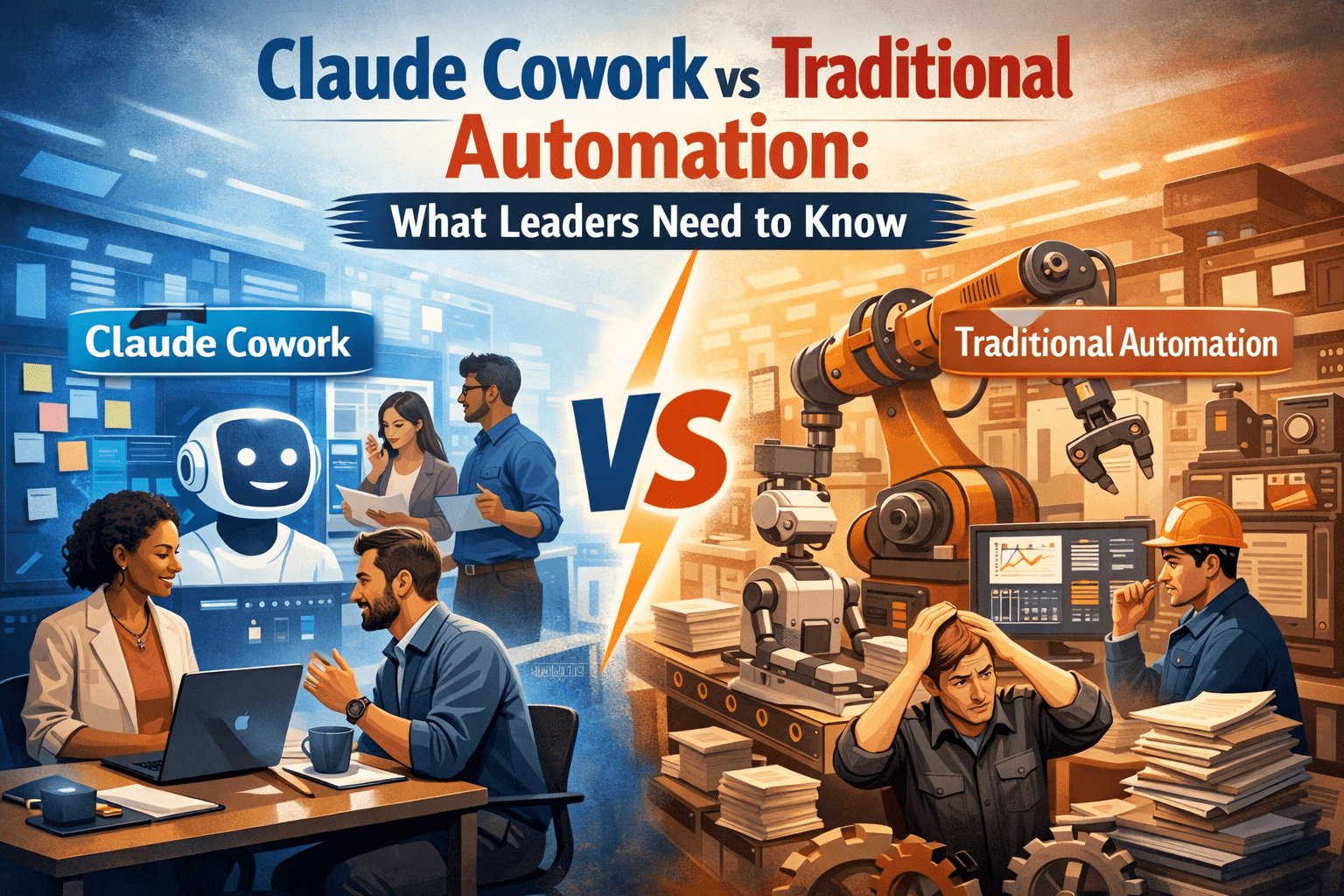
Traditional automation was built for technical teams. Claude Cowork was built for everyone else.
That single distinction explains most of what separates them — and why organizations that have invested heavily in traditional automation platforms still have large populations of operational staff running manual workflows every day. The tools exist. They are just not accessible to the people who need them most.
This is not a feature comparison. It is a deployment model comparison. And for enterprise leaders evaluating where AI-driven automation produces real operational return, the deployment model is the decision.
Overview
Traditional automation platforms — RPA tools, workflow builders, integration platforms — deliver genuine value in the right hands. Those hands have historically belonged to developers, IT administrators, and technical operations staff. The operational employees who manage the highest volume of repetitive work have been excluded from automation access by a configuration barrier that those platforms were never designed to remove. Claude Cowork removes it.
- Traditional automation requires technical configuration; Cowork uses plain-language setup accessible to non-technical staff
- RPA tools automate at the UI layer; Cowork operates as a desktop agent with direct system-level access
- Traditional platforms scale through IT and engineering resources; Cowork scales through individual employee adoption
- Maintenance overhead in traditional automation compounds with complexity; Cowork workflows are modified without developer involvement
- The ROI comparison shifts when total cost of deployment — including IT dependency — is included
The 5 Why’s
- Why have traditional automation platforms not reached most operational employees? Configuration requires technical skill. Non-technical staff cannot build, modify, or maintain workflows without IT or engineering support — creating a permanent bottleneck between the people who need automation and the tools that provide it.
- Why does that bottleneck matter at the leadership level? It means automation investment reaches a fraction of the workforce. The operational staff managing the highest manual workload — the population where automation ROI is highest — remain unserved by the tools the organization has already paid for.
- Why is plain-language configuration a structural advantage, not just a usability feature? It removes the dependency. Every operational employee can deploy, run, and modify automation independently. The IT team is not in the critical path for every workflow change. Adoption scales without a corresponding increase in technical workload.
- Why does desktop-level access matter compared to UI-layer automation? RPA tools interact with application interfaces — they simulate clicks and keystrokes on top of existing software. Cowork operates at the system level, interacting directly with file structures and task workflows. That distinction determines reliability, speed, and resistance to interface changes that break RPA scripts.
- Why is the total cost of automation the right leadership metric, not the license cost? Traditional automation platforms carry significant hidden costs: developer time to build and maintain workflows, IT resources to manage integrations, and the ongoing cost of broken automations when underlying interfaces change. Cowork’s non-technical model eliminates most of those costs from the calculation.
Where Traditional Automation Falls Short for Most Enterprises
Traditional automation platforms made a reasonable set of design decisions for the problem they were solving in 2010. Structured IT environments, stable application interfaces, technical staff to configure and maintain workflows. That problem has evolved significantly. The workforce that needs automation today is broader, less technical, and operating across more distributed and variable work environments than traditional platforms were designed to serve.
The gaps show up in three consistent places:
- Accessibility — configuration requires skills that most operational employees do not have and should not need to acquire
- Maintenance — RPA scripts break when application interfaces change; fixing them requires the same technical resources that built them
- Reach — automation stays with the technical teams that can deploy it, leaving the highest-volume manual work populations unserved
How Cowork Addresses the Accessibility Gap
Cowork’s plain-language configuration is not a simplified version of traditional automation logic. It is a different model entirely. Workflows are defined in terms an operational employee understands — what to do with this type of file, when to update this task, how to route this output. No scripting. No visual flow builder that requires a training certification to use. No IT ticket to get started.
The result is that automation reaches the employees who have always needed it most — and reaches them immediately, not after a months-long implementation project.
How Cowork Addresses the Maintenance Gap
Traditional RPA automation is brittle. Scripts interact with application interfaces at a pixel-and-element level. When those interfaces change — and they do, with every software update — scripts break and require technical resources to repair. For enterprises running dozens or hundreds of automations, that maintenance load is a significant ongoing cost that rarely appears in the initial ROI calculation.
Cowork operates at a higher level of abstraction. Workflow logic is defined in terms of conditions and outcomes, not interface elements. When the underlying environment changes, workflows do not break — they adapt. And when modification is needed, the operational employee who owns the workflow makes the change directly.
How Cowork Addresses the Reach Gap
Traditional automation reaches the technical perimeter of the organization. Cowork reaches the operational one. The difference is the population of employees who can access, deploy, and benefit from automation without external support.
For enterprise leaders, that reach gap represents the largest untapped automation ROI in most organizations. The operational staff managing file and task volume daily — without automation access, without the ability to change that on their own — are the employees where deployment produces the most immediate measurable return.
Side-by-Side: Cowork vs Traditional Automation
- Configuration — Traditional: developer or IT staff required. Cowork: plain-language, accessible to any operational employee
- Deployment time — Traditional: weeks to months per workflow. Cowork: same day, no implementation project
- Maintenance — Traditional: technical resources required when interfaces change. Cowork: modified directly by the workflow owner
- Target user — Traditional: technical staff. Cowork: non-technical operational employees
- System access — Traditional: UI-layer simulation. Cowork: desktop-level direct system interaction
- Scalability — Traditional: scales with IT and engineering capacity. Cowork: scales with employee adoption
A Simple Automation Gap Check for Leaders
Your automation investment is not reaching its full potential if:
- Operational staff manage file and task workflows manually despite having automation tools available
- Workflow changes require IT or developer involvement to implement
- RPA scripts have broken after software updates and remained broken pending repair
- Automation adoption is concentrated in technical teams, not across operational departments
- Total cost of automation ownership includes significant developer and maintenance time not reflected in license cost
These are deployment model gaps. New tool licenses will not close them.
Final Takeaway
Traditional automation is not the wrong tool. It is the wrong tool for most of the workforce. It was built for technical staff in structured IT environments, and it delivers value in those conditions. The operational employees managing the highest volume of repetitive daily work exist outside those conditions — and they have been waiting for an automation model that accounts for that reality.
Claude Cowork is that model. Desktop-level access, plain-language configuration, no IT dependency, persistent execution across the full operational workforce. The comparison with traditional automation is not about which platform has more features. It is about which one actually reaches the employees who need it — and produces returns across the full organization, not just the technical perimeter of it.
Close the Automation Gap With Mindcore Technologies
Mindcore Technologies helps enterprise leaders assess where traditional automation has fallen short — and where Claude Cowork fills the gap. From operational workflow mapping to non-technical deployment, we build the automation coverage your existing platforms never reached.
Talk to Mindcore Technologies About Closing Your Automation Gap →
Contact our team for an automation coverage assessment. We will show you exactly where manual work is still running — and what it takes to change that.

