

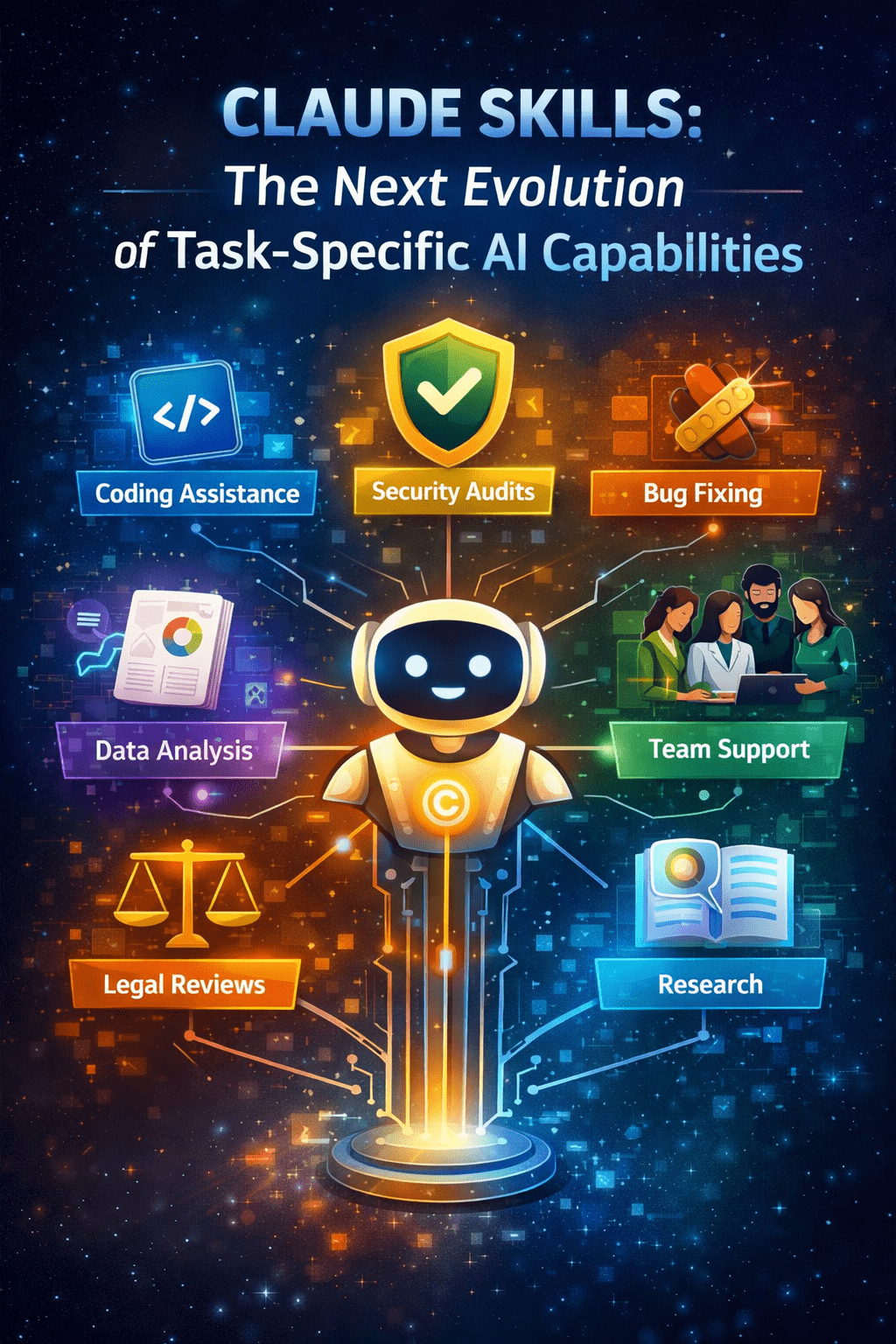
General-purpose AI is useful. Task-specific AI is operational.
The difference matters at the enterprise level. A general-purpose AI can answer questions, draft content, and assist with a wide range of tasks when prompted correctly. A task-specific AI capability executes a defined workflow reliably, every time, without requiring a carefully constructed prompt from the person invoking it. One is a tool. The other is infrastructure.
Claude Skills represent that evolution — from general AI capability to structured, repeatable, task-specific execution that enterprise operations can be built around.
Overview
Claude Skills are purpose-built AI capabilities designed to handle specific business tasks consistently and reliably across the organization. They move AI from the prompt layer — where output quality depends on how well an individual constructs their request — to the execution layer, where defined workflows run predictably regardless of who initiates them.
- Claude Skills are structured AI capabilities optimized for specific, repeatable business tasks
- They remove the prompt quality variable from AI-driven workflow execution
- Task-specific design produces more consistent, more accurate outputs than general-purpose prompting
- Skills are deployable across departments without requiring each user to develop AI prompting expertise
- The evolution from general AI to task-specific Skills is the transition from AI experimentation to AI operations
The 5 Why’s
- Why does general-purpose AI have a ceiling for enterprise operations? Output quality from a general-purpose AI depends on prompt quality. In enterprise operations, that means output consistency depends on individual employee AI proficiency — which varies widely and cannot be standardized without significant training investment.
- Why do task-specific AI capabilities produce better enterprise outcomes? When the task is defined, the workflow is structured, and the execution parameters are set at the capability level rather than the prompt level, every invocation of that capability produces outputs within a consistent quality range. The variability that comes from general prompting is removed.
- Why is repeatability the defining requirement for enterprise AI operations? Enterprise operations run on repeatable processes — workflows that execute consistently, produce predictable outputs, and can be audited, optimized, and scaled. AI capabilities that cannot meet that repeatability standard cannot be operationalized in the same way. Claude Skills are designed to meet it.
- Why does removing the prompt quality variable matter at the organizational scale? In an organization of hundreds or thousands of employees, the difference between a well-constructed and a poorly-constructed AI prompt produces enormous variation in output quality at aggregate. Skills standardize that quality floor across every employee who uses them, regardless of individual AI proficiency.
- Why does the evolution from general AI to Skills represent a maturation of enterprise AI adoption? Early enterprise AI adoption was characterized by access — giving employees access to AI tools and letting usage develop organically. Mature enterprise AI adoption is characterized by structure — defining the tasks AI should handle, building the capabilities that handle them reliably, and deploying those capabilities as operational infrastructure.
What Claude Skills Actually Are
Claude Skills are not prompts saved for reuse. They are structured AI capabilities designed from the ground up for a specific task — with the workflow, the inputs, the outputs, and the quality parameters defined at the capability level rather than the invocation level.
A Skill for contract review does not ask the user to describe what contract review involves. It knows what contract review involves, what it should check for, what format the output should take, and what constitutes a complete result. The user provides the contract. The Skill handles the rest.
That structural difference — between a saved prompt and a purpose-built capability — is what makes Skills operational rather than merely helpful.
Why Task-Specific Design Outperforms General Prompting
General prompting asks an AI to apply broad capability to a specific task based on instructions provided at invocation time. The AI is capable. The output quality depends on how well those instructions capture what the task actually requires.
Task-specific design builds the task requirements into the capability itself. The Skill knows what good output looks like for that specific task, what inputs it needs, what edge cases to handle, and how to format results for the people using them. The quality parameters are set once, at the design level, and apply consistently to every execution.
For any task the organization runs repeatedly — document review, report generation, data extraction, workflow classification — the task-specific approach produces better and more consistent results than general prompting at scale.
Why Skills Are the Bridge Between AI Experimentation and AI Operations
Most enterprise AI programs follow a recognizable pattern: initial excitement, broad access deployment, inconsistent adoption, and a plateau where AI is used by some employees for some tasks with results that are useful but not transformative.
The plateau exists because general AI access does not translate automatically into operational change. Skills are the bridge. They take the tasks where AI has proven useful, build them into structured capabilities, and deploy those capabilities as standard operational infrastructure — removing the dependency on individual AI proficiency and making consistent AI-driven execution available to every employee who needs it.
Why the Shift to Skills Is an Organizational Capability Decision
Deploying Claude Skills is not a technology decision in isolation. It is an organizational capability decision: identifying which tasks in the operation are high-frequency, rule-consistent, and well-defined enough to be built into a Skill; designing those Skills to meet the quality and workflow requirements of the people using them; and deploying them as operational infrastructure rather than optional tools.
That decision requires clarity about which tasks to prioritize, what good output looks like for each one, and how Skills integrate with the workflows and systems they are part of. Organizations that make that decision deliberately build AI operational capability that compounds over time. Those that stay at the general-access layer continue to produce inconsistent results that never quite justify the investment.
What Claude Skills Enable at the Organizational Level
- Consistent output quality — task-specific design produces predictable results regardless of individual user AI proficiency
- Scalable AI-driven workflows — Skills deployable across departments without requiring each team to develop independent AI usage practices
- Reduced training dependency — employees invoke Skills without needing to construct effective prompts; the expertise is built into the capability
- Auditable AI execution — structured Skills produce outputs that conform to defined parameters, making AI-driven work reviewable and improvable
- Operational AI infrastructure — Skills move AI from the tool layer to the infrastructure layer, where it runs reliably as part of standard business operations
A Simple Skills Readiness Assessment
Your organization is ready to move from general AI access to Claude Skills if:
- AI output quality varies significantly across employees using the same tools for the same tasks
- Specific high-frequency tasks have been identified where AI assistance would produce the most consistent value
- Employees are spending time constructing prompts for tasks that run repeatedly and could be standardized
- AI adoption has plateaued because general-access deployment did not translate into consistent operational change
- Leadership is ready to define AI capability at the organizational level rather than leaving it to individual employee initiative
These are the conditions where Skills produce the most immediate return.
Final Takeaway
General-purpose AI access was the right first step for enterprise AI adoption. It is not the right final state. Organizations that remain at the general-access layer indefinitely produce variable outputs, inconsistent adoption, and an AI investment that never quite delivers on its operational potential.
Claude Skills represent the next layer — purpose-built, task-specific AI capabilities that execute reliably, scale across departments without training dependencies, and turn AI from a useful tool into operational infrastructure. The evolution from general AI to task-specific Skills is not incremental. It is the transition that separates AI experimentation from AI operations.
Build Task-Specific AI Capabilities With Mindcore Technologies
Mindcore Technologies works with enterprise teams to design and deploy Claude Skills — identifying the highest-value tasks for Skill development, building capabilities that meet operational quality requirements, and integrating them into existing workflows as standard business infrastructure.
Talk to Mindcore Technologies About Claude Skills for Your Organization →
Contact our team to map which tasks in your operation are ready for Skill-level AI capability — and what it takes to get there.

