

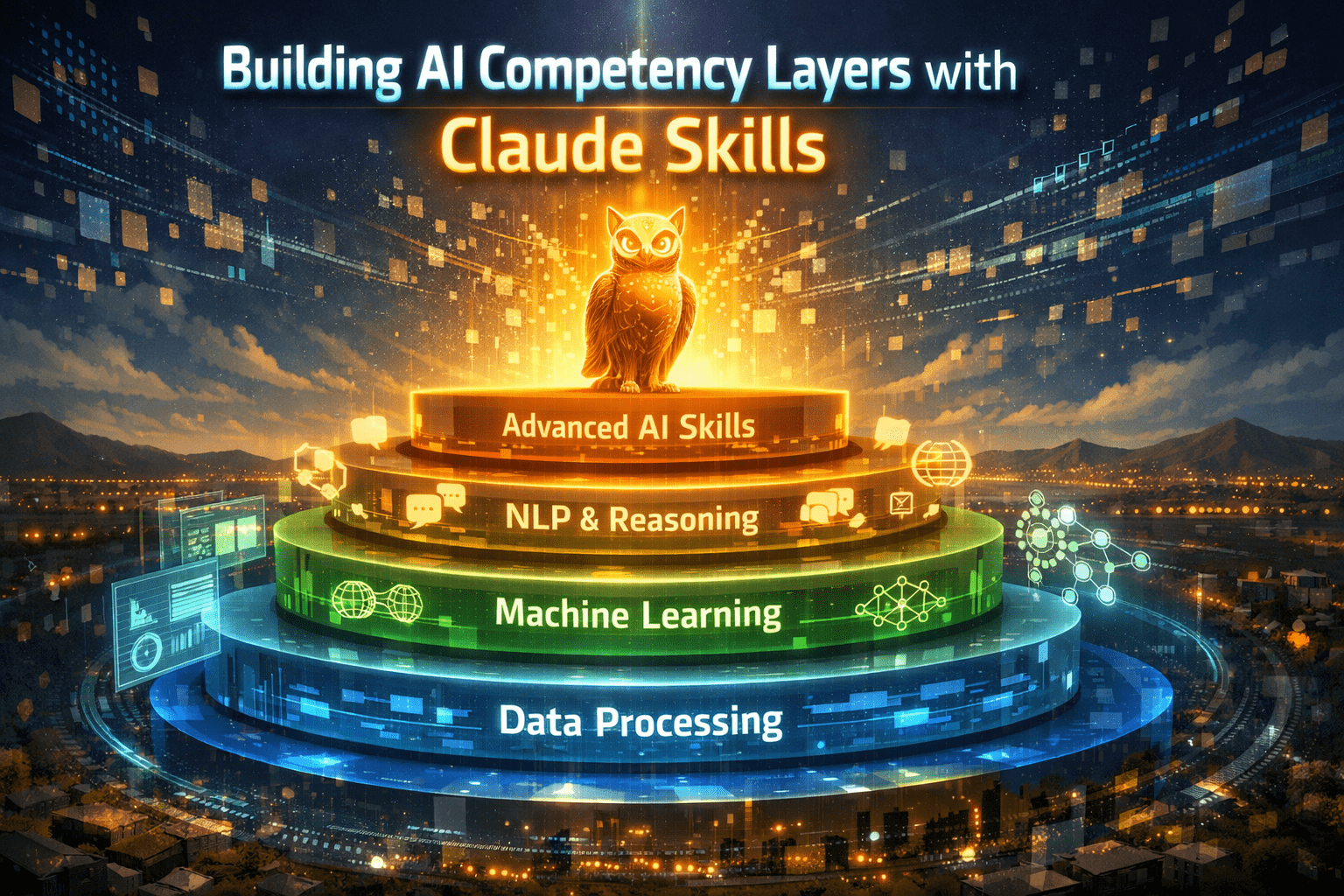
AI competency in an enterprise is not a single capability. It is a stack.
The organizations that build durable AI operational advantage do not do it by deploying one high-impact AI capability and stopping. They build in layers — foundational task automation at the base, increasingly sophisticated workflow intelligence above it, and strategic AI capability at the top. Each layer depends on the one beneath it. Each one extends the organization’s AI operational reach into more complex, higher-value work.
Claude Skills are the building blocks of that stack. Understanding how to design and sequence them — which capabilities to build first, how they connect, and how they enable the next layer — is what separates organizations building compounding AI competency from those accumulating disconnected AI tools.
Overview
Building AI competency layers means designing Skills not just for immediate value but for the foundation they create for subsequent capability development. A Skill that automates document classification is valuable on its own. It is more valuable as the foundation for a Skill that routes classified documents into downstream workflows, which in turn enables a Skill that synthesizes workflow outputs into management reporting. Each layer extends the organization’s AI operational capacity in ways the layer below made possible.
- AI competency layers build on each other — foundational Skills enable more sophisticated ones
- Skill sequencing matters: designing for the layer above is as important as designing for immediate value
- Competency layers create compounding AI operational advantage that is difficult for competitors to replicate quickly
- The layered model requires deliberate architecture, not just opportunistic Skill deployment
- Organizations that build competency layers move from AI cost reduction to AI-driven capability expansion
The 5 Why’s
- Why does layered competency produce more durable AI advantage than individual Skill deployment? Individual Skills produce point-in-time value. Competency layers produce compounding value — each layer extends the organization’s AI operational reach, the combined stack is more valuable than the sum of its parts, and the institutional knowledge embedded in the architecture is difficult for competitors starting later to replicate.
- Why does Skill sequencing determine the quality of the competency stack? Skills that are designed without considering what they enable above them are harder to connect into higher-order capabilities. A classification Skill that produces unstructured outputs cannot easily feed a synthesis Skill that requires structured inputs. Sequencing at the design stage prevents integration friction at the deployment stage.
- Why do foundational Skills need to be built before advanced ones? Higher-order AI capabilities depend on reliable structured inputs. If the foundational layer produces inconsistent or unstructured outputs, the layers above it inherit that inconsistency and compound it. Foundational Skill quality is the prerequisite for the capabilities that build on it.
- Why is deliberate architecture different from opportunistic Skill deployment? Opportunistic deployment produces Skills that solve immediate problems but do not connect into a coherent capability stack. Deliberate architecture designs the full competency model first, then builds Skills in the sequence that creates the most coherent and extensible foundation. The difference shows up in whether Skills compound in value over time or accumulate as isolated tools.
- Why does the layered model eventually enable strategic AI capability, not just operational efficiency? Operational efficiency is the return from the foundational layers — time saved, consistency improved, volume handled. Strategic capability is the return from the higher layers — intelligence generated from aggregated outputs, insights that inform decisions, AI-driven competitive advantage that goes beyond cost reduction.
The Competency Layer Model
Layer 1: Foundational Task Automation
The first competency layer automates the high-frequency, well-defined tasks that consume the most operational time and produce the clearest ROI. These are the Skills that handle document classification, data extraction, form processing, and routing decisions — tasks with structured inputs, defined outputs, and high execution volume.
Design priorities for this layer:
- Structured, consistent output formats that downstream Skills can consume reliably
- Comprehensive edge case handling that prevents workflow breakage when inputs vary
- Audit trail generation built in from the start, not added later
- Quality parameter definition that is explicit enough to measure and improve
The foundational layer does not need to be comprehensive before the second layer begins. It needs to be reliable. A small number of well-designed foundational Skills is better than a large number of inconsistent ones.
Layer 2: Workflow Intelligence
The second competency layer builds on foundational outputs to handle multi-step workflows that require contextual understanding, conditional logic, and synthesis across multiple inputs. These are Skills that take the structured outputs from Layer 1 and apply more sophisticated processing — identifying patterns across classified documents, synthesizing extracted data into analytical outputs, applying policy logic to routed items.
Design priorities for this layer:
- Integration with foundational layer outputs as structured inputs
- Multi-step context maintenance across workflow stages
- Conditional logic that applies different processing paths based on input characteristics
- Output formats designed for both downstream automation and human review
Layer 3: Strategic AI Capability
The third layer builds on accumulated workflow outputs to generate the intelligence and insights that inform strategic decisions. Aggregated workflow data becomes the input for Skills that identify trends, surface anomalies, produce management reporting, and generate the kind of synthesized analysis that previously required significant analyst time to produce.
Design priorities for this layer:
- Access to aggregated outputs from the layers below
- Analytical frameworks built into the capability, not applied ad hoc
- Output formats appropriate for executive and strategic audiences
- Clear attribution of the underlying data and logic that produced each insight
How to Sequence Competency Layer Development
- Map the full value chain first — before building any Skills, identify the complete sequence from foundational automation through strategic capability so each Skill is designed for the layer it sits in and the one above it
- Build the foundation before advancing — higher-order Skills built on an unreliable foundation inherit its inconsistencies; foundational layer quality is the prerequisite for everything above it
- Design outputs for downstream consumption — every Skill’s output format should be designed for the next Skill in the sequence, not just for human readability
- Expand within layers before moving up — comprehensive foundational layer coverage produces more stable second-layer capabilities than premature advancement to higher-order Skills built on partial foundations
- Measure at each layer before building the next — demonstrate that each layer produces reliable, measurable value before investing in the layer above it
What the Competency Stack Enables Over Time
- Year 1: Operational efficiency — foundational Skills reduce per-task handling time and standardize output quality across high-frequency workflows
- Year 2: Workflow intelligence — second-layer Skills apply sophisticated logic to workflow complexity, reducing handling time for multi-step processes and improving quality at the workflow level
- Year 3+: Strategic capability — third-layer Skills generate insights from accumulated operational data, producing AI-driven intelligence that informs decisions and creates competitive advantage
The organizations that start building now are three years ahead of those that wait.
A Simple Competency Layer Development Assessment
Your organization is ready to build AI competency layers if:
- High-frequency foundational tasks have been identified and are ready for Skill development
- Workflow architecture has been mapped well enough to design foundational Skills with downstream consumption in mind
- Governance frameworks exist for managing Skills as an organizational capability portfolio rather than isolated tools
- Leadership is committed to a multi-layer development roadmap, not just immediate ROI from individual Skills
- The organization is willing to invest in foundational layer quality before advancing to higher-order capabilities
Final Takeaway
AI competency is built in layers, not deployed all at once. The organizations that understand this build foundational Skills with the next layer in mind, sequence their Skill development for maximum architectural coherence, and advance through the layers systematically as each one proves reliable.
The result is not just operational efficiency — it is a compounding AI capability stack that extends the organization’s AI operational reach over time, generates strategic intelligence from accumulated operational outputs, and creates an advantage that is difficult for later-adopting competitors to replicate quickly.
Claude Skills are the building blocks. The architecture determines how much they compound.
Build Your AI Competency Stack With Mindcore Technologies
Mindcore Technologies works with enterprise teams to design AI competency layer strategies — mapping the full development sequence from foundational automation through strategic capability, building Skills that are designed for their layer and the one above it, and deploying them in the sequence that creates the most coherent and extensible organizational AI infrastructure.
Talk to Mindcore Technologies About Building AI Competency Layers With Claude Skills →
Contact our team to design your AI competency stack — starting with the foundational Skills that make everything above them possible.

