

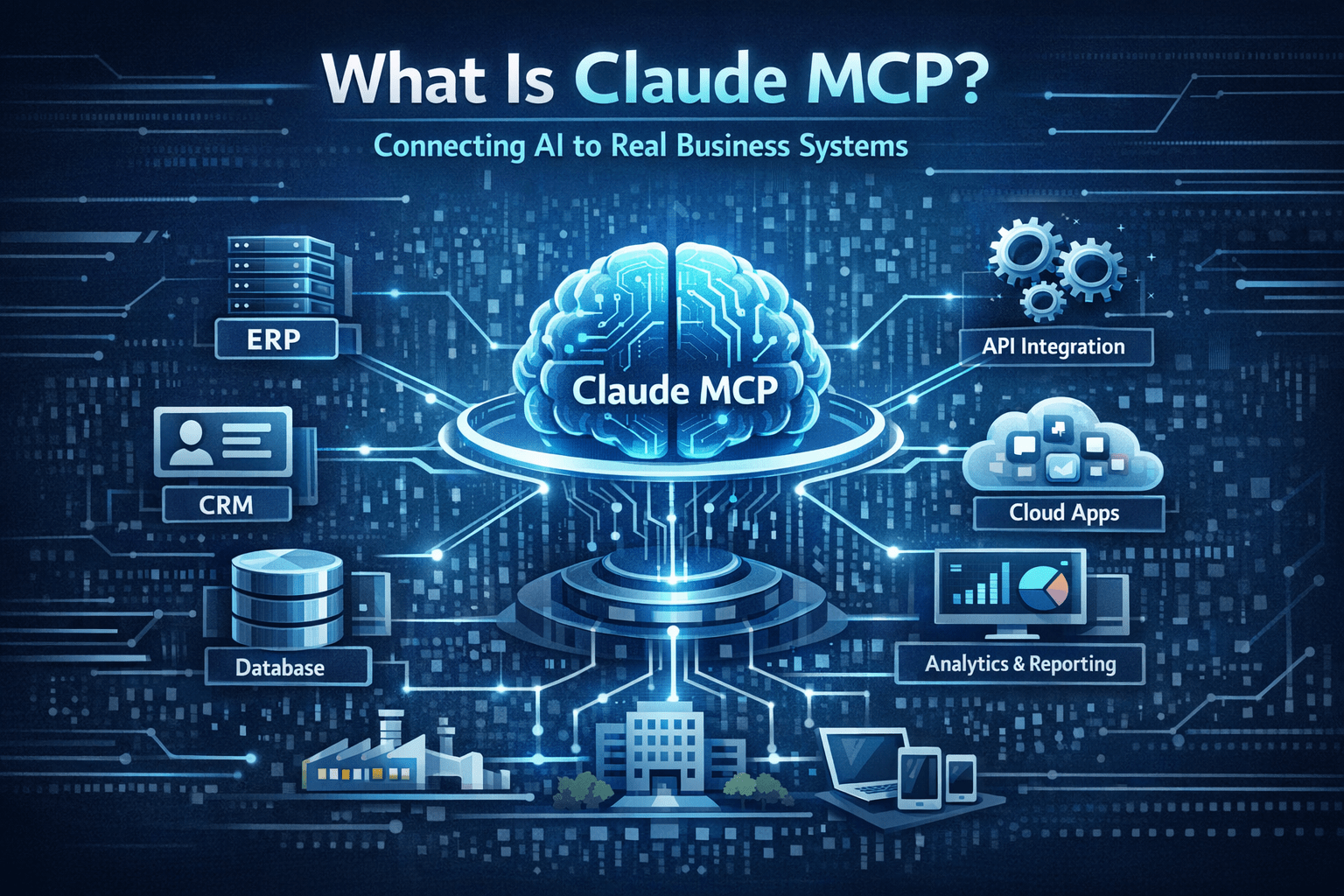
AI that cannot reach your business data is not fully useful. It is helpful within the boundaries of what you can manually provide it — which means every AI interaction involves an employee retrieving data from the systems that hold it, formatting it for the AI, and then manually executing whatever the AI recommends in those same systems. The AI assists. The employee still does the work of connecting the AI to the business.
Claude MCP — the Model Context Protocol — removes that dependency. It is the protocol that connects Claude directly to real business systems, enabling live data access, real-time context, and direct action execution across enterprise infrastructure. This is what AI-to-system integration looks like when it is designed to scale.
Overview
Claude MCP is a standardized communication protocol that defines how Claude connects to external business systems, retrieves live data from them, and takes actions within them. Rather than requiring custom API development for every system connection, MCP provides a common interface — any system that implements MCP becomes directly accessible to Claude through the same protocol. The result is AI that operates with live business context and can act in the systems where work actually happens.
- MCP is a protocol — a standardized interface that any business system can implement to become accessible to Claude
- It enables live data access, not static data import — Claude retrieves current information at the time it is needed
- Action execution through MCP means Claude can update records, create tasks, and trigger workflows directly in connected systems
- The protocol design scales — adding new system connections does not require building new custom integrations each time
- MCP is the layer that connects AI reasoning capability to real business system operations
The 5 Why’s
- Why do most enterprise AI deployments work with static data rather than live system data? Getting AI to access live system data has required custom API development for every connection — expensive, time-consuming, and requiring ongoing maintenance. Most organizations do not have the development resources to build and maintain those connections at scale, so AI ends up working with whatever data employees can manually provide.
- Why does static data limit what AI can do for business operations? Static data reflects the state of the business when it was exported. Business operations are continuous. AI working with data from yesterday’s export cannot answer questions about today’s orders, current project status, or live inventory levels. For operations that require current information, static data produces answers that require manual verification before they can be trusted.
- Why is MCP a protocol rather than an integration tool? A protocol defines how systems communicate — the rules of the conversation. Any system that follows those rules can participate. An integration tool connects specific systems to specific other systems, one at a time. The protocol approach scales indefinitely. The integration tool approach scales linearly with the number of connections required.
- Why does action execution matter as much as data access? Data access allows Claude to inform. Action execution allows Claude to act. An AI that can read your CRM can tell you what it contains. An AI that can act in your CRM can update records, create tasks, and close cases directly — without the employee manually executing each step after receiving Claude’s recommendation.
- Why is MCP the right foundation for enterprise AI integration architecture? Enterprise AI integration needs to scale across the full system landscape — dozens or hundreds of business systems — without proportional increases in custom development cost. MCP’s protocol approach provides that scaling model. It is the architectural foundation that makes enterprise-wide AI integration economically feasible.
What Claude MCP Connects To
MCP is a protocol — which means it connects to any system that implements it. The growing ecosystem of MCP-enabled systems includes:
Productivity and collaboration tools — calendars, email, document management, and project management systems. Claude connected to these systems can read current schedules, draft and send communications, retrieve documents, and update project records directly.
CRM and customer data platforms — Claude connected to CRM systems accesses live customer records, interaction histories, and account data at the time of the query — not from a static export that may be days or weeks old.
Enterprise resource planning systems — inventory, procurement, financial records, and operational data that Claude can retrieve and act on directly, without requiring manual data extraction before each interaction.
Development and IT operations platforms — code repositories, ticketing systems, deployment pipelines, and infrastructure management tools. Claude connected to these systems can retrieve current system status, create and update tickets, and take actions in development workflows directly.
Custom business systems — any internally developed or specialty business system that implements the MCP protocol becomes accessible to Claude through the same interface as any other MCP-enabled system.
How MCP Works in an Enterprise Interaction
The operational experience of MCP in an enterprise context is straightforward. An employee asks Claude a question that requires current system data. Claude connects to the relevant MCP-enabled system, retrieves the current data, incorporates it into its response, and — if the interaction calls for it — takes the requested action in that system directly.
The employee does not extract data from the system before the interaction. They do not manually execute actions in the system after it. The interaction is with Claude. Claude handles the connection to the system, the data retrieval, and the action execution through the MCP protocol.
Why MCP Produces a Different Class of AI Interaction
The difference between an MCP-connected AI interaction and a conventional AI interaction is the difference between asking a knowledgeable colleague who has access to all your business systems and asking a knowledgeable consultant who is working from whatever documents you emailed them before the meeting.
Both are useful. Only one is grounded in the current state of the business and capable of acting within it. MCP is the capability that makes the first kind of AI interaction possible at enterprise scale.
What MCP Enables for Business Users
- Real-time answers — questions answered with live system data, not static exports that may not reflect current operational reality
- Direct system actions — records created, updated, and closed in connected systems without manual execution after each AI interaction
- Multi-system workflows — processes that span multiple connected systems handled in a single interaction, without manual handoffs between each step
- Accurate operational context — AI assistance grounded in what is actually happening in the business today, not what was happening when the last data export was run
- Reduced manual coordination — the work of moving data between AI and systems, and of executing AI recommendations in systems, handled through the protocol rather than by employees
A Simple MCP Value Assessment
MCP produces the most immediate value in your organization if:
- Employees regularly extract data from business systems before AI interactions and manually execute AI recommendations in those systems afterward
- AI outputs require manual verification against live system data before they can be acted on
- Custom API development has prevented AI integration with business systems that would significantly improve AI usefulness
- Multi-system workflows currently require employees to coordinate data and actions across systems manually
- AI deployment has been limited to tasks where static context is sufficient, leaving higher-value live-data use cases unaddressed
Final Takeaway
The missing layer in most enterprise AI deployments is system connectivity. AI reasoning capability without access to live business data and the ability to act in business systems is AI that informs at the margins rather than operates at the center of how work gets done.
Claude MCP provides that connectivity — through a standardized protocol that scales across the full enterprise system landscape without proportional custom development cost. The question is not whether your business systems contain data and workflows that AI could operate with more effectively given live access. They do. The question is whether MCP is in your integration architecture yet.
Connect Claude to Your Business Systems With Mindcore Technologies
Mindcore Technologies works with enterprise teams to design and deploy Claude MCP integrations — connecting Claude to the business systems that hold live operational data, enabling direct action execution, and building the integration architecture that makes AI a connected participant in how your business operates.
Talk to Mindcore Technologies About Connecting Claude to Your Business Systems →
Contact our team to assess which of your business systems are the highest-priority MCP integration targets — and what live data access and action execution would make possible in those workflows.

