

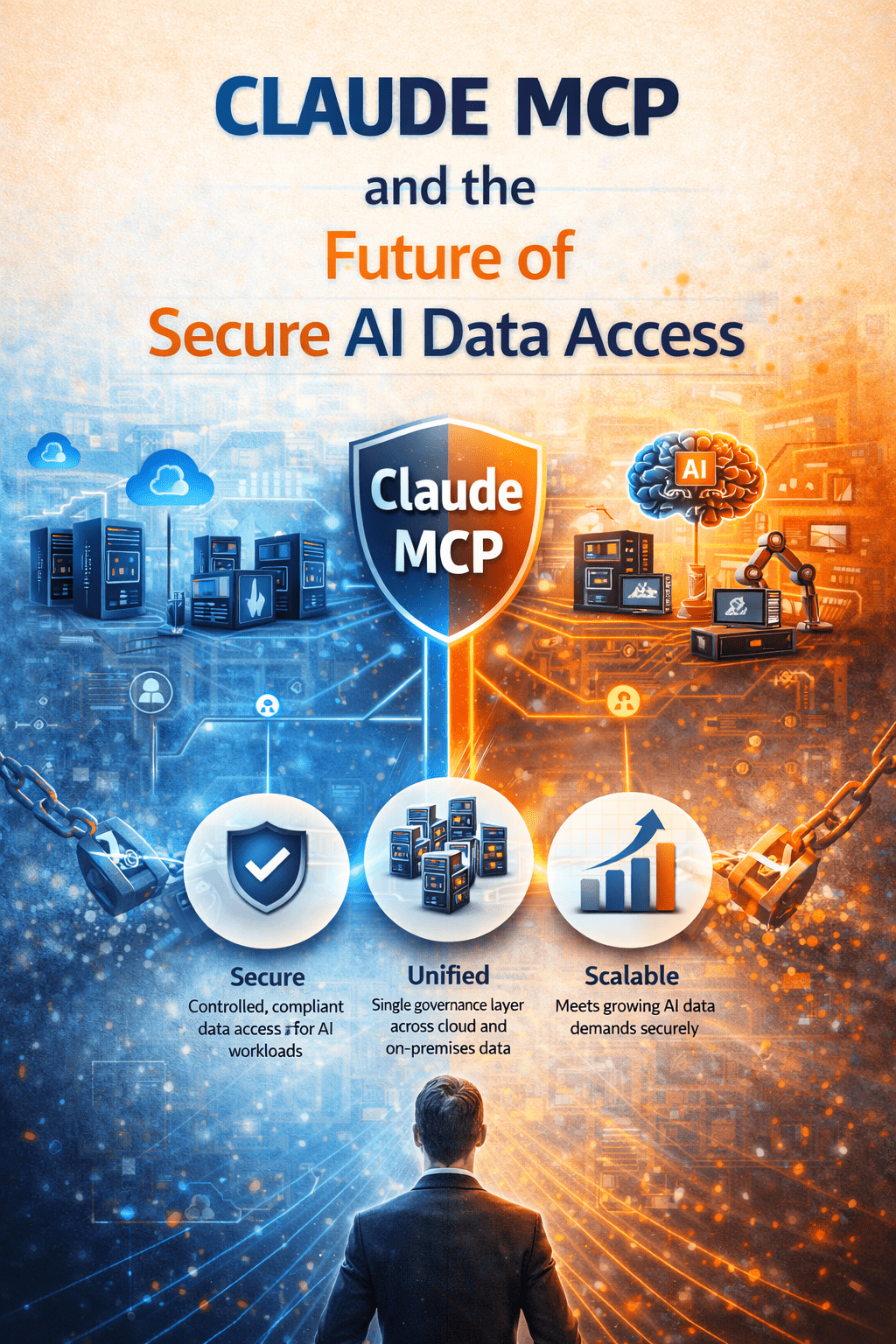
AI that cannot access enterprise data is safe and limited. AI that can access everything is powerful and ungovernable. The future of secure AI data access is neither of those — it is an architecture that provides AI with precisely the access it needs, governed by the controls that already protect that data, and auditable at every point in the interaction.
Claude MCP — the Model Context Protocol — is designed for that architecture. Not as a security product, but as a protocol that builds access governance into the connectivity model from the start. How AI accesses enterprise data through MCP is not a security afterthought. It is a first-order design decision.
Overview
Secure AI data access requires three properties: AI can access the data it needs to be operationally useful, AI cannot access data it is not authorized to access, and every data access by AI is traceable and auditable. Claude MCP provides the protocol layer that makes all three properties achievable simultaneously — through integration with existing authorization infrastructure, bounded access scope, and built-in audit trail generation. The future of secure AI data access is a governed protocol layer, not a choice between security and capability.
- MCP access scope is bounded by existing authorization frameworks — AI accesses what the connecting user is authorized to access
- Every MCP data access and action execution is loggable and attributable
- The protocol model enables consistent access governance across all connected systems
- Secure AI data access does not require choosing between security and operational capability
- MCP’s approach to access governance is the scalable model — it does not require per-system security design for every AI integration
The 5 Why’s
- Why is secure AI data access a different security problem than conventional system access? Conventional system access is user-initiated and bounded by explicit user permissions. AI data access can be broad in scope, rapid in execution, and driven by AI reasoning rather than explicit user requests — which creates the potential for access patterns that existing monitoring and alerting were not designed to detect or govern.
- Why does the protocol layer matter for access governance, not just the AI model? The AI model reasons about what data to access and what actions to take. The protocol layer determines whether those access requests are authorized, executed within defined scope limits, and logged for audit. Governance built into the protocol layer applies consistently across every MCP-connected system — not just the systems where security teams had time to build custom access controls.
- Why does MCP’s integration with existing authorization frameworks simplify secure deployment? Organizations that already have well-designed role-based access controls and system authorization models can apply those same controls to AI data access through MCP without building a new security layer from scratch. MCP respects the existing authorization infrastructure — AI access is bounded by what the connecting user is authorized to access in each connected system.
- Why does audit trail generation matter specifically for AI data access? AI systems can access data at a rate and scope that is difficult for human administrators to monitor without structured audit capability. Complete, structured audit trails of AI data access through MCP provide the visibility that security and compliance functions need to detect anomalous access patterns, support compliance audits, and maintain accountability for AI-driven data interactions.
- Why is the governed protocol model the right long-term architecture for AI data access? The alternative — building security controls for AI data access individually for each system integration — creates inconsistent governance, high maintenance overhead, and security gaps at the integration seams. A protocol that provides consistent governance across all connected systems is the scalable approach that organizations can maintain as the AI system landscape expands.
How MCP Governs AI Data Access
Authorization Enforcement
MCP connects Claude to systems using the authorization credentials of the invoking user or the service account configured for the integration. The access Claude can perform through that connection is bounded by what those credentials authorize in the connected system.
This means:
- Claude cannot access records that the invoking user is not authorized to see
- Claude cannot perform actions that the invoking user does not have permission to execute
- Existing data classification policies, access tiers, and role-based permissions govern the AI’s data access scope automatically — without requiring separate AI-specific access rules for every system
Audit Trail Architecture
Every data access and action execution through MCP produces a log entry. The log captures what system was accessed, what data was retrieved, what actions were taken, when the interaction occurred, and under what authorization credentials. That audit trail is:
- Complete — every MCP interaction is logged, not just flagged interactions
- Structured — log entries follow consistent formats that security information and event management systems can ingest and analyze
- Attributable — every interaction is linked to the user or service account that authorized it
- Immutable — log entries cannot be modified after the fact by the AI or by the invoking user
For organizations in regulated industries — financial services, healthcare, government — this audit trail is the compliance evidence that AI data access produces under MCP. It is generated automatically, without additional configuration per interaction.
Access Scope Controls
Beyond user-level authorization, MCP deployment can define scope controls at the integration level — limiting what Claude can access and what actions it can take in each connected system independent of what the invoking user is authorized to do.
Scope controls for MCP deployments can include:
- Data scope limits — defining which record types, data fields, or system sections Claude can access through a given MCP connection
- Action scope limits — defining which action types Claude can execute in a connected system (read only, read and create, read/create/update, full access)
- Temporal limits — defining time-bounded access windows for MCP connections that should not operate continuously
- Approval workflows — requiring human approval for high-impact actions before Claude executes them in connected systems
These scope controls are defined at the integration architecture level — not built into individual AI interactions — which means they apply consistently across every interaction that uses the affected MCP connection.
Secure AI Data Access by Data Classification
Different data classifications require different access governance approaches. MCP supports tiered access governance that matches data sensitivity:
- Public and internal data — standard MCP connectivity with user-level authorization and full audit trail; no additional scope controls required
- Confidential business data — user-level authorization combined with integration-level data scope controls; audit trails required; action scope limited to what the use case requires
- Regulated data (PHI, PII, financial records) — strict access scope limits, approval workflows for any action execution, enhanced audit trail requirements, and access controls that enforce regulatory minimum necessary standards
- Highly sensitive or classified data — MCP access limited to explicitly authorized users and service accounts; tight scope controls; human approval for all AI-initiated access; comprehensive audit retention
The tiered approach means secure AI data access does not require a single restrictive governance model that limits capability across all data types. It requires the right governance model for each data classification — which MCP’s scope control and audit architecture supports.
What the Future of Secure AI Data Access Requires
- Protocol-level governance — access controls built into the connectivity layer, not assembled from individual system-specific security configurations
- Existing authorization integration — AI access scope governed by the same role-based controls that govern all other system access, not a separate AI-specific authorization framework
- Complete audit trails — every AI data access logged, attributed, and retained in compliance with applicable regulatory requirements
- Tiered access governance — governance models calibrated to data classification rather than applied uniformly across all data types
- Scalable consistency — governance that applies the same controls across all connected systems without requiring per-system security design for every AI integration
A Simple Secure AI Data Access Assessment
Your organization is ready to build secure AI data access on MCP if:
- Role-based access controls are mature enough to govern AI access scope through the same authorization framework that governs human access
- Audit trail requirements for AI data access have been defined and can be implemented through MCP log infrastructure
- Data classification policies exist and can inform tiered access governance for MCP-connected AI
- Security and compliance teams have reviewed the MCP access model and confirmed it meets applicable regulatory requirements
- IT architecture is prepared to manage MCP integration scope controls as enterprise governance infrastructure
Final Takeaway
The future of secure AI data access is not AI that cannot reach enterprise data or AI that can reach all of it without governance. It is AI that accesses precisely what it needs, under precisely the controls that apply to that data, with every interaction logged and attributable.
Claude MCP is the protocol architecture that makes that future achievable today. Authorization enforcement through existing access frameworks, scope controls at the integration level, complete and structured audit trails, and tiered governance models calibrated to data classification — built into the connectivity layer, not assembled from individual system-specific security decisions.
Secure AI data access is a design decision. MCP provides the protocol foundation that makes the right design achievable at enterprise scale.
Design Secure AI Data Access Architecture With Mindcore Technologies
Mindcore Technologies works with enterprise security, compliance, and IT teams to design Claude MCP deployments that meet the access governance, audit trail, and data classification requirements of regulated enterprise environments — building the secure AI data access architecture that enables operational AI capability without the security exposure that ungoverned AI connectivity would introduce.
Talk to Mindcore Technologies About Secure AI Data Access Architecture →
Contact our team to assess your data access governance requirements and design the MCP integration architecture that meets them.

