

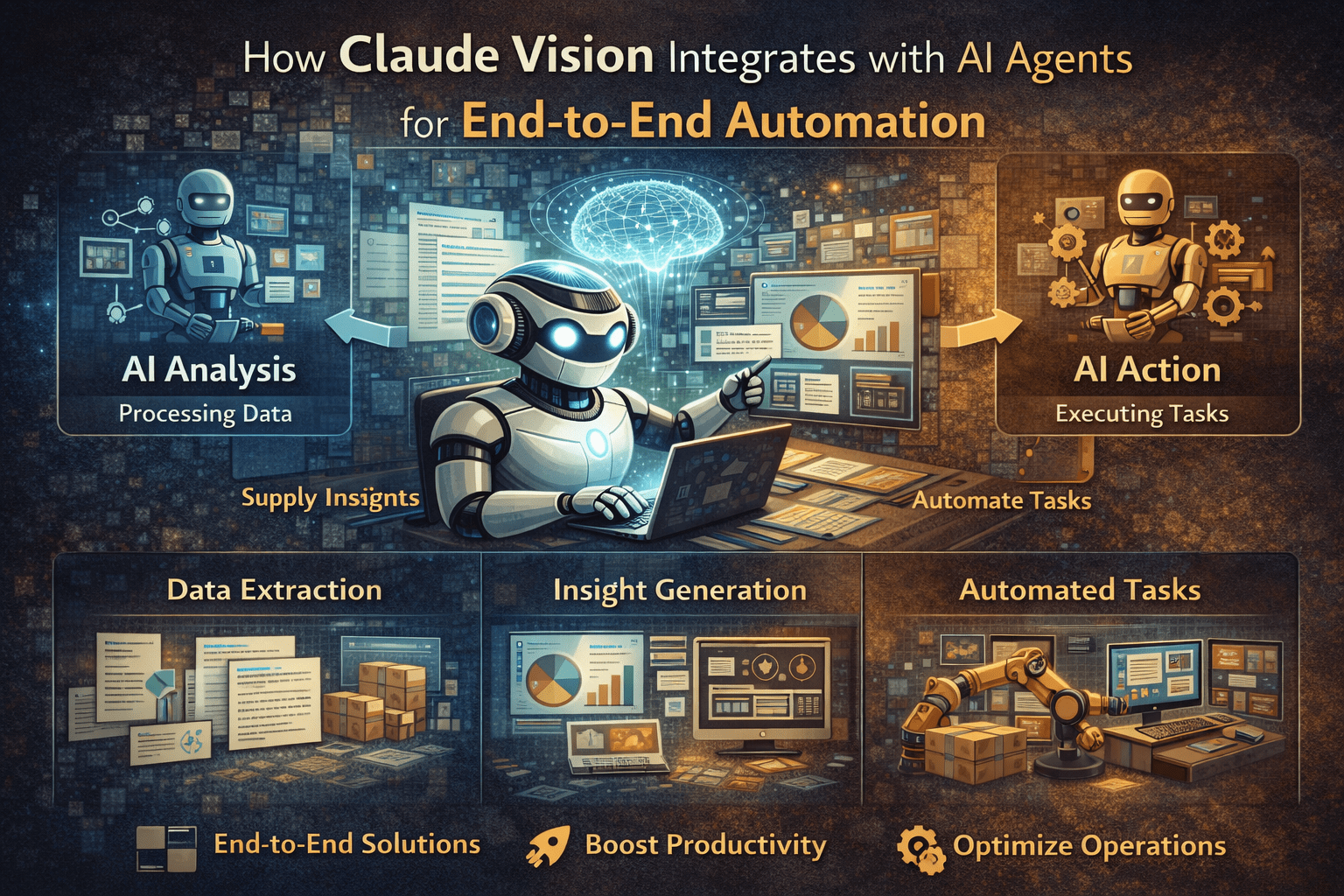
Claude AI Vision enables end-to-end automation by producing structured outputs that feed directly into agents, demonstrating how Claude AI Vision integrates with workflows for maximum efficiency.
The gap between “here is what the image contains” and “here is what happened as a result of what the image contained” is where end-to-end visual automation lives. Claude Vision handles the analysis. The agent handles the action. Together, they close the workflow loop that previously required a human in the middle — receiving the analysis output, deciding what to do with it, and manually executing the downstream action.
Overview
Enterprises use Claude AI Vision to automate visual workflows from capture to action, showing that Claude AI Vision transforms image analysis into actionable outcomes without manual intervention. That integration changes visual AI from an analytical output source to an operational process participant, handling the full sequence from visual input to system action.
- Claude Vision provides the visual analysis output that agents act on — combining visual and text-based reasoning in the same agent workflow
- Agent integration enables visual analysis to trigger multi-step automated processes without manual action at each step
- The combination handles workflows that require both understanding visual content and acting on that understanding in connected systems
- Governance design for integrated visual agents requires scope controls for both the analysis and the action layers
- End-to-end visual automation produces the highest operational return for high-volume, well-defined visual workflows with clear action paths
The 5 Why’s
- Why does agent integration extend the value of Claude Vision beyond analytical output? Visual analysis that produces an output for a human to act on is constrained by human availability, attention, and consistency. Visual analysis that feeds directly into an agent that executes the defined action for that output type is constrained by the quality of the analysis and the correctness of the action definition — both of which are more consistent at scale than human execution.
- Why do end-to-end visual automation workflows require both visual reasoning and action execution capability? Visual reasoning identifies what the image contains and what it means. Action execution translates that meaning into a system change — a record update, a routing decision, a workflow trigger. Those are different capabilities. The combination is what produces automation that handles the full workflow from input to outcome.
- Why does human oversight remain necessary at specific points in end-to-end visual automation? Not every visual finding maps to a fully automated action path. Findings that trigger high-consequence actions, findings that fall below defined confidence thresholds, and findings that match exception patterns all require human review before action. End-to-end automation design explicitly identifies those review triggers and routes them correctly rather than automating past them.
- Why does governance design for integrated visual agents require scope controls at both the analysis and action layers? Analysis scope controls define what images the agent processes and under what authorization. Action scope controls define what the agent can do with the analysis findings — which system actions are automated, which require approval, and which are referred to human judgment regardless of analysis confidence. Both layers require explicit design.
- Why does the integration architecture matter for reliability in production end-to-end visual automation? Claude Vision analysis can produce unexpected outputs. Connected systems can be temporarily unavailable. Action authorization checks can fail. End-to-end visual automation that does not have explicit handling for each of those conditions fails in ways that affect downstream workflows without clear failure signals. Reliability requires explicit handling of every failure mode in the integrated pipeline.
How Claude Vision and Agent Integration Works
The Integration Pattern
A Claude Vision and agent integration follows a defined sequence:
- Image captured or received by the automation pipeline
- Image passed to Claude Vision analysis with the task-specific prompt
- Analysis output returned — classification, extraction, assessment, or recommendation
- Agent evaluates the output against defined action criteria
- If output meets automated action criteria: agent executes the defined action in the connected system
- If output meets review trigger criteria: agent routes to human review with the structured analysis as the review brief
- Action completion or review outcome is logged to the audit trail
The human is in the loop for the cases that require judgment. The automated path handles the volume of cases where the analysis output maps clearly to a defined action.
Use Case: Document Intake and Processing
Claude AI Vision enhances document intake by classifying types, extracting required fields, and assessing completeness, illustrating Claude AI Vision’s role in automated processing. The agent receives the structured analysis output, routes complete and valid extractions to the appropriate downstream processing queue, flags incomplete documents to the review queue with the extraction attempt log, and updates the intake record with the classification and routing outcome. The full intake sequence — classification, extraction, validation, routing, record update — executes automatically for documents that meet the completeness criteria.
Use Case: Inspection and Quality Response
Claude AI Vision automates manufacturing inspections, classifying defects, assessing pass/fail criteria, and reporting confidence levels, making Claude AI Vision crucial for operational efficiency in production lines. The agent receives the assessment, records the inspection finding in the quality management system, routes passed components to the next production step, routes failed components to the defined rejection handling workflow, and escalates low-confidence assessments to quality engineering for review. The inspection response is automated for clear passes and clear failures. The edge cases reach a quality engineer with the structured finding already prepared.
Use Case: Visual Compliance Monitoring and Response
Facility inspection images are analyzed by Claude AI Vision against defined compliance criteria. The agent receives the compliance analysis, records the inspection finding in the compliance management system, generates the compliance documentation entry, routes non-compliant conditions to the compliance officer review queue with the visual evidence and structured finding, and updates the compliance calendar with the next required inspection date. The documentation and routing are automated. The compliance determination remains with the compliance officer.
Governance Design for End-to-End Visual Automation
- Analysis confidence thresholds — define minimum confidence levels for automated action; below-threshold outputs route to human review regardless of the analysis finding
- Action authorization tiers — define which actions execute automatically, which require approval, and which are always human regardless of analysis confidence
- Exception routing — every failure mode in the pipeline — analysis failure, action execution failure, authorization failure — has a defined routing path that does not allow silent failure
- Audit trail completeness — every image processed, every analysis performed, every action taken, and every review triggered is logged in a connected audit trail
- Scope limits — explicit definition of what images the agent processes and what actions it can take, reviewed and approved by security and compliance before production deployment
Final Takeaway
Claude Vision integrated with AI agents is the architecture that closes the loop on visual automation — not just producing analysis outputs for humans to act on, but executing the actions that defined outputs call for, within the governance framework that keeps consequential actions in human hands.
End-to-end visual automation handles the full workflow from image to outcome at the scale and consistency that manual handling cannot match. The governance design is what makes it trustworthy in production. Both are required. Together, they produce the highest operational return that visual AI in enterprise environments can deliver.
Build End-to-End Visual Automation With Mindcore Technologies
Mindcore Technologies works with enterprise teams to design and deploy integrated Claude Vision and agent automation pipelines — analysis configuration, action logic design, governance framework, audit trail architecture, and production reliability engineering for end-to-end visual workflows.
Talk to Mindcore Technologies About End-to-End Visual Automation →
Contact our team to map your visual automation use cases and build the integrated pipeline that handles them from image to outcome.
Frequently Asked Questions
How does Claude Vision work with AI agents?
Claude Vision analyzes visual content such as documents, inspection images, and compliance records, while AI agents execute actions based on the analysis results. Together, they create end-to-end automation workflows that move from image analysis to operational action without requiring constant manual intervention.
What are the benefits of integrating Claude Vision with AI agents?
Integrating Claude Vision with AI agents improves workflow speed, operational consistency, automation scalability, and response accuracy. Businesses can automate classification, routing, reporting, validation, and workflow execution across high-volume visual processes.
Why is governance important in visual AI automation?
Governance controls help define which actions can be automated, when human review is required, and how audit trails are maintained. Strong governance reduces operational risk and prevents unauthorized or incorrect automated actions.
What industries benefit from end-to-end visual automation?
Healthcare, manufacturing, logistics, finance, legal, and regulated industries benefit significantly from visual AI automation because they process large amounts of image-based data and operational workflows that traditionally require manual review.
Why are confidence thresholds important in AI-driven automation?
Confidence thresholds determine when AI-generated outputs are reliable enough for automated action versus when human review is necessary. This helps organizations balance automation efficiency with operational accuracy and compliance requirements.
Enterprise AI Automation Expertise from Matt Rosenthal
Matt Rosenthal, CEO of Mindcore Technologies, has extensive experience helping organizations deploy secure AI automation strategies across complex enterprise environments. His expertise in AI orchestration, workflow automation, governance architecture, cybersecurity, and operational infrastructure helps businesses integrate visual AI systems with intelligent agents to improve scalability and operational efficiency. His leadership focuses on designing secure, governance-driven AI automation frameworks that align workflow execution, compliance visibility, auditability, and operational resilience with long-term business objectives.

