

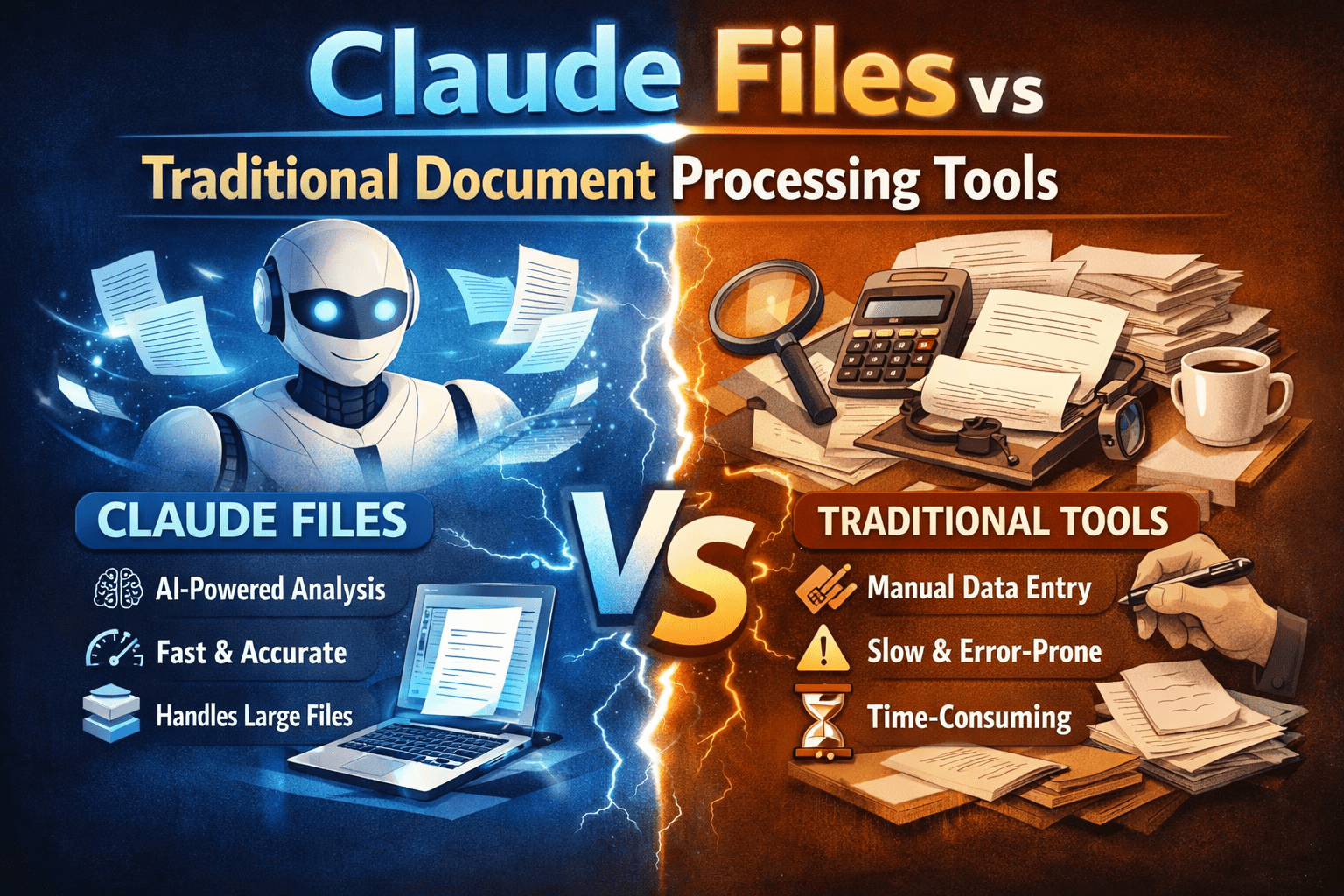
Traditional document processing tools have been solving document extraction and classification problems for years. Template-based extraction, rules-based classification, optical character recognition, and workflow routing are mature capabilities that work well for the document types they were designed for.
Claude Files handles what they cannot: documents that vary in structure, content that requires contextual interpretation to extract accurately, analysis tasks that combine reading and reasoning rather than just parsing and extracting, and document types that no template was ever built for because they change too frequently to maintain templates against.
This is not a replacement comparison. It is a task classification comparison — which tool handles which document types, which analysis requirements, and which operational contexts better. Understanding that classification is what determines whether document processing investment compounds or fragments.
Overview
Traditional document processing tools and Claude Files differ primarily in how they handle variability and what cognitive operations they apply to documents. Traditional tools parse structured content with high speed and accuracy for documents that match their configuration. Claude Files reasons about content with flexibility for documents that vary in structure, contain contextual information, or require analysis that goes beyond field extraction. The enterprise that gets the classification right deploys both effectively.
- Traditional tools excel at high-speed extraction from consistently structured documents
- Claude Files handles variable structures, contextual analysis, and reasoning-dependent tasks
- Traditional tools require template and rule development for each new document type; Claude Files handles new document types through instruction
- The maintenance burden of traditional tools scales with document type diversity; Claude Files handles that diversity without per-type configuration
- The strategic deployment model uses both — traditional tools for structured, high-speed processing; Claude Files for variable, reasoning-dependent analysis
The 5 Why’s
- Why do traditional document processing tools fail on the documents enterprises actually receive? Template-based tools work on documents that match the template. Enterprise documents arrive from multiple sources, in multiple formats, with variations that no single template anticipates. Rules-based classification breaks when documents contain unexpected content or format variations. The real-world variability of enterprise document intake exceeds what traditional tools were designed to handle consistently.
- Why does contextual reasoning change what document analysis can produce? Traditional tools extract what is present at a defined location in a defined format. Contextual reasoning extracts what is present based on understanding what the document is, what each section means, and what the extracted value represents in context. The difference is most significant for handwritten content, variable-format documents, and documents where the relevant information requires interpretation rather than direct extraction.
- Why does the template and rule maintenance burden matter at enterprise scale? An enterprise that processes hundreds of document types maintains hundreds of templates and rule sets — each requiring updates when document formats change, each requiring development when new document types appear. That maintenance burden grows with the document type portfolio. Claude Files handles new document types through instruction, without template development — reducing the ongoing maintenance cost proportionally.
- Why is the comparison a task classification question rather than a replacement question? Traditional tools are faster, more cost-efficient, and more accurate for the specific tasks they were designed for. Claude Files is more flexible, more capable with variable inputs, and applicable to reasoning-dependent analysis tasks. The enterprise that replaces traditional tools with Claude Files for structured extraction tasks over-engineers the solution. The enterprise that uses only traditional tools for variable-format documents under-solves the problem. Task classification determines which tool belongs where.
- Why does the maintenance cost comparison favor Claude Files for variable document type environments? In environments where document types are numerous, formats change regularly, and new document types appear frequently, the ongoing cost of maintaining templates and rules for traditional tools exceeds the operational cost of configuring Claude Files through instruction. The crossover point where Claude Files becomes the more economical choice is reached faster than most organizations expect.
The Comparison in Detail
What Traditional Document Processing Tools Do Well
- High-speed structured extraction — properly templated documents are extracted at speeds that Claude Files cannot match for the specific configured document type
- High accuracy for consistent inputs — OCR and template-based extraction on clean, consistently structured documents achieves accuracy that contextual reasoning does not improve
- Cost efficiency for high-volume standard processing — per-document processing cost for traditionally configured document types is lower than AI reasoning costs at equivalent volume
- Deterministic behavior — the same input always produces the same output; behavior is predictable and testable for compliance-sensitive processing requirements
What Claude Files Does Well
- Variable format handling — documents that vary in structure, source format, or content organization are analyzed without per-format configuration
- Contextual content interpretation — content that requires understanding rather than just locating is extracted accurately — handwritten entries, contextually labeled fields, implicit data relationships
- Reasoning-dependent analysis — analysis tasks that require applying judgment to document content — compliance assessment, risk flagging, completeness verification — are performed with the same analytical capability Claude applies to any reasoning task
- New document type handling — new document types are handled through instruction without template development delay
- Cross-document synthesis — Claude Files can reason across multiple documents simultaneously, identifying relationships and patterns that single-document extraction tools cannot
The Deployment Decision Framework
| Document Processing Characteristic | Traditional Tools | Claude Files |
|---|---|---|
| Input consistency | High (consistent format) | Variable (diverse formats) |
| Required cognitive operation | Parse and extract | Interpret and reason |
| Per-type configuration | Template and rules required | Instruction-based |
| Processing speed requirement | Milliseconds | Seconds acceptable |
| Document type diversity | Low (bounded set) | High (diverse, changing) |
| New document type handling | Template development required | Instruction-based immediate |
| Analysis beyond extraction | Not applicable | Core capability |
| Maintenance burden | High (template portfolio) | Low (instruction updates) |
Where They Work Together
High-performance enterprise document processing architectures use both. Traditional tools handle the high-volume, consistently structured document types at the front of the pipeline — where speed, cost, and accuracy for specific configured types favor traditional approaches. Claude Files handles the variable, reasoning-dependent analysis deeper in the pipeline — where traditional tools produce inadequate results on inputs they were not configured for.
The integrated architecture processes more documents faster and more accurately than either tool alone, with each tool handling the document types and analysis tasks it was designed for.
Final Takeaway
Traditional document processing tools are not obsolete. They are optimized for a specific problem domain — consistent, structured documents processed at speed with deterministic behavior. Claude Files is optimized for a different problem domain — variable, reasoning-dependent document analysis that adapts to the document as it arrives rather than requiring the document to match a predefined configuration.
The enterprise that understands that distinction deploys each where it produces the most value — and builds document processing infrastructure that handles the full range of document types the business actually encounters, not just the ones that fit the templates that were built first.
Design Your Enterprise Document Processing Architecture With Mindcore Technologies
Mindcore Technologies works with enterprise teams to assess document processing requirements, determine where traditional tools and Claude Files each belong, and design the integrated architecture that handles the full document type portfolio — at speed where structure permits, with reasoning where variability demands it.
Talk to Mindcore Technologies About Your Enterprise Document Processing Strategy →
Contact our team to audit your current document processing coverage and identify where Claude Files fills the gaps your traditional tools cannot reach.

