

Every enterprise has a knowledge problem. The institutional knowledge that determines how things get done, what decisions were made and why, what has been tried before, and where the expertise lives — most of it is locked in documents. Reports, contracts, procedure manuals, meeting records, project files. The knowledge exists. Accessing it requires knowing where to look, having time to read it, and being able to synthesize across sources that were never designed to be read together.
Knowledge management systems have tried to solve that problem for decades with indexing, tagging, and search. Those approaches make documents findable. They do not make the knowledge inside them accessible.
Claude Files changes what knowledge management can do — extracting knowledge from documents, synthesizing across sources, and making institutional intelligence accessible through AI-driven query and analysis rather than through search results that require human synthesis to produce an answer.
Overview
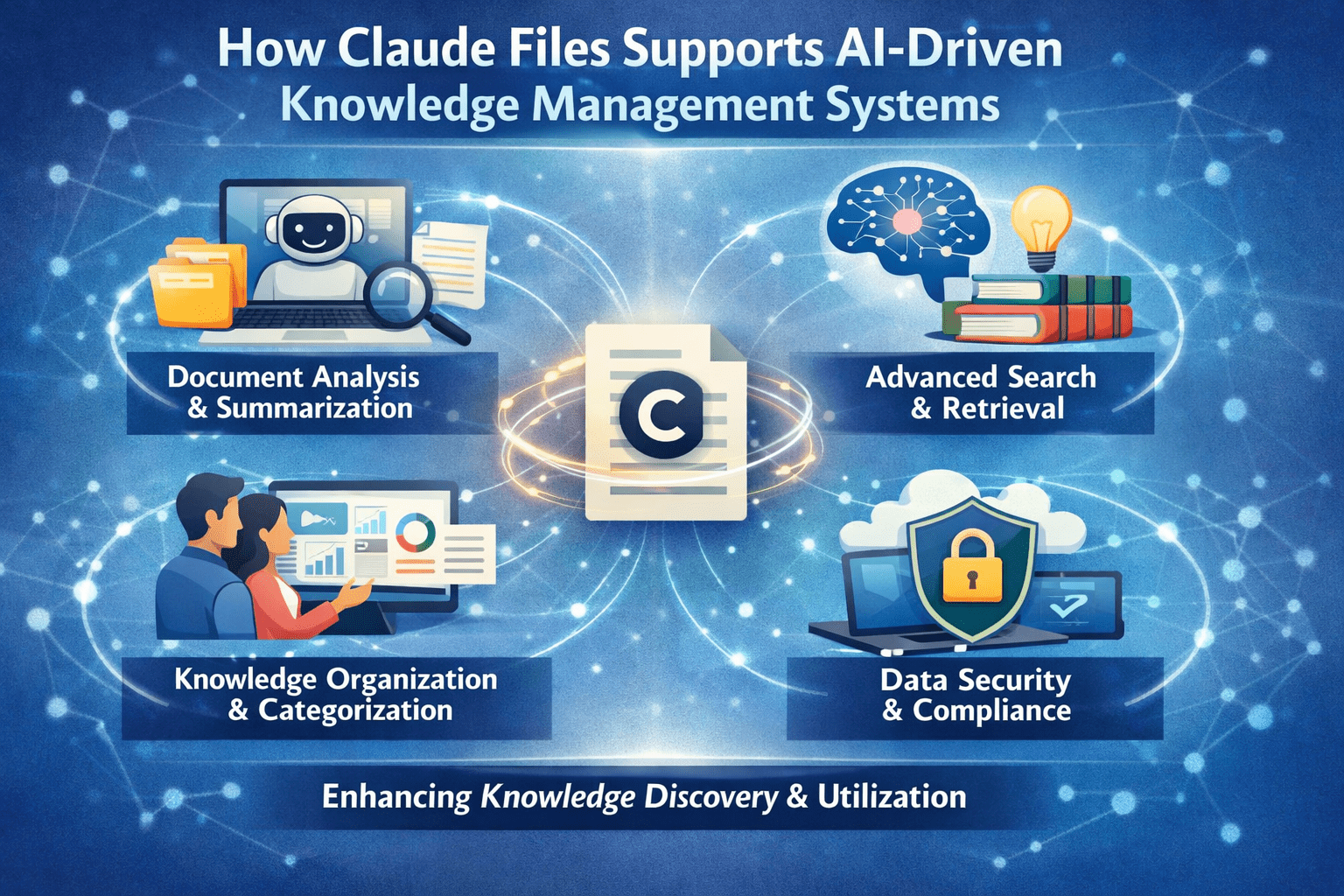
Claude Files supports AI-driven knowledge management by enabling document analysis that extracts, synthesizes, and surfaces institutional knowledge at the query level — not just the document level. Instead of returning a list of documents that might contain an answer, Claude Files reasons across the relevant documents and produces the answer, with the document sources attributed and the synthesis traceable. Institutional knowledge becomes accessible without requiring every question to be answered by the person who originally had it.
- Knowledge extraction from documents produces structured knowledge assets that can be queried, updated, and referenced independently of the source documents
- Cross-document synthesis enables answers to questions that span multiple documents and sources
- Institutional knowledge becomes accessible to employees who were not present when it was created
- Knowledge management scales with the document volume rather than with the number of knowledge experts available to answer questions
- Governance architecture ensures that knowledge extracted from sensitive documents respects the classification and access controls of those sources
The 5 Why’s
- Why does traditional knowledge management — indexing and search — fail to solve the institutional knowledge access problem? Search returns documents. Knowledge access requires answers. The gap between a search result and an answer is filled by a human who reads the document, finds the relevant section, interprets it in context, and synthesizes it with other relevant information. That gap is exactly where employee time goes in knowledge-intensive enterprise work. Claude Files closes that gap.
- Why does cross-document synthesis produce knowledge value that single-document analysis cannot? Institutional knowledge is distributed. A question about how a specific contract issue was resolved historically requires reading multiple contracts, internal correspondence, and decision records — not just one file. Cross-document synthesis that reasons across those sources simultaneously produces the answer that none of them contains individually.
- Why does AI-driven knowledge extraction improve knowledge retention in high-turnover environments? When an expert employee leaves, the institutional knowledge they carried leaves with them — unless it was documented in a form that can be accessed and synthesized later. Claude Files applied to the documentation they produced during their tenure extracts and structures the knowledge that documentation contains — making it accessible to successor employees without the original expert’s presence.
- Why does knowledge management governance require the same security architecture as document analysis? Knowledge extracted from sensitive documents inherits the sensitivity of its sources. Knowledge management systems that store extracted knowledge without the classification controls that applied to the source documents create ungoverned exposure of sensitive institutional content. Governance must follow the knowledge, not just the original document.
- Why does the knowledge management value of Claude Files compound over time? Each document analyzed adds to the knowledge base. Each synthesis query exercises that base. Each answered question that would previously have required expert time is handled by the knowledge management system. The value grows as the document base grows and as the query patterns establish what institutional knowledge is most in demand.
How Claude Files Enables AI-Driven Knowledge Management
Knowledge Extraction
Documents processed through Claude Files produce structured knowledge extracts — the key decisions, procedures, findings, or provisions that the document contains, in a format that can be stored, referenced, and queried independently of the source document:
- Policy and procedure documents → structured procedure records with applicability, steps, exceptions, and review dates
- Contract documents → structured term records with key provisions, obligations, renewal conditions, and counterparty information
- Project and decision records → structured decision records with context, options considered, rationale, and outcomes
- Research and analysis documents → structured finding records with methodology, conclusions, confidence levels, and applicability conditions
Cross-Document Synthesis
Knowledge management queries that require synthesizing across multiple documents are handled by Claude Files reasoning across the relevant document set:
- “What is our standard practice for handling [situation type]?” → synthesized from policy documents, prior case records, and relevant correspondence
- “What are the recurring issues in contracts with [vendor type]?” → synthesized from contract portfolio analysis across the relevant vendor category
- “What decisions have been made about [topic] and why?” → synthesized from decision records, meeting notes, and implementation documents
Knowledge Accessibility Without Expert Intermediation
The goal of AI-driven knowledge management is that questions get answered from institutional documents without requiring the employee who originally knew the answer to be available. Claude Files enables that by making the knowledge in documents accessible through query rather than through search and manual synthesis.
New employees answer questions about historical decisions from the knowledge base. Operations teams access procedure knowledge without waiting for subject matter experts. Project teams access prior project learnings without requiring project alumni to be tracked down.
Governance Architecture for AI Knowledge Management
- Source classification inheritance — knowledge extracted from classified source documents carries the classification of its source; knowledge management access controls enforce that classification
- Attribution maintenance — extracted knowledge is attributed to its source documents; queries that surface extracted knowledge include source attribution for verification
- Access control enforcement — knowledge management queries are constrained by the user’s access rights to the source documents; users cannot access extracted knowledge from documents they are not authorized to view
- Audit trail for knowledge access — knowledge management queries and the documents they draw from are logged for audit purposes
A Simple Knowledge Management Readiness Check
Your organization is ready for AI-driven knowledge management with Claude Files if:
- Significant institutional knowledge is locked in documents that are difficult to query for specific answers without manual synthesis
- Document volume exceeds the capacity for manual knowledge extraction and maintenance
- Knowledge access currently requires expert intermediation that creates bottlenecks when those experts are unavailable
- Governance infrastructure can extend classification controls from source documents to extracted knowledge assets
- Knowledge management system architecture can integrate Claude Files extraction and synthesis as a processing layer above the existing document repository
Final Takeaway
AI-driven knowledge management is not a better search engine. It is a system that makes the knowledge inside enterprise documents accessible as answers rather than as search results — synthesizing across sources, extracting structured knowledge, and enabling institutional intelligence to scale with the document volume rather than with the number of experts available to translate documents into answers.
Claude Files is the analytical layer that makes that possible. Applied to enterprise document repositories, it transforms static document libraries into living knowledge bases that answer questions, surface institutional learning, and make every employee’s access to organizational knowledge proportional to the knowledge the organization has actually documented — not to the network connections they happen to have.
Build AI-Driven Knowledge Management With Mindcore Technologies
Mindcore Technologies works with enterprise knowledge management and operations teams to design and deploy Claude Files knowledge management integrations — extraction schema design, cross-document synthesis architecture, governance controls, and integration with existing document repositories and knowledge management systems.
Talk to Mindcore Technologies About AI-Driven Knowledge Management With Claude Files →
Contact our team to assess your institutional knowledge access problem and build the Claude Files architecture that solves it.Share

