

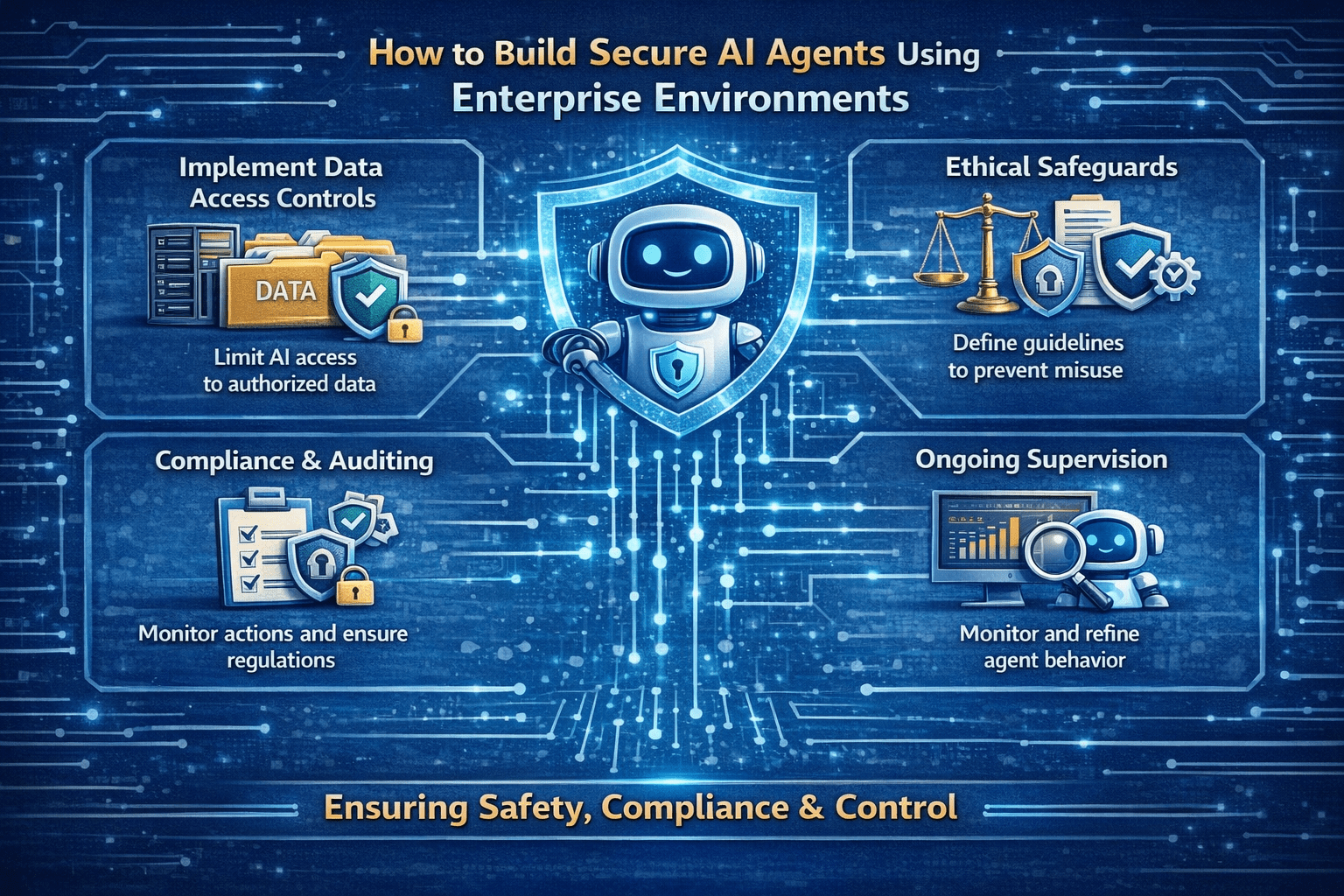
Building a Claude agent that works is an engineering problem. Building a Claude agent that works securely in an enterprise environment is an architectural problem — one that requires security, governance, and audit design before the first line of agent code is written.
The security gaps that create enterprise AI incidents are almost never discovered during development. They surface in production, when an agent with inadequately scoped access, insufficient action authorization controls, or missing audit trail infrastructure encounters a condition the development environment never produced. By that point, the cost of correction is substantially higher than the cost of design.
This is the secure design framework that prevents those gaps.
Overview
Secure enterprise Claude agents are not agents with security controls retrofitted onto working implementations. They are agents designed from the ground up with access scope, action authorization, context security, and audit trail architecture as first-order design requirements — alongside functionality, not after it. Every security gap in a production agent traces to a design decision that was made without security consideration. Every secure production agent traces to the same counter-decision made deliberately.
- Access scope is defined before implementation — agents access only what the specific workflow requires
- Action authorization tiers are defined before deployment — not every action executes automatically
- Context security prevents sensitive data from persisting beyond the task that requires it
- Audit trail architecture is designed alongside agent functionality, not appended afterward
- Failure handling is designed explicitly — agents fail gracefully to human handoff, not silently to unknown states
The 5 Why’s
- Why must security architecture be designed before agent implementation, not after? Security controls retrofitted onto working agent implementations are more expensive to implement correctly, more likely to create functionality conflicts, and less likely to cover all the access and action paths that were established during implementation without security consideration. The design sequence determines the quality of the result.
- Why is access scope definition the first security design decision for any enterprise agent? An agent that has access to more data and systems than its specific workflows require creates exposure that no subsequent security control fully mitigates. Minimum necessary access — scoped to the specific data and system access the agent’s defined workflows require — is the foundational control. Everything else builds on it.
- Why does action authorization design require explicit tier definition rather than general approval requirements? “Require approval for sensitive actions” is not a governance design. It is a statement of intent that produces inconsistent implementation. Explicit tier definition — these action types execute automatically, these send notifications, these require approval, these are always human — produces consistent behavior across every agent execution, regardless of which workflow triggered which action.
- Why does context security matter specifically for agents that operate across multiple steps? Agents maintain context across the steps of a workflow. That context may include sensitive data retrieved at step one that is no longer needed at step five but is still present in the context window. Context security design — what enters the context, what is cleared when, and what is never retained — prevents sensitive data from persisting in agent working memory beyond the step that required it.
- Why is failure mode design a security requirement rather than just a reliability requirement? Agents that encounter unexpected conditions — API failures, access denials, ambiguous task states — and fail without defined behavior can leave enterprise systems in inconsistent states, trigger partial action sequences, or continue executing in degraded states that produce incorrect outcomes. Defined failure modes that route to human handoff rather than to unknown states are both a reliability and a security requirement.
The Secure Agent Design Framework
Step 1: Workflow Scope Definition
Before any implementation begins, define the specific workflows the agent will handle, the specific systems and data each workflow requires access to, and the specific actions the agent will take in each system. This scope definition is the reference against which every subsequent design decision is validated.
Any access, action, or capability outside the defined workflow scope requires justification before implementation — not after.
Step 2: Access Architecture
For each system the agent requires access to:
- Define the specific data objects or record types the agent needs to access
- Define whether read access, write access, or both are required — and for which specific action types
- Create service account credentials scoped to exactly those permissions — no broader
- Store credentials in enterprise secrets management infrastructure with automated rotation
- Define the authentication mechanism — service account keys, OAuth scopes, API tokens — appropriate for each system
Step 3: Action Authorization Design
For each action type the agent may take across its defined workflows, assign an authorization tier:
- Tier 1 (automated) — read operations, classification actions, record lookups, status queries
- Tier 2 (notify) — low-impact write operations within defined parameters, task creation, status updates on existing records
- Tier 3 (approve) — write operations that affect external parties, create financial obligations, or modify access controls — queued for human approval before execution
- Tier 4 (human only) — deletions, regulatory submissions, high-value financial transactions, access privilege changes — always referred to a human, not executed by the agent
Step 4: Context Security Design
For each data type the agent retrieves during workflow execution:
- Define when the data enters the context window
- Define when the data is no longer needed and should be cleared
- Define whether the data type should be summarized or abstracted rather than retained in full within the context
- Define retention prohibitions — data types that should never persist in agent logs or memory beyond the immediate task
Step 5: Audit Trail Architecture
Design the audit trail before building the agent:
- Every workflow initiation — timestamp, trigger source, workflow type, initiating user or system
- Every data access — system accessed, data type, access result
- Every action taken — system, action type, parameters, result, authorization tier under which it executed
- Every failure event — failure type, system state at failure, recovery action taken
- Every human handoff — handoff trigger, context delivered, human responder
What Secure Agent Design Produces
- Auditable operations — every agent action traceable to its trigger, authorization, and outcome
- Bounded access — agent exposure limited to the minimum required for defined workflows
- Predictable failure behavior — failures produce defined outcomes, not unknown states
- Maintainable governance — action tiers, access scope, and audit requirements documented and enforceable independently of the implementation
- Production reliability — security architecture that was designed in does not conflict with functionality in production
Final Takeaway
Secure enterprise Claude agents are built, not secured. The security is in the design sequence — access scope defined before implementation, action authorization tiers explicit before deployment, context security designed alongside workflow logic, audit trail architecture built before the first production execution. Agents built that way are deployable in regulated enterprise environments on the first production deployment. Agents built without that design sequence are discovered to be insecure in production — and corrected at the cost of the oversight that the design sequence would have prevented.
Build Secure Claude Agents With Mindcore Technologies
Mindcore Technologies works with enterprise security and engineering teams to design Claude Agents with security architecture built in from the start — access scope definition, action authorization tiers, context security design, audit trail architecture, and failure mode handling that make agents production-ready for regulated enterprise environments.
Talk to Mindcore Technologies About Secure Claude Agent Design →
Contact our team to assess your agent use cases and design the security architecture that makes them enterprise-deployable.

