

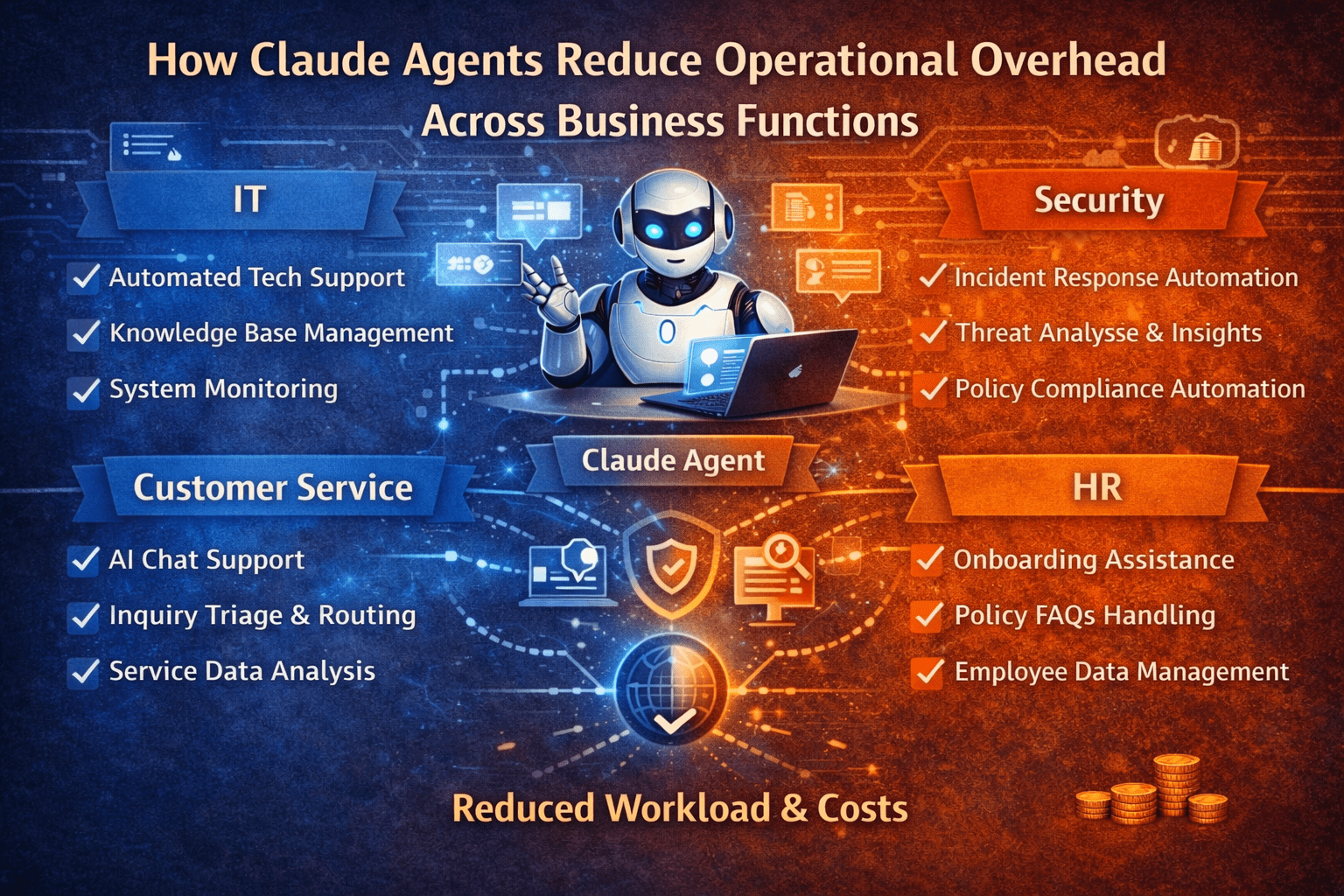
Operational overhead is the cost of running the business rather than growing it. The coordination steps, the manual processing cycles, the follow-up sequences, the routine decision-making on well-defined conditions — work that is necessary, that consumes significant staff time, and that produces no competitive advantage because every organization in the industry performs the same functions at similar cost.
Claude Agents reduce that overhead by handling the execution of high-volume routine workflows autonomously — not replacing the judgment that business functions require, but eliminating the manual execution steps that precede and follow that judgment and that currently consume the majority of the time professionals in those functions spend per workday.
Overview
Operational overhead reduction through Claude Agents is achievable across Finance, HR, Legal, Customer Operations, and IT functions — because each function has a consistent structure: high-volume routine workflows that follow defined execution paths, minority cases requiring professional judgment that benefit from having the routine volume cleared so that judgment can be applied efficiently, and administrative coordination that consumes professional time without requiring professional expertise. Agents handle the first and third categories. Professionals focus on the second.
- Finance overhead reduced through automated invoice processing, reconciliation, and reporting cycles
- HR overhead reduced through automated onboarding, offboarding, and document management workflows
- Legal overhead reduced through automated contract intake, review preparation, and obligation tracking
- Customer operations overhead reduced through automated inquiry handling, routing, and follow-up sequences
- IT overhead reduced through automated ticket handling, access management, and monitoring response workflows
The 5 Why’s
- Why is operational overhead a cross-functional problem rather than a function-specific one? Every business function has the same structure: defined, high-volume routine work alongside judgment-dependent work that requires professional expertise. The ratio of routine to judgment work varies by function, but the pattern is consistent. Agents address it consistently — not as a custom solution for each function but as a deployment of the same autonomous execution capability across different workflow types.
- Why does reducing routine workflow overhead produce compounding returns rather than one-time savings? When professional time is freed from routine execution, it becomes available for judgment-dependent work — analysis, problem-solving, relationship management, strategy development. That work improves function quality over time in ways that produce returns beyond the immediate time savings. The compounding effect is what makes overhead reduction an investment, not just a cost cut.
- Why does autonomous agent execution produce more consistent outcomes than manual execution at scale? Human execution of high-volume routine workflows introduces variation — different staff members handle the same situation differently, the same staff member handles the same situation differently on different days. Agent execution is consistent by definition — the same workflow conditions produce the same execution path every time. That consistency is a quality benefit independent of the time saving.
- Why does overhead reduction require workflow-specific agent design rather than generic automation? Generic automation handles generic processes. Operational overhead reduction requires agents designed for the specific workflows of each function — with the correct data access, the correct action authorization, the correct escalation criteria, and the correct audit trail for the specific regulatory and operational context of that function. Generic automation produces generic results that do not meet function-specific requirements.
- Why is escalation quality as important as routine execution quality for overhead reduction? Overhead is not reduced if agents handle the routine well but escalate to professionals without context — requiring the professional to reconstruct the situation from scratch before applying judgment. Escalation with full workflow context, relevant history, and structured situation assessment is what makes professional time efficient after the agent hands off.
Operational Overhead Reduction by Function
Finance
Finance operational overhead concentrates in accounts payable, accounts receivable, reconciliation, and reporting cycles. Agent applications:
- Accounts payable — invoice intake through payment scheduling automated for standard invoice types; exception escalation with full invoice context and discrepancy documentation for non-standard cases
- Accounts receivable — invoice generation, delivery, follow-up sequences, and payment application automated; dispute escalation with full account and invoice history
- Reconciliation — automated reconciliation matching with structured exception reporting for items requiring analyst review
- Reporting cycles — data aggregation, standard report generation, and distribution automated; analyst time concentrates on variance explanation and narrative
Human Resources
HR operational overhead concentrates in onboarding, offboarding, document management, and benefits administration. Agent applications:
- Onboarding workflow execution — system access provisioning, equipment requests, training enrollment, and compliance requirement assignment automated against role-based matrices
- Offboarding workflow execution — access revocation across connected systems, equipment return tracking, and separation document processing automated
- Document management — incoming HR document classification, data extraction, record population, and routing automated for standard document types
Customer Operations
Customer operations overhead concentrates in inquiry handling, case management, and follow-up sequences. Agent applications:
- Inquiry triage and response — incoming inquiry classification, account context retrieval, and response generation for routine inquiry types automated; complex or sensitive inquiries escalated with full context to service staff
- Case management — case creation, status update, follow-up scheduling, and closure documentation automated for cases following standard resolution paths
- Satisfaction follow-up — post-resolution follow-up sequences automated with escalation triggered by responses indicating unresolved concerns
Measuring Operational Overhead Reduction
- Routine workflow volume handled per agent per period — direct measure of automation throughput
- Professional time per judgment-dependent case — if agent automation is working, professional time per case decreases as routine volume is cleared
- Escalation-to-resolution time — if escalation quality is adequate, the time from agent handoff to professional resolution decreases as professionals receive better-prepared escalations
- Error rate on automated workflows — baseline comparison against manual handling error rates validates quality maintenance alongside efficiency gain
- Employee time allocation shift — tracking whether professional time moves from routine execution toward judgment-dependent work as agent deployment matures
Final Takeaway
Operational overhead is not an unavoidable cost of running an enterprise. It is the cost of running an enterprise that handles routine execution manually. Claude Agents reduce that cost by handling routine execution autonomously — across every business function with the workflow characteristics that autonomous execution addresses — and returning professional time to the judgment-dependent work that functions were staffed for in the first place.
The overhead reduction compounds. The judgment-dependent work quality improves. The functions run better — not just cheaper — because the people in them are doing the work their expertise is for.
Reduce Operational Overhead With Mindcore Technologies
Mindcore Technologies works with enterprise business function leaders to identify overhead reduction opportunities, design function-specific Claude Agent workflows, and deploy autonomous execution capability that produces measurable time savings and quality improvements across Finance, HR, Legal, Customer Operations, and IT functions.
Talk to Mindcore Technologies About Reducing Operational Overhead With Claude Agents →
Contact our team to map your operational overhead by function and design the agent deployment that addresses it.

