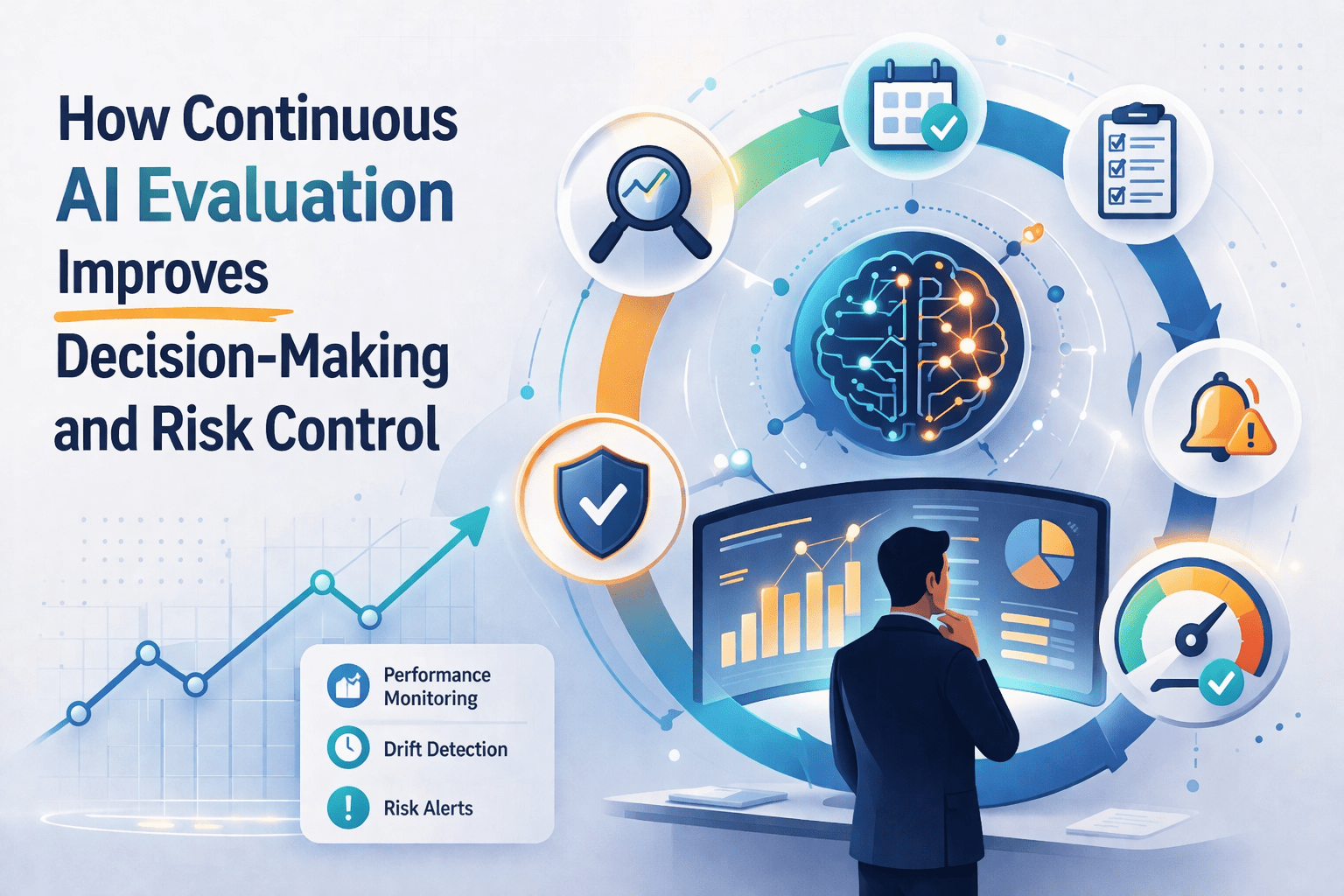
Pre-deployment evaluation is a gate. Continuous evaluation is the practice.
The gate determines whether an AI deployment is acceptable at the point of deployment. The practice determines whether it remains acceptable over time — as input distributions shift, model behavior changes with version updates, downstream workflows evolve, and the regulatory requirements that govern the deployment are updated or interpreted differently.
Most enterprise AI programs have gates. Few have practices. The deployments that degrade, produce compliance findings, or generate operational incidents are almost never the ones where pre-deployment evaluation failed. They are the ones where continuous evaluation was not established to catch what changes after deployment.
Overview
Continuous AI evaluation is the systematic practice of measuring AI performance in production, tracking that performance over time, and acting on changes before they create operational or compliance consequences. For enterprise AI deployments in regulated and operationally critical contexts, continuous evaluation is the control that keeps the risk profile of AI-assisted workflows within acceptable bounds as production conditions evolve.
- Continuous evaluation detects input distribution drift before it creates performance degradation
- It identifies model version changes that affect production quality before those changes propagate to downstream workflows
- It provides the evidence base for model management decisions — upgrade, reconfigure, or roll back
- It supports regulatory audit requirements by demonstrating ongoing performance monitoring
- It converts AI risk management from reactive incident response to proactive quality governance
The 5 Why’s
- Why does pre-deployment evaluation alone not maintain acceptable AI performance over time? Pre-deployment evaluation measures performance at a point in time on inputs that represent the distribution at that time. Production conditions change — input patterns shift, workflows evolve, model versions update. Performance that was acceptable at deployment degrades under those changes without anyone knowing unless evaluation continues.
- Why is input distribution drift the most common cause of silent post-deployment performance degradation? When the distribution of inputs the AI processes in production shifts away from the distribution it was evaluated on, quality metrics degrade — not because the model changed, but because the production inputs no longer match the evaluation baseline. Without continuous monitoring that detects this drift, the degradation is invisible until it manifests as a downstream failure.
- Why do model version changes require re-evaluation against production-specific test sets rather than just provider release notes? Provider release notes describe changes at the model level. The effect of those changes on specific enterprise deployment performance is not predictable from general descriptions. Production-specific re-evaluation measures the actual performance impact of the version change on the specific task types and input distributions that matter for each enterprise deployment.
- Why does continuous evaluation support regulatory audit requirements beyond general quality management? Regulatory examinations in healthcare, financial services, and other regulated industries increasingly include AI governance reviews. Organizations that can demonstrate continuous performance monitoring — with documented metrics, threshold management, and corrective action records — satisfy AI governance audit requirements that organizations relying only on pre-deployment evaluation cannot.
- Why does continuous evaluation improve decision-making beyond risk control? The performance data continuous evaluation produces informs model management decisions — whether to upgrade to a new model version, whether to reconfigure a deployment, whether to expand or restrict the scope of automated operation. Organizations with continuous evaluation data make those decisions based on production evidence. Organizations without it make them based on provider marketing and internal intuition.
What Continuous Evaluation Monitors
Input Distribution Monitoring
- Statistical tracking of the input distribution across defined dimensions — document types, query categories, data formats
- Alerting on distribution shifts that exceed defined thresholds — indicating that the production inputs are moving away from the evaluated baseline
- Periodic test set updates triggered by significant distribution shifts — ensuring the evaluation baseline reflects current production conditions
Output Quality Monitoring
- Automated quality sampling — random sample of production outputs evaluated against defined quality criteria on a continuous basis
- Quality metric tracking across the same dimensions measured in pre-deployment evaluation — accuracy rate, consistency rate, safety incident rate
- Threshold alerting — automated alerts when monitored quality metrics decline below deployment approval thresholds
Error Pattern Monitoring
- Tracking of validation failures, human review escalations, and downstream error events associated with AI outputs
- Error pattern analysis — identifying whether errors cluster around specific input types, time periods, or operational conditions
- Correlation analysis between error patterns and potential causal factors — input distribution shifts, model version changes, workflow modifications
Compliance and Safety Monitoring
- Monitoring for safety incidents — outputs that fall outside safety criteria, inappropriate content handling, adversarial input detection
- Compliance-relevant metric tracking — metrics tied to regulatory requirements, monitored against regulatory compliance thresholds rather than just general quality thresholds
How Continuous Evaluation Improves Risk Control
Early Warning Before Threshold Breach
Continuous evaluation produces trend data that identifies performance decline trajectories before they reach threshold-breaching levels. Organizations with continuous evaluation act on early warning signals. Those without it respond to threshold breaches — after the risk has already materialized.
Informed Model Version Management
Model version changes are among the most significant risk events in AI deployment operations. Continuous evaluation provides the pre-change performance baseline and the post-change performance comparison that informed version management requires — enabling rollback decisions before version changes create downstream consequences.
Documented Evidence for Risk Governance
Risk governance for AI requires evidence — not assertions that performance is acceptable but documented measurements that demonstrate it. Continuous evaluation produces that evidence as an ongoing record, available for governance review, regulatory examination, and internal risk reporting.
Continuous Evaluation Implementation Requirements
- Sampling infrastructure — automated sampling of production inputs and outputs that feeds evaluation without requiring manual selection
- Evaluation pipeline — automated evaluation of sampled outputs against defined quality criteria, producing quality metrics without manual review of every sample
- Metric storage and trending — persistent storage of quality metrics with trending capability to identify trajectories as well as current values
- Alerting infrastructure — threshold-based alerting that triggers investigation before degradation reaches operational or compliance consequences
- Governance integration — continuous evaluation metrics incorporated into AI governance reporting for leadership and risk management visibility
Final Takeaway
Continuous AI evaluation is not an enhancement to pre-deployment evaluation. It is the practice that makes pre-deployment evaluation relevant over time — by ensuring that the performance standard established before deployment is maintained, monitored, and acted upon as production conditions evolve.
Organizations that establish continuous evaluation at deployment have AI risk profiles that are managed proactively. Those that do not have risk profiles that are discovered reactively — in incident reviews, compliance findings, and operational failures that continuous evaluation would have predicted and prevented.
Implement Continuous AI Evaluation With Mindcore Technologies
Mindcore Technologies works with enterprise teams to design and implement continuous AI evaluation infrastructure — sampling design, automated evaluation pipelines, metric tracking and trending, threshold alerting, and governance integration that keeps AI performance within acceptable bounds over the full production lifecycle.
Talk to Mindcore Technologies About Continuous AI Evaluation →
Contact our team to assess your current AI monitoring capabilities and build the continuous evaluation infrastructure your deployments require.