

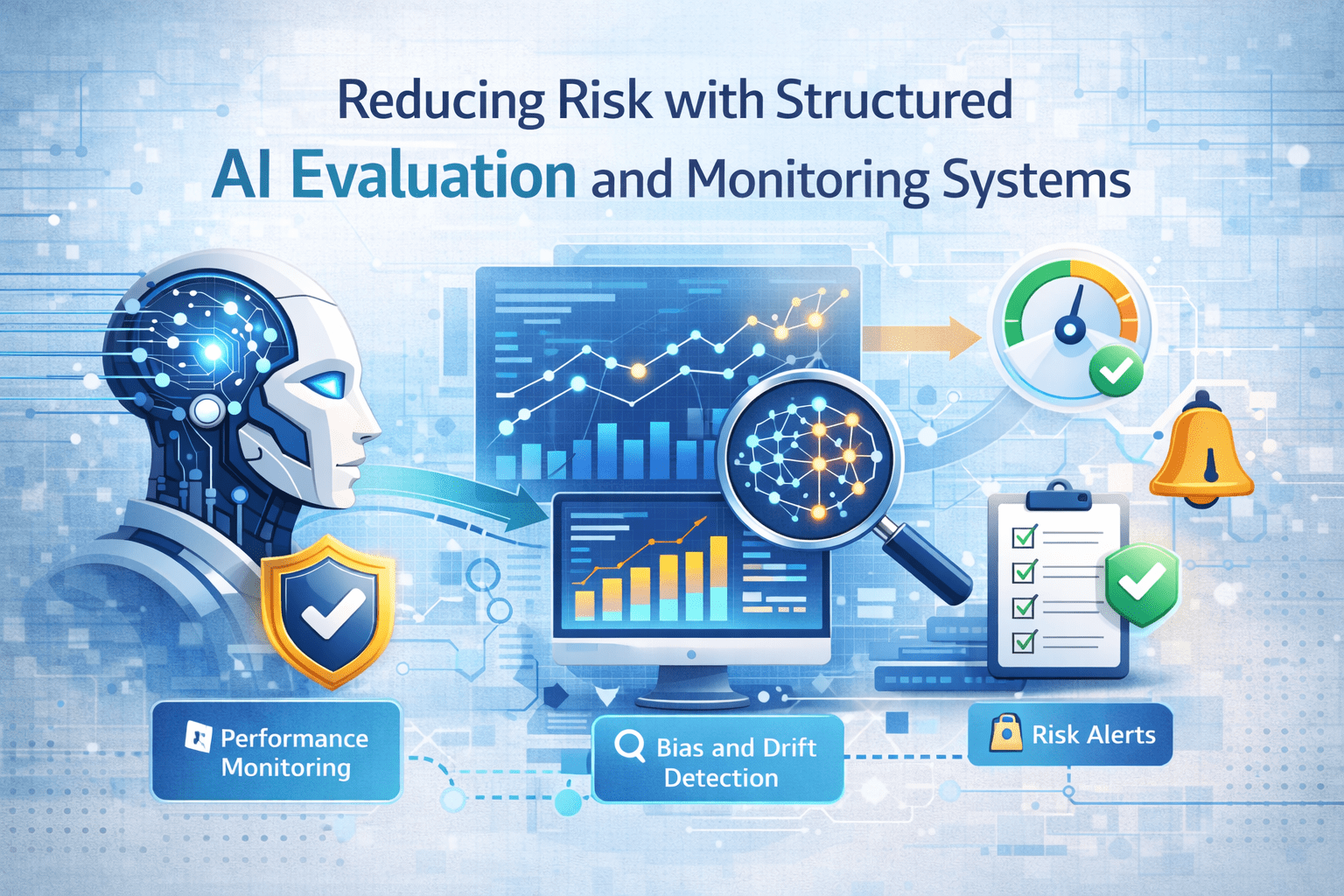
Enterprise AI risk is not primarily a model risk. It is a governance risk — the risk that accumulates when AI systems operate in production without the evaluation and monitoring infrastructure that would detect performance degradation before it becomes an operational incident, a compliance finding, or a customer-facing failure.
The organizations that have experienced significant AI-related operational problems are rarely the ones whose models were fundamentally incapable. They are the ones whose governance infrastructure was insufficient to detect when capable models started producing outputs that fell outside acceptable quality ranges — under new input conditions, after silent model updates, or when workflow requirements evolved past the assumptions the original deployment was validated against.
Structured AI evaluation and monitoring systems are the governance infrastructure that prevents those problems.
Overview
Structured AI evaluation and monitoring systems reduce enterprise AI risk through three mechanisms: detection (identifying quality changes before they create operational or compliance consequences), prevention (maintaining the quality evidence that informs proactive governance decisions), and response (providing the causal information required for effective remediation when quality issues are identified). Each mechanism addresses a different phase of the AI risk lifecycle. Together, they produce the governance posture that transforms AI risk from an unmanaged exposure into a managed operational condition.
- Detection infrastructure identifies performance degradation early — before downstream consequences materialize
- Prevention infrastructure maintains quality evidence that supports proactive governance and avoids the reactive risk management that post-incident investigation requires
- Response infrastructure provides the causal information that reduces remediation time and prevents recurrence
- Compliance infrastructure generates the ongoing evidence that satisfies regulatory AI governance requirements
- Organizational infrastructure defines the human roles, processes, and escalation paths that make technical monitoring systems operationally effective
The 5 Why’s
- Why is AI risk primarily a governance risk rather than a model capability risk? Modern AI models are capable of handling the tasks enterprises deploy them for. The risk is not capability — it is the governance gap between what the model does in production and what the enterprise knows the model is doing. Governance infrastructure closes that gap. Without it, AI operates in a visibility void where risks accumulate undetected.
- Why does early detection produce disproportionate risk reduction compared to rapid response capability? Responding to an AI quality failure after downstream consequences have materialized requires correcting the outputs, addressing the consequences, and remediating the root cause — simultaneously. Detecting the quality change before downstream consequences materialize requires only remediating the root cause. Early detection is not just faster — it is categorically less expensive than rapid response to realized failures.
- Why is quality evidence accumulation a risk reduction practice, not just a governance requirement? Quality evidence that accumulates over time informs governance decisions — whether to expand, restrict, reconfigure, or sunset an AI deployment — based on production evidence rather than on intuition or provider assurances. Organizations with quality evidence make better governance decisions. Those without it make governance decisions in the dark and discover consequences they had insufficient evidence to predict.
- Why do compliance monitoring and AI quality monitoring need to be integrated rather than separate? Compliance and quality are not separate concerns for regulated enterprise AI. Compliance requires specific performance levels, specific safety behaviors, and specific audit evidence. Monitoring that tracks quality metrics independently of compliance requirements may detect quality changes while missing the compliance-specific metrics that determine regulatory exposure. Integrated monitoring tracks both against the thresholds that matter for both dimensions.
- Why is the human governance layer as important as the technical monitoring infrastructure? Technical monitoring systems detect quality changes and generate alerts. They do not make governance decisions, prioritize remediation actions, or communicate with regulatory examiners. Human roles, processes, and escalation paths that translate monitoring outputs into governance actions are what make the technical infrastructure operationally effective. Systems without governance process are instruments without players.
The Structured AI Evaluation and Monitoring System
Detection Infrastructure
- Continuous quality sampling — automated sampling of production outputs against defined quality criteria at intervals appropriate to the deployment’s consequence profile and output volume
- Statistical anomaly detection — statistical methods applied to quality metric time series to identify changes that represent genuine performance shifts rather than normal variation
- Input distribution monitoring — tracking of production input distribution against the baseline established during evaluation, alerting on shifts that predict quality metric changes before they manifest
- Safety incident monitoring — real-time monitoring for safety-specific quality failures — outputs outside safety criteria, adversarial input detection, inappropriate content handling
Prevention Infrastructure
- Baseline documentation — deployment approval quality baselines documented and stored as permanent reference points for ongoing comparison
- Quality evidence archives — evaluation results, production monitoring metrics, and quality incident records retained in organized, accessible archives that support governance review and regulatory examination
- Model change management — evaluation re-execution required before model version changes reach production; change management records document the quality assessment basis for each version deployment decision
Response Infrastructure
- Alert-to-investigation routing — alerts include the context required for initial investigation — current metrics, trend data, recent changes, affected input types — reducing investigation initialization time
- Causal analysis tooling — infrastructure that supports correlation analysis between quality metric changes and potential causal factors: input distribution shifts, model version changes, workflow modifications, infrastructure changes
- Remediation tracking — formal tracking of quality issue remediation from identification through resolution, producing documented evidence of corrective action
Compliance Integration
- Regulatory metric monitoring — compliance-relevant quality metrics tracked against regulatory thresholds rather than just general quality thresholds
- Audit artifact generation — monitoring records formatted and exported as audit artifacts that satisfy regulatory examination evidence requirements without manual assembly
- Compliance reporting — automated generation of compliance-relevant quality evidence reports for regulatory reporting obligations
Organizational Infrastructure
- AI quality ownership — defined human ownership for each AI deployment’s quality monitoring, with accountability for investigation and escalation
- Escalation processes — defined processes for what happens at each alerting tier — who is notified, what investigation is required, what decision authority applies
- Governance review cadence — scheduled governance reviews that incorporate quality monitoring evidence into AI portfolio governance decisions
What Structured Evaluation and Monitoring Produces
- Managed AI risk posture — AI quality is a known, monitored operational condition rather than an unmanaged exposure
- Proactive governance capability — quality trends inform governance decisions before performance reaches threshold-breaching levels
- Regulatory defensibility — documented evaluation and monitoring records satisfy AI governance examination requirements
- Faster remediation — causal information produced by structured monitoring reduces time from detection to root cause identification to corrective action
- Informed expansion decisions — quality evidence supports confident AI deployment expansion rather than cautious restraint based on inadequate performance visibility
Final Takeaway
Structured AI evaluation and monitoring systems are not overhead on AI deployment operations. They are the infrastructure that determines whether AI deployments remain within acceptable risk bounds as production conditions evolve — or drift toward risk conditions that are discovered reactively rather than managed proactively.
The enterprise that builds structured evaluation and monitoring alongside AI deployment capability builds AI operations that are governable, defensible, and scalable. The enterprise that builds capability without governance infrastructure builds exposure that grows proportionally with the capability deployed without oversight.
Build Structured AI Risk Management Infrastructure With Mindcore Technologies
Mindcore Technologies works with enterprise risk, compliance, and AI operations teams to design and implement structured AI evaluation and monitoring systems — detection infrastructure, quality evidence management, response tooling, compliance integration, and organizational governance processes that make enterprise AI risk a managed operational condition.
Talk to Mindcore Technologies About Structured AI Risk Management →
Contact our team to assess your current AI risk posture and build the evaluation and monitoring infrastructure that brings it within governed bounds.

