

The history of enterprise access control is a history of adding controls to architectures that were not designed for them. Firewalls were added to networks. VPNs were added to remote access. MFA was added to authentication systems that were built for passwords. DLP was added to endpoints after data was already on them. The controls are real. Their effectiveness is limited by the architecture they were added on top of — an architecture that was designed for a threat model that no longer exists and a workforce model that no longer describes how enterprises operate.
The future of enterprise access control is not more controls added to the same architecture. It is a different architectural model — one where access control is identity-driven at the foundation, where infrastructure is invisible to unauthorized entities by design, and where access scope is enforced architecturally rather than maintained through policies that require manual verification to produce compliant behavior.
That future is not a roadmap item. It is ShieldHQ Powered by Dispersive® Stealth Networking, deployed today, in enterprises that have made the architectural decision to stop adding controls to a failing model and start operating on a model designed for the environment they actually face.
Overview
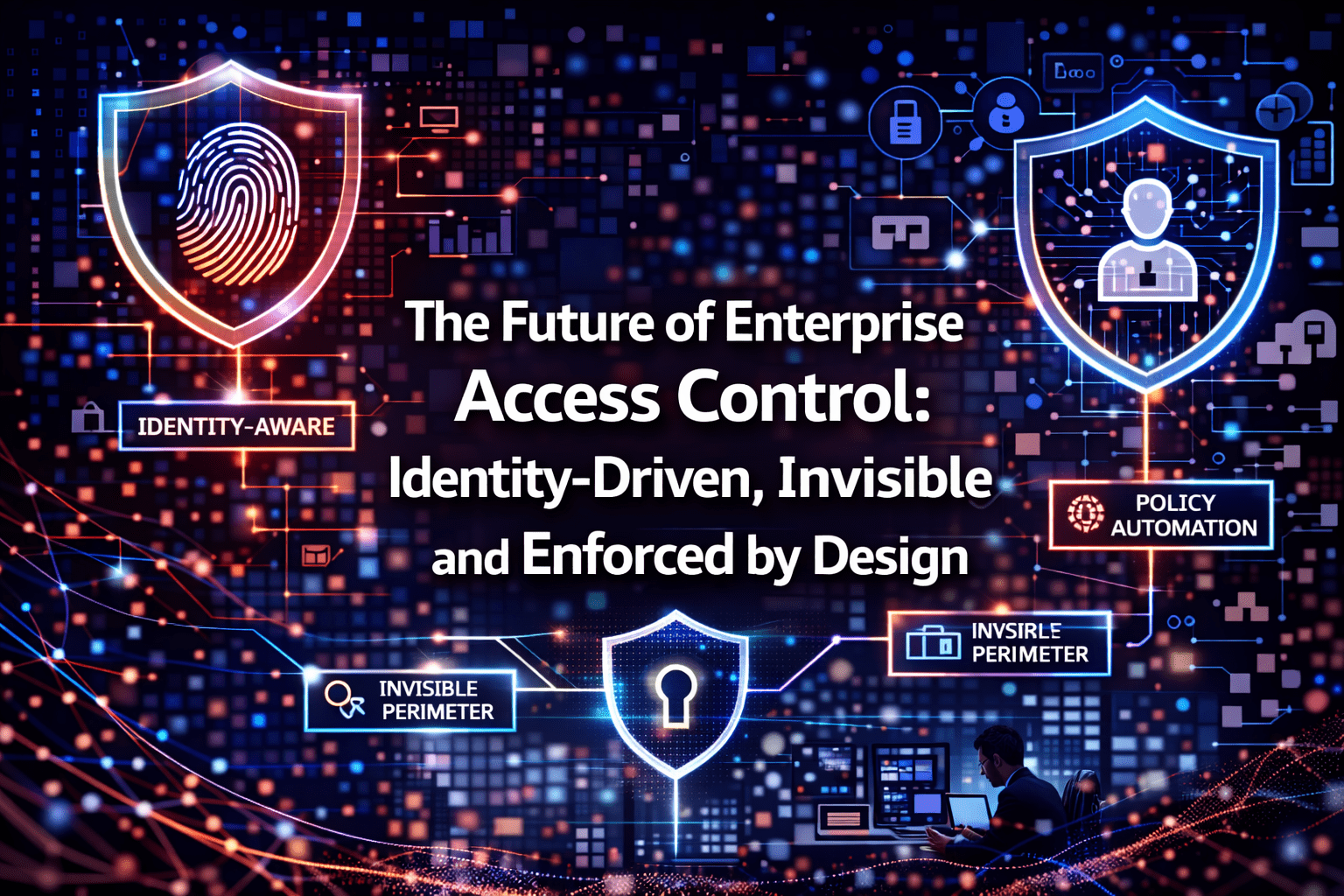
The future of enterprise access control has three defining characteristics that distinguish it from current-state architectures: identity as the primary trust anchor (replacing network location and device ownership as trust signals), infrastructure invisibility (systems are unreachable and undiscoverable by default), and design-enforced access (compliance is a property of the architecture, not a result of policy adherence monitoring). ShieldHQ operationalizes all three today. The organizations deploying it now are not early adopters of an emerging technology — they are early operators of the architectural model that will define enterprise access control for the next decade.
- Identity as trust anchor: access decisions are based on verified identity and role, not network position
- Infrastructure invisibility: systems do not exist from the perspective of unauthorized entities
- Design enforcement: access controls are architectural — they do not depend on policy compliance or monitoring catch
- Continuous verification: every session is re-verified against current authorization state, not just at initiation
- The architectural shift is permanent: organizations that make this transition do not return to perimeter-trust models
This aligns with modern cybersecurity strategies and enterprise security evolution.
The 5 Why’s
Why is identity the only reliable trust anchor in modern enterprise environments?
Network location is not a reliable trust signal — users work from home offices, hotels, and client sites. Device ownership is not reliable — BYOD, contractor devices, and endpoint compromise all undermine device-based trust. The only signal that reliably represents authorization to access enterprise resources is verified identity — who the user is, what role they hold, and whether their current authorization state permits the requested access. ShieldHQ builds the access model entirely on identity, which is the only trust signal that holds across the full range of access scenarios enterprises actually encounter.
Why does infrastructure invisibility represent a permanent architectural advance rather than a temporary security measure?
Making systems invisible to unauthorized entities removes the reconnaissance stage from every attack type that depends on it — which is most of them. Reconnaissance is not a VPN-era problem; it is a network-architecture problem. As long as systems respond to probes from any network-connected entity, they provide targeting information that sophisticated attackers use. ShieldHQ’s invisibility model does not have a patch or workaround — systems that do not respond to unauthorized discovery cannot be discovered by unauthorized entities, regardless of future attack technique evolution.
Why is design enforcement more durable than policy compliance monitoring for maintaining access control?
Policy compliance monitoring catches non-compliant behavior after it occurs — and only when monitoring is comprehensive, accurate, and timely. Design enforcement prevents non-compliant behavior by making it architecturally impossible. An employee who cannot download sensitive data from a secure workspace because the architecture prevents it is not a compliance risk regardless of their intent. An employee who can download sensitive data but is monitored for doing so is a compliance risk that monitoring is trying to manage. Design enforcement is more durable because it does not depend on monitoring quality, analyst availability, or response speed.
Why does continuous re-verification represent the access control model that threat evolution requires?
Static verification — verify once at authentication, trust for the session duration — was appropriate when sessions were short, networks were small, and credential theft was less common. Modern threats involve long-duration sessions, sophisticated credential abuse, and session hijacking techniques that operate after initial verification. Continuous re-verification — ShieldHQ evaluating access authorization throughout the session, not just at initiation — is the access control model that reflects how modern attacks operate and the access assurance that modern compliance requirements are beginning to demand.
Why are organizations that make this architectural transition now positioned better than those that wait?
Early architectural transitions produce compounding advantages: operational maturity with the new model, institutional knowledge about deployment and governance, and security posture improvement that compounds over time as the architecture eliminates risks that legacy architecture continuously regenerates. Organizations that wait deploy the same transition later, at higher implementation cost because legacy infrastructure is more deeply embedded, with less time to build operational maturity before regulatory requirements mandate the model.
What the Future Architecture Looks Like Operationally
For Users
- Authorized users access their applications through a verified session that initiates quickly and performs consistently
- They do not manage VPN connections, certificate renewals, or connectivity troubleshooting
- Access is the same from any device, any location, any network — the session is governed by identity, not by infrastructure configuration
For Security Teams
- Every access event is logged at the session level with full identity, device, and action attribution
- Behavioral monitoring surfaces anomalies during sessions rather than in post-event log review
- Incident response is session termination followed by targeted investigation — not organization-wide shutdown followed by broad remediation
For Compliance and Audit Functions
- Access controls are enforced architecturally — compliance is not dependent on monitoring
- Audit evidence is generated continuously — assessment preparation does not require evidence compilation
- Compliance posture is demonstrable at any time — not just at the end of an assessment cycle
Where Enterprises Are in the Transition
- Early adopters (current): enterprises that have made the architectural decision and are building operational maturity — primarily regulated industries, large financial services, and security-mature technology companies
- Active evaluators (near-term): enterprises that have assessed legacy architecture limitations and are in procurement and planning — driven by compliance requirements, incident experiences, and cost analyses
- Late transition (medium-term): enterprises that will transition when regulatory requirements mandate the architecture or when a significant incident makes the legacy architecture cost undeniable
Final Takeaway
The future of enterprise access control is not VPN with better monitoring. It is identity-driven, infrastructure-invisible, and design-enforced access that treats the current threat model as the baseline rather than as a future contingency to plan for. ShieldHQ delivers that architecture today. The organizations deploying it are not betting on the future — they are operating on the model that the present threat landscape demands and that the regulatory trajectory is moving toward. The architectural decision is available now. The compounding advantage of making it belongs to the organizations that make it first.
This reflects the shift toward modern enterprise security architecture built for evolving threats and global operations.
Build the Future of Access Control With ShieldHQ Through Mindcore Technologies
Mindcore Technologies works with enterprise security and IT leadership to design and implement ShieldHQ as the access control architecture of record — identity-driven access design, infrastructure invisibility implementation, session behavioral governance, and compliance evidence infrastructure that positions organizations at the leading edge of the architectural transition underway in enterprise security.
Learn how ShieldHQ Powered by Dispersive® Stealth Networking enables next-generation access control.
Schedule your free strategy call to evaluate your current architecture and plan your transition.

