

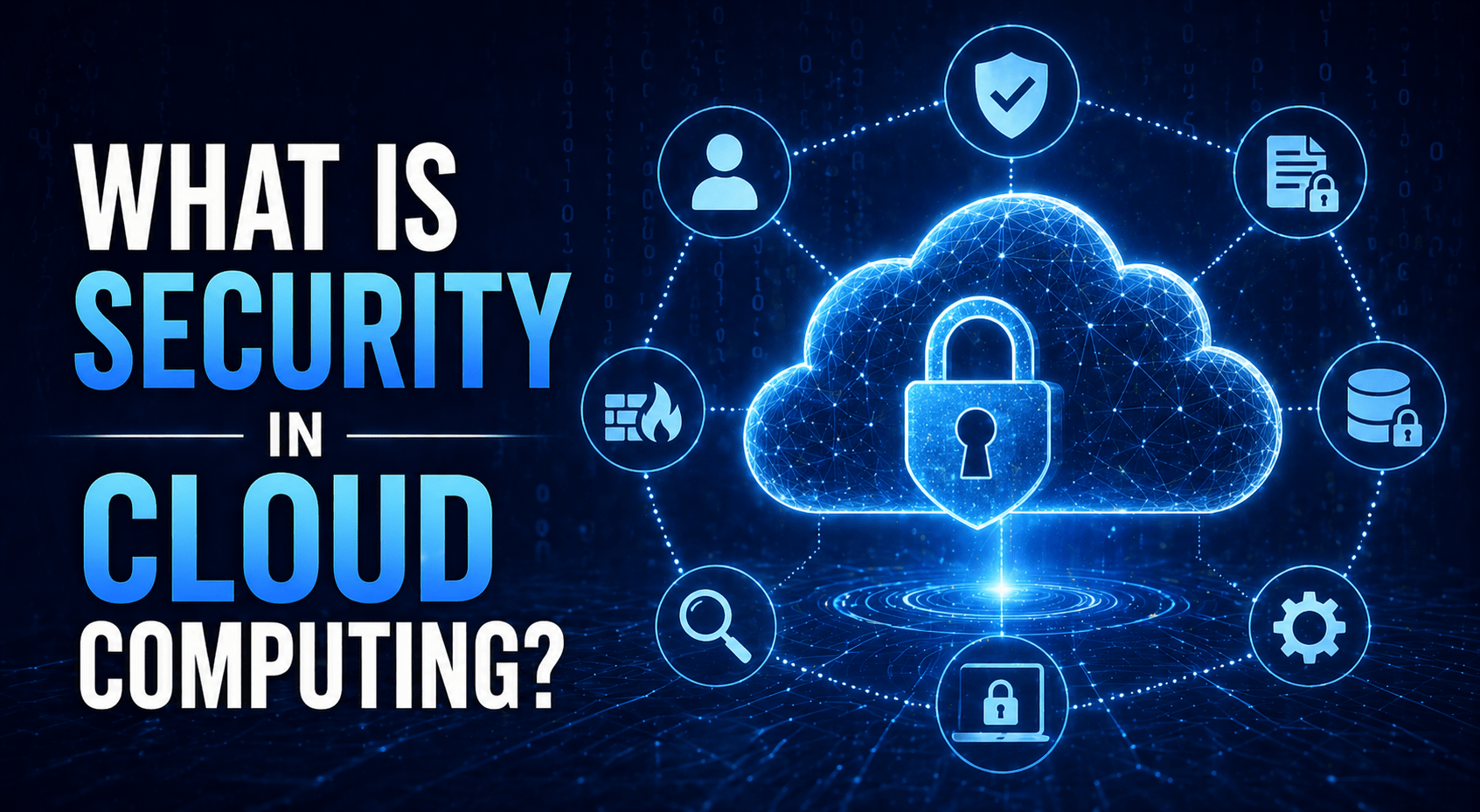
Security in cloud computing is the collection of practices, technologies, and controls that protect data, applications, infrastructure, and users in cloud environments from unauthorized access, data breaches, service disruptions, and compliance failures. It applies to everything from how users authenticate to cloud services, to how sensitive data is encrypted in cloud storage, to how anomalous activity is detected and responded to.
What makes cloud security distinct from traditional IT security is the environment it operates in: cloud infrastructure is internet-accessible, multi-tenant, and managed through software configuration rather than physical controls. Those characteristics require security approaches that are adapted to the cloud environment rather than transplanted from on-premises security models.
Overview
Security in cloud computing is not a single control or a single responsibility — it is a multi-layer discipline that addresses physical infrastructure security (managed by the provider), identity and access management (primarily customer responsibility), network security configuration (shared), data protection (customer responsibility), and threat detection and response (shared, with significant customer-managed components). Effective cloud security requires all of these layers to be addressed; weakness in any one creates an exploitable gap.
- Physical infrastructure security is the provider’s responsibility and is strong in enterprise cloud platforms
- Identity security is the highest-impact customer responsibility — compromised credentials are the dominant attack vector in cloud environments
- Data encryption protects sensitive data from exposure even if storage is accessed improperly
- Network security configuration limits exposure of cloud resources to the internet
- Threat detection and response requires active monitoring — secure configuration alone is insufficient
The 5 Why’s
- Why is cloud security often described as “different” from traditional IT security rather than just “the same principles in a new environment”? The attack surface in cloud environments is different: users authenticate from anywhere on the internet rather than from within a controlled network, infrastructure is configured through APIs rather than physical changes, and the shared responsibility model means that the security posture depends partly on vendor configuration and partly on customer configuration. Traditional perimeter-based security models do not translate directly; cloud security requires identity-centric, configuration-aware approaches.
- Why is identity specifically the primary attack surface in cloud environments? Traditional attacks often targeted network vulnerabilities — finding a path through the perimeter. Cloud environments are internet-accessible; the path to resources goes through identity authentication rather than network entry. Attackers who compromise credentials get authenticated access to whatever those credentials authorize. Phishing, credential stuffing, MFA bypass, and token theft are the dominant attack methods against cloud environments because identity is the primary access control mechanism.
- Why does security configuration matter specifically in cloud environments in a way that is different from on-premises? On-premises security involves physical controls and network-layer controls that are relatively stable — you configure a firewall, and it stays configured unless someone physically changes it. Cloud security configuration is software-defined and can be changed quickly — which also means it can be changed incorrectly or drift from the secure baseline as new resources are added and configuration changes are made. Security configuration in cloud environments requires ongoing verification rather than point-in-time setup.
- Why is zero trust specifically the correct security model for cloud environments rather than perimeter-based security? Perimeter-based security assumes that entities inside the network are trusted. Cloud environments have no reliable perimeter — users access from anywhere, resources are accessed from everywhere, and “inside the network” is not a meaningful security boundary. Zero trust — verify every access request explicitly, grant least privilege, assume breach — is designed for exactly this environment. Cloud security frameworks built on zero trust principles are more effective because they match the actual access model.
- Why does continuous monitoring specifically matter in cloud environments even after secure configuration is established? Security configurations can be changed by administrators, new resources can be provisioned with incorrect settings, and attackers who gain partial access can attempt to escalate or move laterally. Security monitoring detects the behavioral signals of these events — anomalous sign-ins, unusual resource access, configuration changes, data access patterns outside the norm. Secure configuration reduces the probability of incidents; monitoring reduces the impact by enabling early detection and response.
The Layers of Cloud Security
Physical Security Layer
Managed entirely by the cloud provider. Data centers with multi-factor physical access, environmental controls, 24/7 surveillance, and strict personnel access policies. Customers have no visibility into or responsibility for this layer.
Identity and Access Layer
The most critical customer-managed security layer in cloud environments:
- Multi-factor authentication for all user accounts
- Conditional access policies that enforce context-based access decisions (is the device compliant? is the location expected? is the sign-in risk low?)
- Role-based access control with least privilege — users have the minimum permissions required
- Privileged identity management — administrative access is time-bound and requires justification
- Guest and external access management — external users are governed by defined policies
Network Security Layer
Controls that limit exposure of cloud resources:
- Virtual network security groups restricting traffic to required protocols and sources
- Private endpoints for cloud services that should not have public internet exposure
- Azure Firewall or network virtual appliances for traffic inspection and logging
- DDoS protection for internet-facing services
Data Security Layer
Controls that protect sensitive data:
- Encryption at rest for storage, databases, and virtual machine disks
- Encryption in transit (TLS) for all communications
- Data classification and sensitivity labeling
- Data Loss Prevention policies that prevent inappropriate sharing
- Key management practices — control over encryption keys
Application Security Layer
Security controls for applications deployed on cloud infrastructure:
- Secure development practices — input validation, dependency management, authentication implementation
- Web Application Firewall for internet-facing applications
- API authentication and authorization controls
- Regular vulnerability scanning and patching
Monitoring and Response Layer
Continuous visibility into the security state of the cloud environment:
- Microsoft Defender for Cloud: security posture management and threat protection
- Microsoft Sentinel or equivalent SIEM: event correlation and detection
- Activity logs for all Azure resource changes and administrative actions
- Alert configuration for anomalous activity
- Defined incident response procedures
Final Takeaway
Security in cloud computing is a practice, not a feature. It requires understanding what the provider secures and what the customer must secure, configuring the customer-managed controls correctly, and monitoring the environment continuously to detect threats and configuration drift. Organizations that treat cloud security as a practice produce cloud environments that are genuinely secure. Those that treat it as a one-time setup task discover the gaps when they are exploited.
Implement Comprehensive Cloud Security With Mindcore Technologies
Mindcore Technologies implements and manages cloud security for Azure and Microsoft 365 environments — identity controls, network security configuration, data protection, and continuous monitoring that addresses all layers of cloud security responsibility.
Talk to Mindcore Technologies About Cloud Security →
Contact our team for a comprehensive cloud security assessment and implementation plan.

