

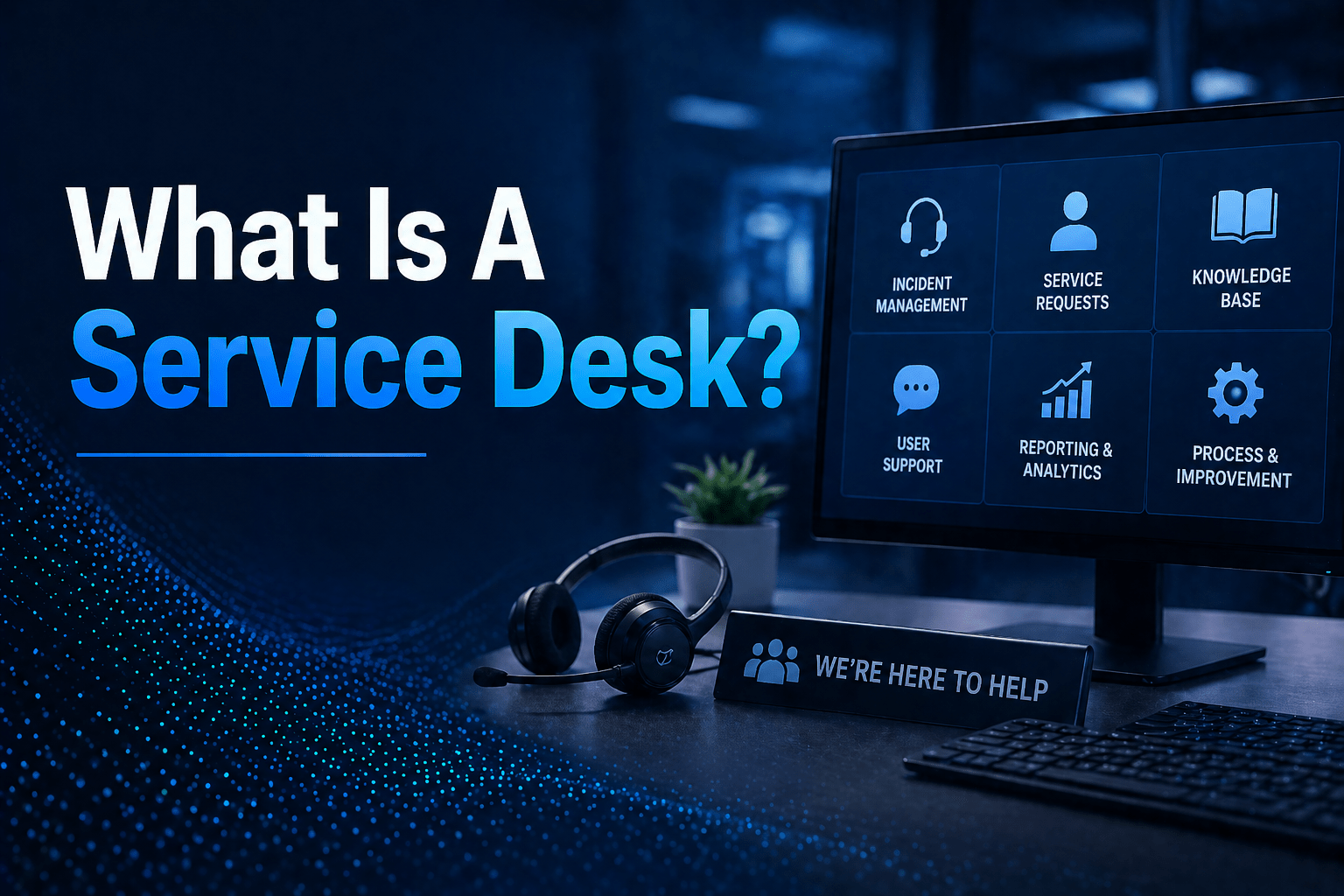
A service desk is the centralized point of contact between an IT organization and the people it supports. It handles incident resolution, service requests, change communications, and user guidance — operating as the operational hub of IT service delivery rather than just a reactive problem-solving function.
The distinction between a service desk and a help desk is meaningful in IT frameworks: a help desk focuses on reactive incident resolution. A service desk extends that scope to include proactive service management — fulfilling requests, communicating about changes and outages, managing the full lifecycle of IT interactions, and feeding information back to improve the overall service.
For businesses using managed IT services, the service desk is the operational center of the managed IT relationship — the team and system through which most day-to-day interactions flow.
Core Service Desk Functions
Incident Management
When IT services fail or degrade, the service desk manages the incident lifecycle: detection (through monitoring or user report), triage, assignment, escalation if needed, resolution, and communication throughout. For major incidents affecting multiple users, the service desk coordinates the response and keeps stakeholders informed.
Service Request Management
Service requests are routine operational asks — new user provisioning, access changes, software installation, hardware orders. Unlike incidents, these are expected activities that should be fulfilled through a standard process. The service desk manages fulfillment, tracks completion, and communicates status.
Change Management Support
When IT changes are made — system upgrades, configuration changes, new service rollouts — the service desk communicates those changes to affected users and manages the coordination between the technical team and the business.
Knowledge Management
A mature service desk maintains a knowledge base: documented solutions to common issues, how-to guides for users, and internal procedures for technicians. This knowledge base reduces resolution time (technicians can reference proven solutions), reduces repeat contacts (users can self-serve common issues), and preserves operational knowledge when staff changes occur.
Problem Management
The service desk identifies patterns in incidents — recurring issues that point to an underlying problem rather than isolated failures. Feeding those patterns into a problem management process prevents repeat incidents rather than just resolving them individually.
Service Desk vs. Help Desk: The Practical Distinction
In practice, many organizations use these terms for the same function. In formal IT frameworks (ITIL), the distinction is:
| Help Desk | Service Desk |
|---|---|
| Reactive incident resolution | Incident + service requests + change communication |
| Focused on fixing problems | Focused on managing the full IT service experience |
| Tactical | Strategic and tactical |
For businesses evaluating managed IT providers, the question is not which term the provider uses — it is whether they cover the full scope of functions the service desk concept implies.
Final Takeaway
A service desk is the operational center of IT service delivery — not just a problem queue. Organizations that have a well-run service desk experience IT as a managed, predictable function. Organizations with only a reactive help desk experience IT as a series of problems to be solved.
Service Desk Capabilities From Mindcore Technologies
Mindcore’s IT support services are built around a mature service delivery model covering incident management, service requests, and proactive communication. Part of our broader managed IT services engagement.

