

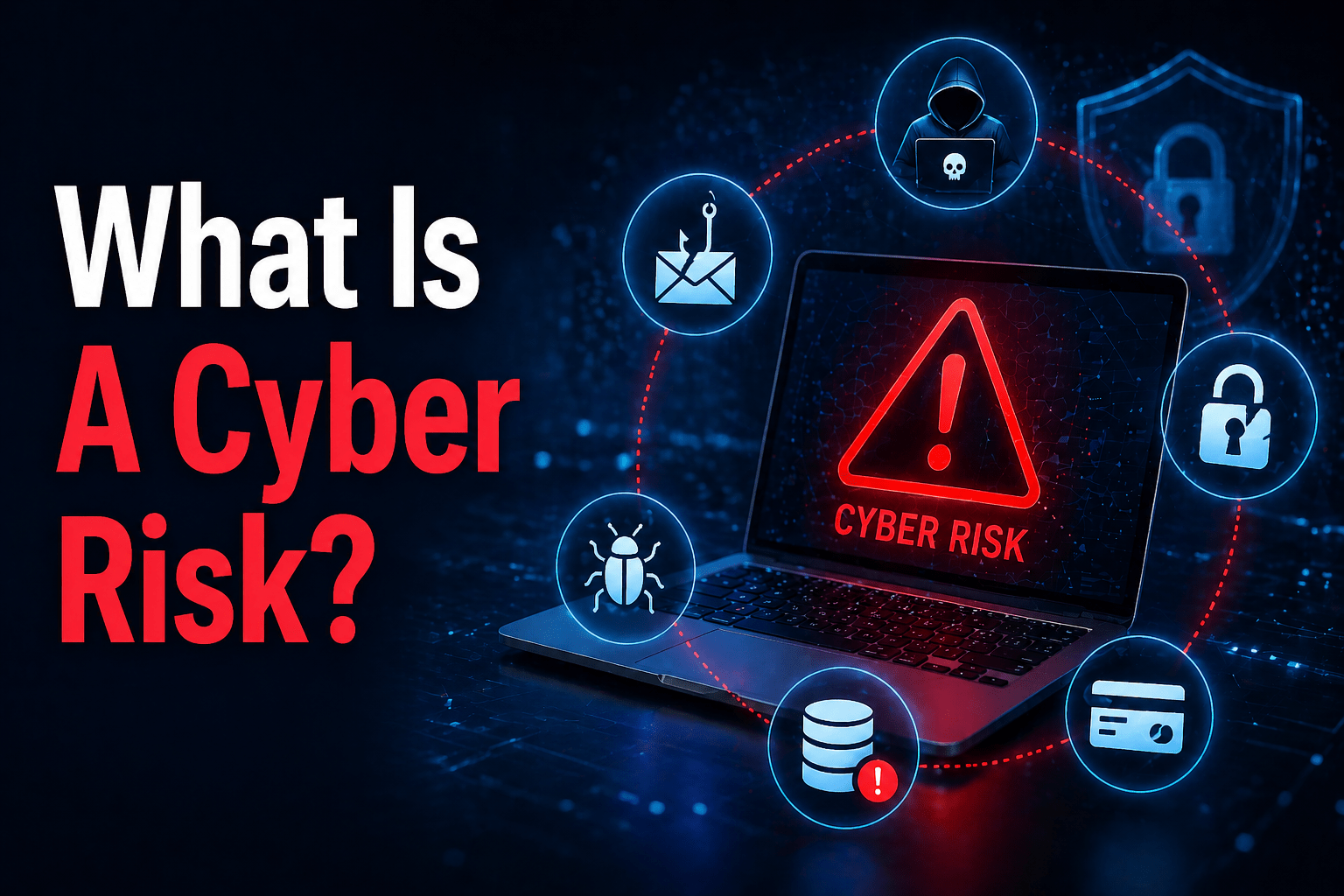
A cyber risk is any potential event or condition that could cause harm to an organization through its digital systems, networks, data, or technology-dependent operations. It encompasses threats from external attackers, internal errors, system failures, and third-party vulnerabilities — anything that could compromise the confidentiality, integrity, or availability of the organization’s digital assets.
Cyber risk is not the same as a cyberattack. A risk is the potential for harm; an attack is one specific type of event that can realize that potential. Unpatched software is a cyber risk — it may or may not be exploited. An employee who has never been trained to recognize phishing is a cyber risk. A cloud storage bucket with default public settings is a cyber risk. The attack is what happens when a threat actor finds and exploits one of those risks.
Understanding cyber risk clearly is the prerequisite for managing it. Organizations that frame all cybersecurity concerns as “will we be attacked?” miss the more actionable question: “what risks do we currently carry, and which ones are we going to address?”
For businesses assessing their current exposure, a cybersecurity assessment maps the risk landscape so investment can be directed at the risks that matter most.
Overview
Cyber risk includes any source of potential harm to digital systems, data, or operations. The major categories are threat-based risks (attacks by external actors), vulnerability-based risks (weaknesses in systems or processes that could be exploited), operational risks (failures in IT processes or controls), and third-party risks (exposure through vendors, partners, or service providers). Each requires different management approaches.
- External threats: ransomware, phishing, credential attacks, supply chain compromise
- Vulnerability risks: unpatched systems, misconfiguration, weak access controls
- Operational risks: human error, process failures, insider actions
- Third-party risks: vendor access, supply chain compromise, partner data exposure
- Risk = likelihood of the event x impact on the organization
The 5 Why’s
- Why is cyber risk defined as a probability-impact combination rather than just the threat itself? Because not every threat represents equal risk to every organization. A ransomware threat is high risk for an organization without tested backups and a low-risk scenario for one with isolated, tested recovery infrastructure. The same threat has different risk levels depending on the organization’s vulnerability and the potential impact. Defining risk as probability times impact allows organizations to prioritize accurately.
- Why does cyber risk include internal and operational sources, not just external attacks? Because a significant share of security incidents result from internal mistakes, misconfiguration, and process failures rather than sophisticated external attacks. An employee who accidentally sends sensitive data to the wrong recipient, a system administrator who configures a cloud service with excessive permissions, or a departing employee whose access is not revoked on time — these are cyber risks that realize into incidents without any attacker involvement.
- Why does third-party risk deserve specific attention as a category? Because the organization’s security perimeter extends to every vendor, partner, and service provider with access to its systems or data. A breach at a payroll provider, a managed IT vendor, or a cloud platform affects the organizations that rely on them. Third-party risk management — understanding who has access, what controls they maintain, and what the exposure is if they are compromised — is a required component of a complete risk picture.
- Why is the absence of a breach not evidence of low cyber risk? Because most cyber risks are invisible until they are exploited. An unpatched vulnerability is a risk whether or not an attacker has found it yet. Misconfigured cloud storage is a risk whether or not anyone has accessed it. The absence of a breach reflects luck, timing, and the fact that no attacker has yet targeted that specific exposure. It does not reflect a low-risk environment.
- Why does cyber risk require ongoing management rather than one-time assessment? Because the factors that determine risk level change continuously. New vulnerabilities are discovered. New systems are deployed. Employee turnover changes access patterns. Vendors change their own security posture. A risk assessment that is not refreshed becomes inaccurate over time, and inaccurate risk understanding leads to misallocated security investment.
Types of Cyber Risk in Business Environments
Data breach risk: the risk that sensitive data — customer information, financial records, employee data, intellectual property — is accessed, exfiltrated, or exposed without authorization. Data breach risk is elevated for organizations holding regulated data under HIPAA, PCI-DSS, or similar frameworks.
Operational disruption risk: the risk that an attack or system failure interrupts business operations. Ransomware is the most common cause, but DDoS attacks, hardware failures, and system compromises can also disrupt operations. For businesses where downtime directly means lost revenue, this is often the highest-impact cyber risk category.
Financial risk: direct financial losses from fraud, theft, ransomware payments, and recovery costs. The 2024 theft of over $2 million from the City of Tallahassee through vendor impersonation fraud illustrates how financial cyber risk materializes through social engineering rather than just technical attacks.
Reputational risk: damage to customer trust, brand reputation, and business relationships resulting from a security incident. For businesses in professional services — legal, accounting, healthcare — reputational damage from a breach can produce client attrition that outlasts the technical recovery.
Compliance risk: regulatory penalties, legal liability, and audit findings resulting from security failures. Organizations in regulated industries that fail to maintain required security controls face penalties that compound the financial impact of an incident.
Final Takeaway
A cyber risk is any source of potential harm through digital systems or processes. It includes external attacks, internal vulnerabilities, operational failures, and third-party exposures. Managing it requires understanding the specific risks present in the organization’s environment, prioritizing by probability and impact, and applying controls that address the most significant exposures first.
Cyber Risk Assessment and Management — Mindcore Technologies
Mindcore’s cybersecurity services include comprehensive risk assessment that maps your specific risk landscape rather than applying generic controls. Our managed IT services maintain the controls that reduce your most significant risks on an ongoing basis.

