

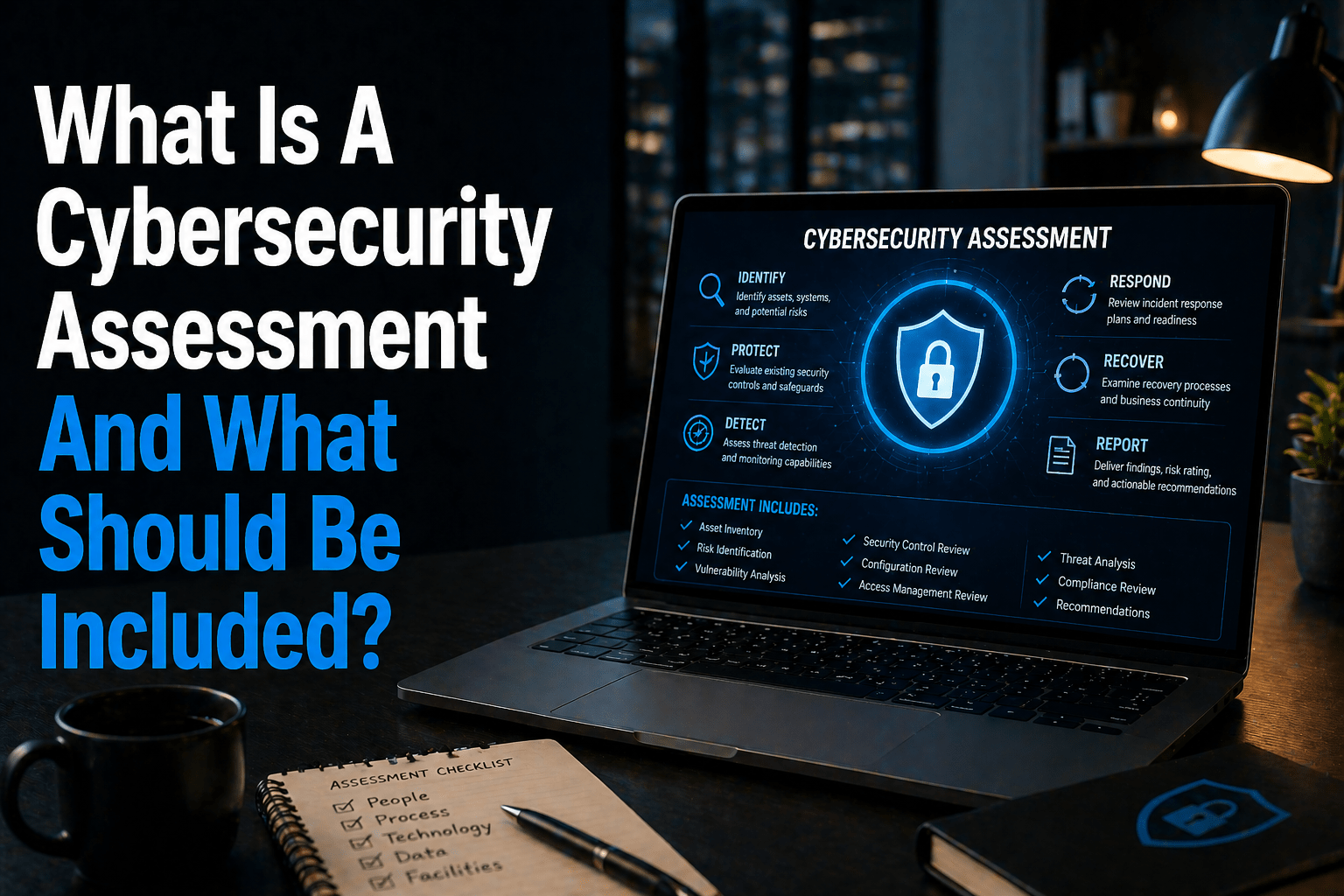
A cybersecurity assessment is a structured evaluation of an organization’s current security posture — identifying vulnerabilities, gaps in controls, and risks that could be exploited before they are. It is the diagnostic step that precedes effective security investment: without knowing where the exposure is, security spending is directed by assumption rather than evidence.
The value of a cybersecurity assessment is not the report it produces. It is the prioritized understanding of which risks are most likely and most impactful, enabling the organization to address the most significant exposures first rather than working through a generic best-practices checklist that may not reflect its specific risk profile.
For businesses building or improving their security program, cybersecurity services that begin with an assessment produce better outcomes than those that begin with product recommendations.
Overview
A cybersecurity assessment examines the organization’s technology environment, security controls, policies, human practices, and compliance posture against a defined standard or framework. The output is a prioritized inventory of findings: what is exposed, how significant each exposure is, and what remediation is recommended. Quality assessments also include an executive summary that communicates risk in business terms alongside the technical findings.
- Scope: network, endpoints, cloud platforms, identity management, data handling, policies, and human practices
- Methodology: interviews, documentation review, automated scanning, and manual testing
- Output: prioritized findings with risk ratings, remediation recommendations, and executive summary
- Framework alignment: findings mapped to relevant standards (NIST, CIS, HIPAA, PCI-DSS as applicable)
- Follow-up: remediation planning and progress tracking against findings
The 5 Why’s
- Why is a cybersecurity assessment the starting point rather than a later step in security program development? Because security investment without assessment is directionally uninformed. Every organization’s risk profile is specific to its technology environment, industry, data types, and operational patterns. Generic best practices do not address specific vulnerabilities. An assessment identifies the specific vulnerabilities that exist in the specific environment and enables investment to be directed at what actually matters.
- Why should the assessment scope include human practices alongside technical controls? Because the majority of successful attacks begin with human action: clicking phishing links, mishandling data, using weak passwords, ignoring security prompts. An assessment that examines only technical controls without assessing the human practices that enable or undermine them produces an incomplete picture. A complete assessment examines training coverage, awareness levels, and behavioral patterns alongside firewall rules and patch levels.
- Why does the assessment output need to be risk-prioritized rather than just a comprehensive list? Because no organization has unlimited resources to address every finding simultaneously. A prioritized output — ordered by likelihood and impact — enables the organization to make evidence-based decisions about sequencing remediation. Addressing the highest-risk findings first produces the most significant risk reduction per dollar and hour invested.
- Why should the assessment include framework alignment? Because many organizations operate under compliance requirements — HIPAA, PCI-DSS, SOC 2, CMMC — that specify required controls. An assessment that maps findings to those frameworks simultaneously addresses security gaps and compliance gaps, making remediation work serve both purposes rather than requiring separate compliance and security assessments.
- Why does a cybersecurity assessment require periodic repetition rather than one-time execution? Because the environment it assesses changes. New systems are deployed. New vulnerabilities are discovered. Personnel changes alter access patterns. Vendors are added. Each change potentially introduces new findings that the previous assessment would not have captured. Annual reassessment at minimum, with more frequent assessment after significant environment changes, maintains accurate risk understanding over time.
What a Quality Cybersecurity Assessment Should Include
Network Security Review
Examination of the network architecture, firewall rules, network segmentation, wireless security, and monitoring configuration. Network scanning to identify exposed services, open ports, and connected devices that may not be known or managed. Assessment of whether the network’s structure limits the blast radius of a successful attack or enables lateral movement.
Endpoint Security Assessment
Review of endpoint protection deployment, patch management status, device management configuration, and the security posture of endpoints across the environment. Assessment of whether all devices are covered, whether protection is current, and whether devices that are not managed by the organization (personal devices, contractor systems) have appropriate access restrictions.
Identity and Access Management Review
Assessment of user account management, access control policies, privilege management, MFA enforcement, and offboarding procedures. Review of whether access follows least-privilege principles, whether service accounts are appropriately controlled, and whether former employees’ access has been properly revoked.
Cloud and SaaS Security Review
Assessment of cloud platform configurations — Microsoft 365, Azure, AWS, and other platforms in use. Review of sharing settings, external access permissions, MFA enforcement, audit logging, and data residency controls. Cloud misconfigurations are among the most common sources of data exposure.
Data Security Assessment
Review of data classification practices, encryption implementation, data handling procedures, and backup and recovery testing. Assessment of where sensitive data resides, who has access to it, and whether the controls protecting it are proportionate to its sensitivity.
Policy and Governance Review
Assessment of whether documented security policies exist, whether they are current, and whether they are enforced. Review of incident response plan, business continuity and disaster recovery plans, and vendor management procedures.
Human Security Assessment
Review of security awareness training coverage, content currency, and effectiveness measurement. Assessment of whether phishing simulation is conducted and whether results are used to improve training.
Compliance Gap Analysis
For regulated organizations: mapping current security controls against the specific requirements of applicable frameworks — HIPAA, PCI-DSS, SOC 2, CMMC, or state data protection laws — identifying gaps that require remediation for compliance.
Using Assessment Results
The assessment report is the beginning of the remediation work, not the end of the engagement. A prioritized remediation plan translates findings into a sequenced action plan: which findings to address first, by whom, on what timeline, and with what resources. Progress tracking against that plan confirms remediation is completed and validates that findings are actually resolved rather than acknowledged.
IT consulting services that support remediation planning alongside the assessment produce better outcomes than assessments delivered and left for the client to interpret independently.
Final Takeaway
A cybersecurity assessment is the diagnostic step that enables evidence-based security investment. It identifies specific vulnerabilities in the specific environment, prioritizes them by risk, and maps them to compliance requirements where applicable. The result is a prioritized remediation plan that directs security investment at the exposures that matter most rather than the ones on a generic best-practices list.
Cybersecurity Assessments From Mindcore Technologies
Mindcore’s cybersecurity services include comprehensive security assessments for businesses across Louisiana and beyond. Our assessments cover the full scope outlined above and produce prioritized findings with remediation recommendations that our IT consulting team can help implement.
Talk to Mindcore Technologies About a Cybersecurity Assessment

