

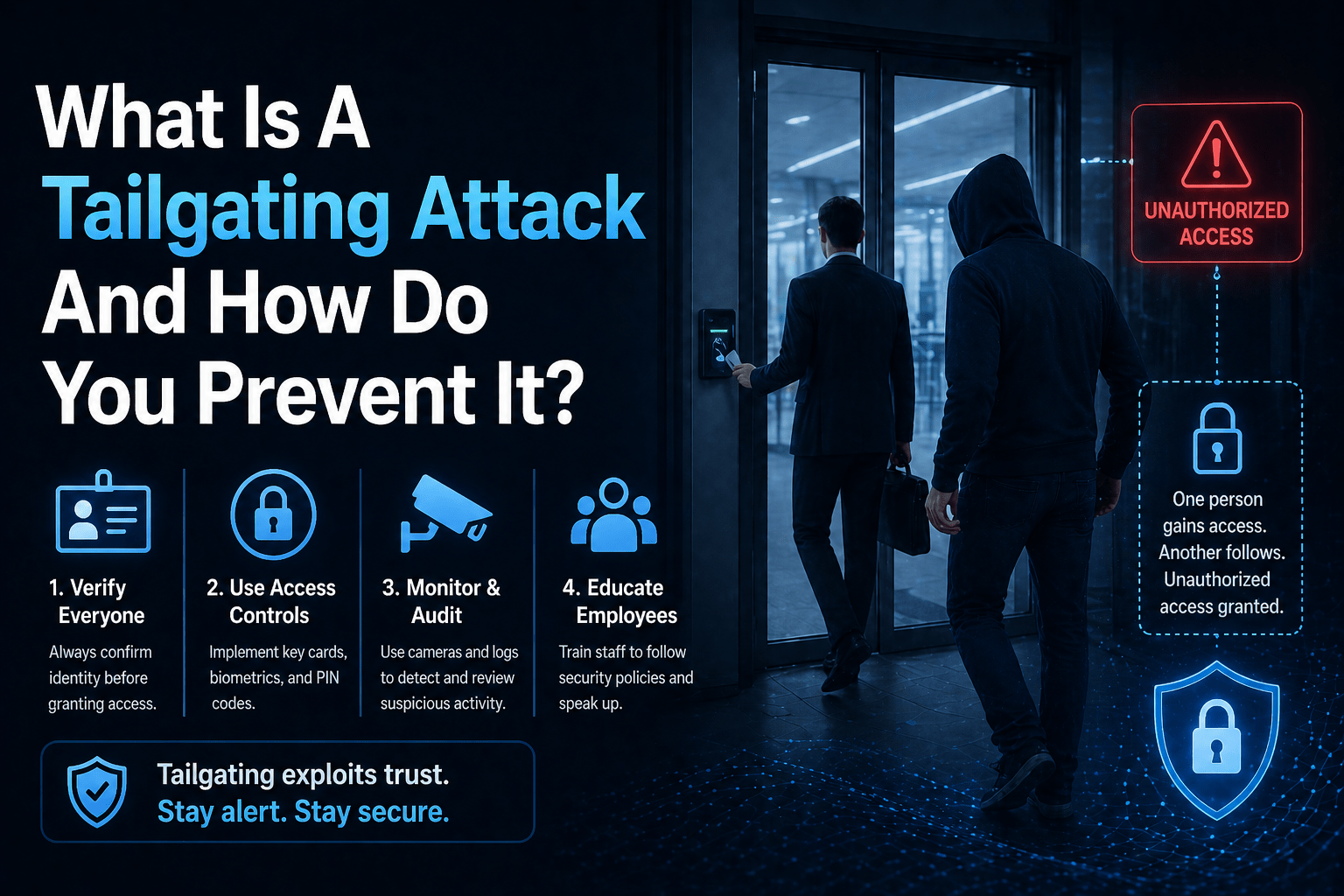
A tailgating attack — also called piggybacking — is a physical security breach in which an unauthorized person gains access to a restricted area by following an authorized person through a secured entry point. The attacker exploits social norms: most people hold doors open for others, feel uncomfortable challenging someone who looks like they belong, and do not want to appear rude or suspicious by questioning someone’s right to enter.
Tailgating is one of the most underappreciated attack vectors in cybersecurity because it is simultaneously a physical security issue and a digital security issue. An attacker who gains physical access to a facility can access unlocked computers, install hardware keyloggers, plug USB devices into internal network ports, steal devices and documents, or gain access to server rooms and networking equipment. Physical security breaches enable digital breaches.
For businesses with managed IT services handling network and system security, physical security of the environments those systems operate in is the necessary complement that technical controls cannot replace.
Overview
Tailgating works because humans are social — designed to follow social norms of courtesy and to avoid the discomfort of challenging others. The attacker appears to belong: they may be dressed professionally, carrying equipment, or simulating a plausible context (food delivery, IT vendor, facilities maintenance). They time their approach to coincide with an authorized person’s entry. The authorized person, operating on social autopilot, holds the door.
- Tailgating bypasses electronic access control through human courtesy
- The attacker requires no credentials — only plausibility and timing
- Once inside, physical access enables a wide range of further attacks
- Defenses are behavioral and procedural, not primarily technical
- Security culture — where employees challenge unauthorized presence — is the most effective defense
The 5 Why’s
- Why does tailgating succeed against organizations with electronic access control? Because electronic access control protects the door, not the opening. A card reader or keypad grants access to authorized cardholders. It does not prevent an authorized cardholder from holding the door for an unauthorized person. The technical control is bypassed through human behavior — the social norm of courtesy that most people follow automatically.
- Why are employees reluctant to challenge potential tailgaters even when they suspect them? Because challenging someone requires social confidence and the willingness to be wrong. If the person challenging turns out to be wrong — the person they challenged is a new employee, a vendor, someone they did not recognize — the challenger may feel embarrassed or face awkwardness. Attackers exploit this dynamic by projecting confidence and plausibility. Security culture that normalizes challenging unknown individuals removes the social cost of the challenge.
- Why do server rooms and network equipment closets specifically require physical security beyond general office access? Because access to physical network infrastructure enables attacks that are difficult or impossible to execute remotely. Plugging a network tap into a switch provides traffic interception capability. Connecting a device to an internal network port provides network access from inside the security perimeter. Installing a rogue access point creates a persistent wireless entry point. Physical access to networking infrastructure bypasses network security controls entirely.
- Why is visitor management specifically important as a tailgating countermeasure? Because it creates a documented, visible process for legitimate visitor access that makes unauthorized access patterns more recognizable. A visitor who has a badge, is escorted, and is expected by a named host stands in contrast to an unknown person who appeared without documentation. Visitor management also provides accountability — a record of who entered and when — that supports incident investigation.
- Why does a “challenge culture” require explicit management support to develop? Because the default social norm — not challenging people who appear to belong — must be actively replaced by a different norm: “everyone who enters must be authorized, and it is everyone’s responsibility to ensure that.” That cultural shift requires leadership to model the challenging behavior, to explicitly communicate that challenging unknown individuals is expected and valued, and to ensure that employees who do challenge are not penalized when they turn out to be wrong.
Real-World Tailgating Scenarios
The food delivery approach: an attacker orders food to the target organization, then times their approach to arrive alongside the legitimate delivery. They hold open the door for the delivery person and enter with them, bypassing the access control point.
The hands-full approach: an attacker carries a large box or equipment near an entry point and waits for an authorized person to exit. They appear to be struggling with the load; the authorized person holds the door from inside as they leave, allowing the attacker to enter.
The IT vendor scenario: an attacker dresses in business casual, carries a laptop bag, and approaches an entry point at a time when IT vendor visits are plausible. They engage an employee in brief conversation about a “scheduled maintenance visit” and enter with them.
The insider assist: an attacker who has some social connection to an employee — met at an industry event, connected on LinkedIn — visits the office and asks the employee to let them in briefly to “use the restroom” or retrieve something. The employee, wanting to be helpful, complies.
How to Prevent Tailgating
Mantrap and airlock entries: physical security systems requiring each person to badge through a second controlled entry after the first, preventing following. Expensive for most environments but effective for high-security areas like server rooms.
Visitor management systems: requiring all visitors to check in, receive a temporary badge, and be escorted provides a documented, observable contrast to unauthorized access.
Security awareness training on tailgating: employees who understand that tailgating is a real attack vector and who are trained on how to challenge unknown individuals — “May I help you? Who are you here to see?” — are the most effective countermeasure.
Challenge culture with management support: explicit policy and leadership modeling that makes challenging unknown individuals the expected and valued behavior, removing the social cost of the challenge.
Access control review for sensitive areas: server rooms, network equipment closets, HR and finance offices, and executive areas should have separate access controls that require specific authorization, not just general building access.
Security cameras and review: cameras at entry points support both deterrence and post-incident investigation. Periodic review of entry logs alongside camera footage identifies anomalies.
Final Takeaway
Tailgating attacks succeed because they exploit social norms rather than technical vulnerabilities. Physical access obtained through tailgating enables a wide range of digital attacks that technical controls cannot prevent once physical access is gained. Prevention requires a challenge culture, visitor management, physical security controls for sensitive areas, and employee training — working together as a physical security posture that complements technical controls.
Physical and Technical Security Integration — Mindcore Technologies
Mindcore’s cybersecurity services address the full security posture — including physical security considerations for IT infrastructure — through our security assessment and consulting work. Our IT consulting team helps businesses identify where physical security gaps create digital security exposure.
Talk to Mindcore Technologies About Physical and Digital Security Integration

