

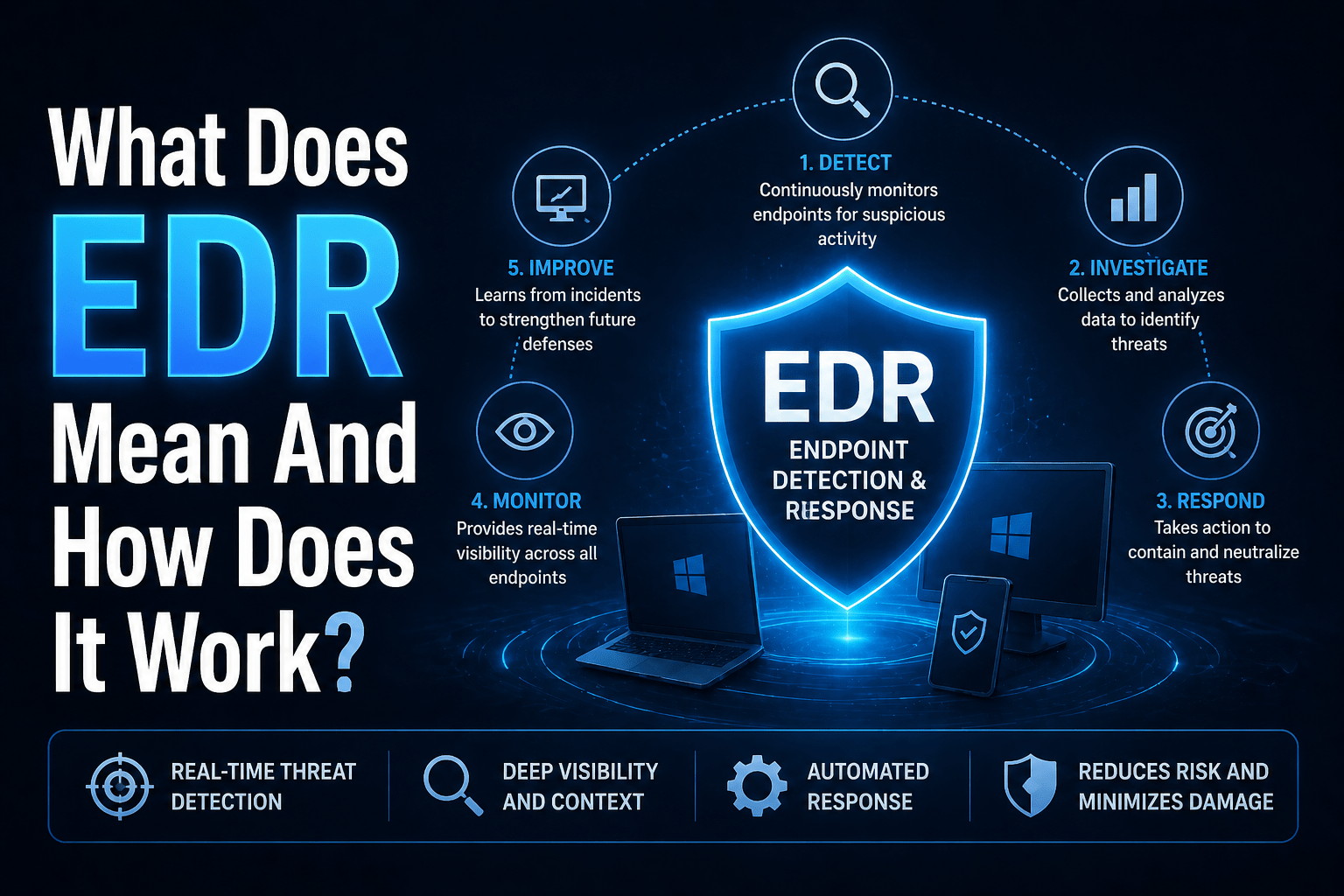
EDR stands for Endpoint Detection and Response, a cybersecurity technology that continuously monitors endpoint devices — laptops, desktops, servers, and mobile devices — to detect threats, investigate suspicious activity, and enable rapid response when a security event occurs.
EDR is the successor to traditional antivirus. Where antivirus scans for known malicious signatures and blocks them, EDR watches what endpoints are actually doing — what processes are running, what files are being accessed, what network connections are being made — and identifies threats through behavioral analysis rather than signature matching alone. This distinction matters: most modern malware is specifically designed to evade signature-based detection.
For businesses evaluating cybersecurity services or reviewing what their managed IT services provider includes for endpoint security, EDR represents the current baseline for meaningful endpoint protection.
Overview
EDR operates through an agent installed on each endpoint that continuously collects behavioral telemetry — process activity, file system changes, registry modifications, network connections, and user actions — and sends that data to a central platform for analysis. The platform applies behavioral detection rules and machine learning to identify patterns consistent with attack activity, generates alerts, and enables security teams to investigate and respond.
- EDR monitors endpoint behavior continuously, not just at file scan intervals
- Behavioral detection catches threats that signature-based tools miss
- Investigation capability allows security teams to understand what happened, how far it spread, and what to do
- Response capability enables containment — isolating a compromised endpoint without manual physical intervention
- EDR provides the telemetry that makes threat hunting and forensic investigation possible
The 5 Why’s
- Why is EDR specifically necessary when antivirus already exists? Because the majority of modern threats are designed to evade signature-based detection. Fileless malware executes in memory without creating files that signatures can match. Living-off-the-land attacks use legitimate system tools for malicious purposes. Novel malware has no signature until it is identified — which means the first victims face zero-day exposure. EDR’s behavioral detection catches these threats by identifying what the attack is doing rather than matching what it looks like.
- Why does continuous monitoring matter compared to scheduled scanning? Because attacks move faster than scan intervals. Ransomware can encrypt thousands of files before a scheduled scan would detect the malware that launched it. EDR’s continuous monitoring detects the behavioral pattern of mass file encryption as it begins — not after it completes. The time between detection and response determines how much damage is done; continuous monitoring compresses that window.
- Why does EDR’s investigation capability matter beyond detection? Because detection alone does not answer the questions required for effective response: how did the attacker get in, what did they access, what did they do, and what else might be compromised? EDR’s recorded telemetry provides the timeline and evidence base that answers those questions. Without it, incident response is reconstruction from incomplete information rather than review of recorded activity.
- Why is remote isolation — the ability to disconnect a compromised endpoint from the network without physical access — specifically valuable? Because containment speed determines breach scope. A ransomware infection spreading across a network must be stopped at the device level. Physical access to shut down or disconnect every affected machine is slow and may not be possible for remote employees. EDR’s remote isolation capability enables immediate containment from the security console regardless of the device’s physical location.
- Why do organizations with EDR have meaningfully better security outcomes than those without it? Because the combination of earlier detection, richer investigation capability, and faster response contains incidents before they reach their most damaging phase. Organizations with mature EDR deployments detect and contain threats in hours; organizations relying on antivirus and reactive response measure containment in days or weeks after the damage is done.
How EDR Works Step by Step
1. Agent deployment: a lightweight agent is installed on every endpoint — laptops, desktops, servers. The agent runs continuously in the background with minimal performance impact on the device.
2. Telemetry collection: the agent collects behavioral data continuously: which processes are running, what files are being created or modified, what registry keys are being changed, what network connections are being made, and what user actions are occurring.
3. Data transmission: telemetry is transmitted to the EDR platform — typically a cloud-hosted console — where it is aggregated, stored, and analyzed.
4. Detection: the platform analyzes behavioral data against detection rules, threat intelligence feeds, and machine learning models. When patterns consistent with attack activity are identified, alerts are generated.
5. Investigation: security analysts use the EDR console to investigate alerts — reviewing the full timeline of activity on the affected endpoint, understanding the attack chain, and identifying the scope of potential compromise.
6. Response: analysts use EDR response capabilities to contain the threat: isolating the endpoint from the network, terminating malicious processes, quarantining suspicious files, and rolling back changes where the EDR platform supports it.
What EDR Does Not Replace
EDR is a critical endpoint security layer but does not replace the full security stack. It complements:
- Email security (phishing is still the most common initial access vector — EDR catches what gets through but email security reduces delivery rates)
- Network security (EDR sees endpoint activity; network security monitors traffic between endpoints and external destinations)
- Identity and access management (EDR monitors what endpoints do; access controls govern who can access what)
- Security awareness training (EDR catches attacks; trained employees prevent them from starting)
Final Takeaway
EDR continuously monitors endpoint behavior, detects threats through behavioral analysis, enables rich investigation of security events, and provides response capabilities that contain threats before they spread. It is the current baseline for meaningful endpoint security — not a premium add-on to basic protection, but the foundation that basic antivirus no longer adequately provides.
EDR Deployment and Management From Mindcore Technologies
Mindcore’s cybersecurity services include EDR deployment and ongoing management for businesses across Louisiana and the Gulf South. Our managed IT services include EDR as a standard component of endpoint protection — not an optional upgrade.

