

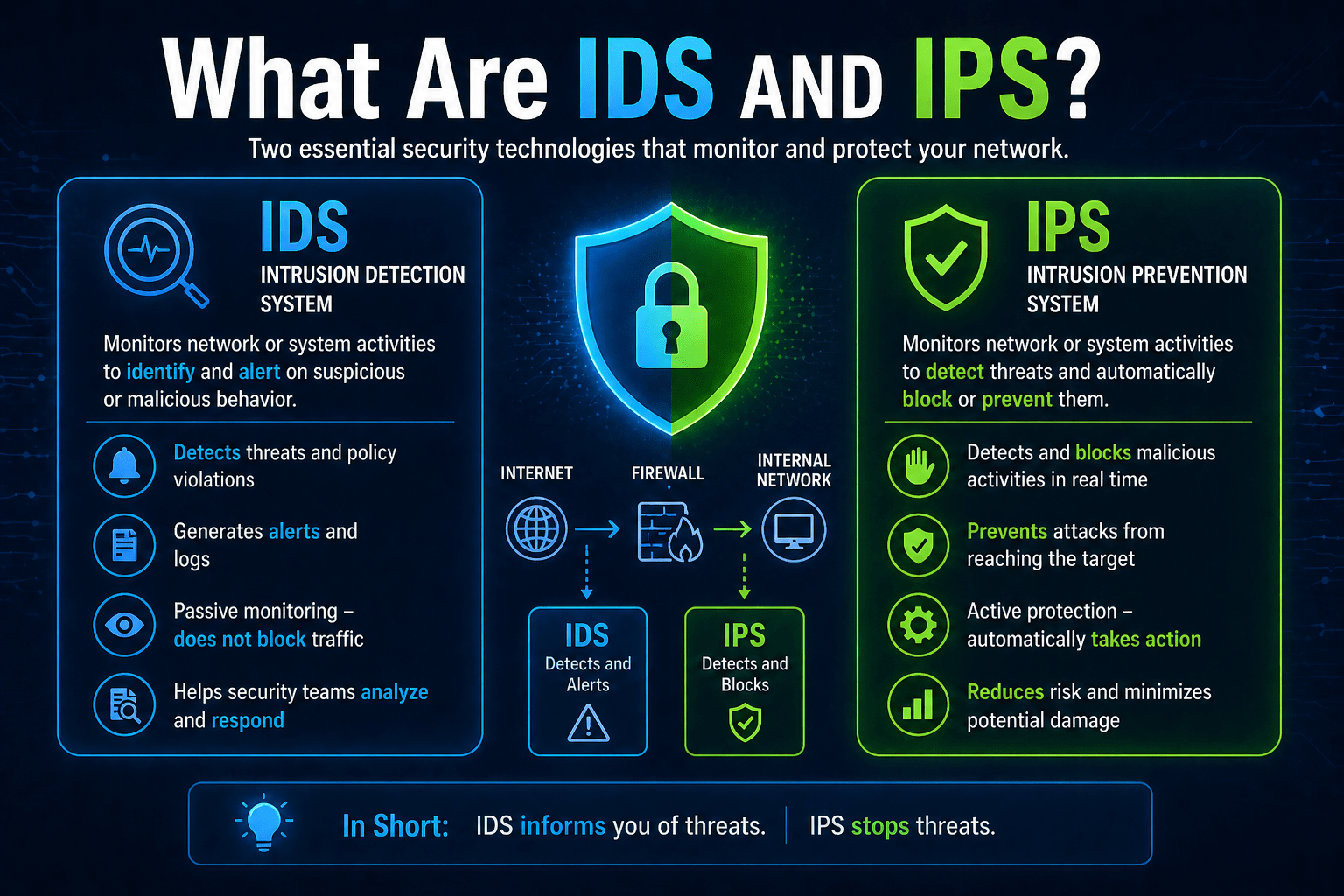
IDS and IPS are two closely related network security technologies that monitor network traffic for signs of malicious activity.
IDS — Intrusion Detection System — monitors network traffic and generates alerts when it identifies patterns consistent with known attacks or suspicious behavior. It is a passive monitoring tool: it detects and reports, but does not block.
IPS — Intrusion Prevention System — monitors network traffic and actively blocks threats when it identifies them. It is an active inline control: it detects and prevents, stopping malicious traffic before it reaches its destination.
The distinction matters: an IDS tells you an attack is happening. An IPS stops it. Most modern implementations are combined as IDPS (Intrusion Detection and Prevention System), providing both detection visibility and active blocking in a single system.
For businesses whose managed IT services provider manages network security, IDS/IPS functionality is often delivered as a feature of the next-generation firewall rather than a standalone system — but understanding what it does remains important for evaluating coverage.
Overview
IDS and IPS both analyze network traffic against a set of known attack signatures and behavioral rules. The difference is the action taken when a match is found. IDS generates an alert; IPS generates an alert and drops or blocks the offending traffic. Both provide network-layer threat visibility that endpoint security cannot — network monitoring sees traffic between systems, including lateral movement between endpoints that endpoint tools do not directly observe.
- IDS: passive detection — monitors and alerts without blocking
- IPS: active prevention — monitors, alerts, and blocks
- Both analyze traffic against signatures and behavioral rules
- Network-layer visibility complements endpoint and identity security
- False positive management is critical for IPS to avoid blocking legitimate traffic
The 5 Why’s
- Why do organizations need network-layer detection alongside endpoint security? Because endpoint security sees what individual devices are doing. Network security sees what is happening between devices — lateral movement, data exfiltration over the network, command and control communications, and attacks targeting network infrastructure itself. The two layers provide different visibility and both are necessary for a complete detection picture.
- Why is the IDS vs. IPS choice not purely “IPS is better because it blocks”? Because active blocking introduces false positive risk — the risk that legitimate traffic is blocked, causing operational disruption. In sensitive environments where network disruption is costly, IDS-only modes may be used for some traffic categories with human review before blocking is implemented. Most modern deployments run IPS for known-bad signatures and IDS-only for more ambiguous behavioral rules.
- Why are IDS/IPS increasingly delivered as features of next-generation firewalls rather than standalone appliances? Because next-generation firewalls perform traffic inspection that overlaps significantly with IDS/IPS functionality. Combining deep packet inspection, application awareness, threat intelligence feeds, and IPS functionality in a single managed appliance reduces complexity and eliminates the gap between firewall and IPS coverage.
- Why does IPS specifically protect against known vulnerability exploitation? Because network exploit attempts — targeting unpatched CVEs in services exposed on the network — follow predictable traffic patterns that IPS signatures detect and block. Organizations that lag on patching benefit from IPS as a compensating control that blocks exploitation attempts against known vulnerabilities while patching is in progress.
- Why does network-based IDS/IPS complement rather than replace endpoint EDR? Because they see different aspects of the same environment. IPS sees network traffic; EDR sees device behavior. Ransomware executing in memory may not produce distinctive network traffic until exfiltration begins. Lateral movement detected by network monitoring provides context for EDR alerts on specific endpoints. Together, they provide a more complete threat picture than either alone.
IDS vs. IPS: Side by Side
| Dimension | IDS | IPS |
|---|---|---|
| Action on detection | Alert only | Alert and block |
| Placement | Out of band — monitors a copy of traffic | Inline — all traffic passes through it |
| False positive impact | Alert fatigue | Traffic disruption |
| Response speed | Requires human action | Automated |
| Risk | Missing alerts | Blocking legitimate traffic |
Final Takeaway
IDS detects network threats and alerts; IPS detects and actively blocks them. Both provide network-layer visibility that complements endpoint and identity security. Modern deployments typically combine both capabilities in next-generation firewalls or unified security platforms.
Network Security Including IDS/IPS From Mindcore Technologies
Mindcore’s cybersecurity services include network security management with IDS/IPS functionality as a component of the network security stack. Our managed IT services maintain and monitor these controls continuously.
Talk to Mindcore Technologies About Network Security Coverage

