

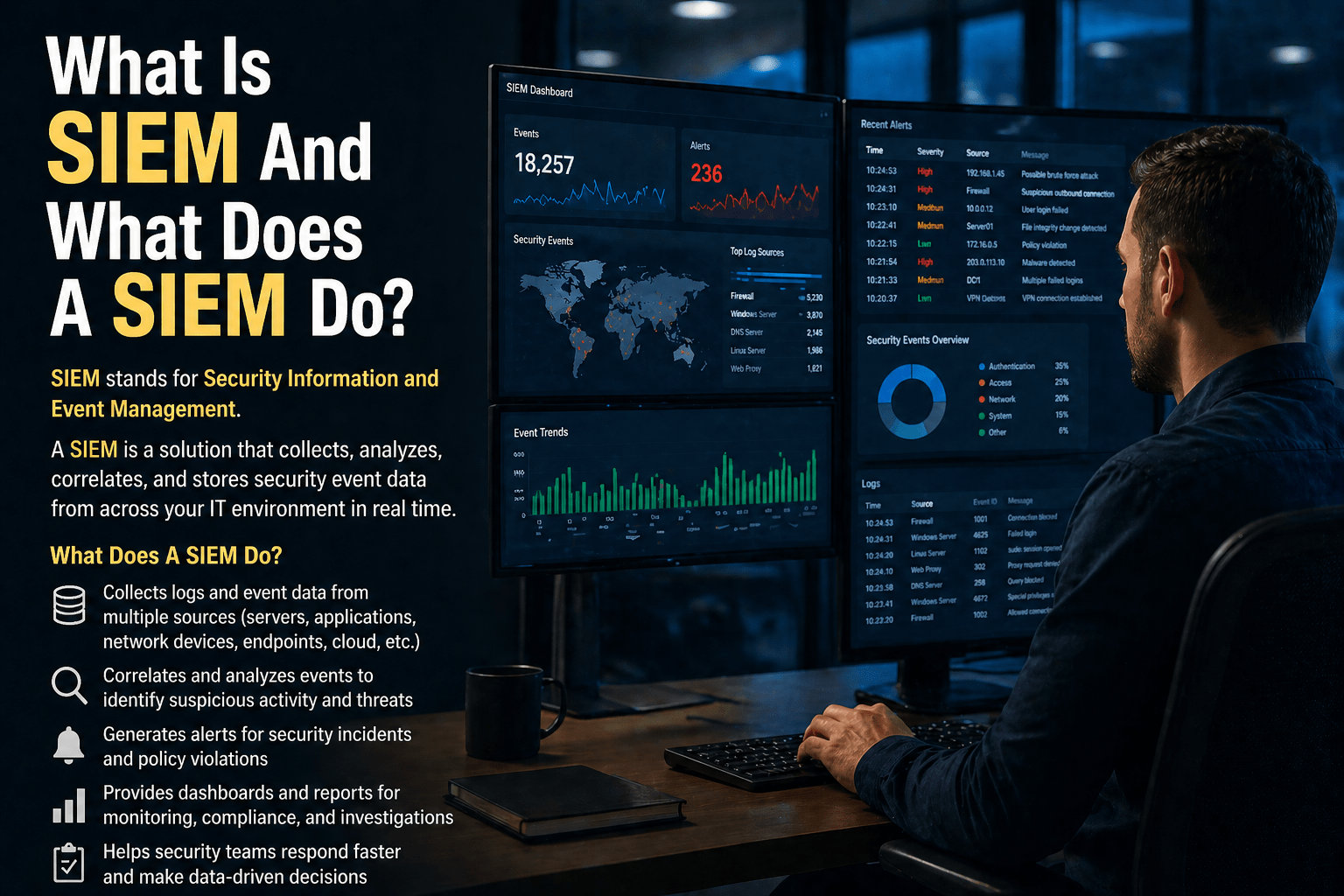
SIEM stands for Security Information and Event Management. It is a platform that collects, normalizes, and analyzes security log data from across an organization’s entire technology environment — endpoints, network devices, cloud platforms, identity systems, applications, and any other connected source — and applies correlation rules and analytics to detect threats that no single source would surface alone.
The core value proposition of SIEM is aggregation and correlation. Individual security tools — firewalls, EDR, email security — each see their own slice of the environment. A firewall sees network traffic. An EDR sees endpoint behavior. An email security platform sees phishing attempts. SIEM collects all of these data streams, normalizes them into a consistent format, and identifies patterns that span multiple sources — the multi-stage attacks that look like routine activity in any individual tool’s view.
For businesses evaluating their cybersecurity services and monitoring capabilities, SIEM represents the intelligence layer that makes the rest of the security stack more effective.
Overview
A SIEM ingests log data from every connected security and IT source, normalizes it to a consistent format, applies detection rules and analytics, generates alerts, and provides investigation tooling for security analysts. It is both a detection platform and an investigation platform — the central console through which a security operations team monitors the organization’s security posture.
- Log aggregation: collects data from every connected source into a single platform
- Normalization: converts different log formats into a consistent, queryable structure
- Correlation: identifies patterns across multiple sources that indicate threat activity
- Alerting: generates prioritized alerts when correlation rules match
- Investigation: provides search and visualization tools for analyst investigation
- Compliance: generates audit logs and reports for regulatory requirements
The 5 Why’s
- Why does correlation across multiple data sources specifically improve threat detection? Because sophisticated attacks span multiple layers. An initial phishing email triggers no EDR alert. The malware it delivers may not match any signature. The lateral movement that follows may look like authorized administrative activity. The data exfiltration may look like normal cloud sync. No individual tool sees the full chain. SIEM correlates the email event, the malware behavior, the lateral movement, and the exfiltration as a connected sequence — and identifies the attack that each individual tool missed.
- Why is log normalization specifically important for SIEM to function? Because different security tools generate logs in different formats. A Cisco firewall log, a Windows event log, a Linux syslog, and an AWS CloudTrail record all contain security-relevant information but structure it differently. Without normalization, correlating across these sources requires tool-specific queries that are slow and error-prone. SIEM normalization converts all sources into a consistent format that enables cross-source queries and correlation rules.
- Why does SIEM serve compliance requirements alongside security monitoring? Because most compliance frameworks — HIPAA, PCI-DSS, SOC 2 — require organizations to demonstrate that they log security-relevant events, retain those logs for defined periods, and have the capability to investigate security incidents using those logs. SIEM satisfies all three requirements: it collects the logs, retains them according to configured retention policies, and provides the investigation tooling that incident response requires.
- Why is SIEM effectiveness dependent on tuning and ongoing management? Because SIEM out of the box generates enormous volumes of alerts, many of which are false positives. An untuned SIEM produces alert fatigue — security teams overwhelmed by noise who begin ignoring or auto-closing alerts. Effective SIEM requires ongoing tuning: adjusting correlation rules to reduce false positives, adding new detection rules for emerging threats, and updating data sources as the environment changes.
- Why do managed security services increasingly include SIEM rather than organizations maintaining it internally? Because SIEM management is a 24/7 operational function that requires security expertise, tool proficiency, and continuous tuning. Few SMBs can maintain this capability internally. Managed security service providers operate shared SIEM infrastructure, providing the detection and monitoring capability to multiple clients with shared operational overhead — making SIEM economics accessible for organizations that could not justify dedicated internal SIEM teams.
What SIEM Collects: Common Log Sources
- Firewall and network device logs
- Endpoint security (EDR) alerts and telemetry
- Active Directory and identity platform authentication logs
- Cloud platform audit logs (Microsoft 365, AWS, Azure)
- Email security platform events
- VPN connection logs
- Application and web server logs
- Database access logs
- Physical access control logs
The completeness of SIEM detection is proportional to the completeness of log source coverage. Sources not connected to the SIEM are blind spots in detection.
SIEM vs. SOAR: A Related Distinction
SOAR (Security Orchestration, Automation, and Response) is a related technology often deployed alongside SIEM. Where SIEM detects and alerts, SOAR automates the response — executing predefined response playbooks automatically when specific alert types are triggered. SIEM provides the detection; SOAR compresses the time between detection and response by automating containment actions.
Final Takeaway
SIEM is the central intelligence platform that aggregates security data from across the environment, correlates it to identify multi-stage threats, and provides the monitoring and investigation capability that a mature security operations function requires. It is the difference between security tools that each see their own slice and a security program that sees the full picture.
SIEM-Backed Security Operations From Mindcore Technologies
Mindcore’s cybersecurity services include SIEM-backed security monitoring for businesses that need continuous detection capability without a dedicated internal security operations team. Our managed IT services ensure the log sources that feed SIEM are connected and producing quality data.
Talk to Mindcore Technologies About SIEM and Security Monitoring

