

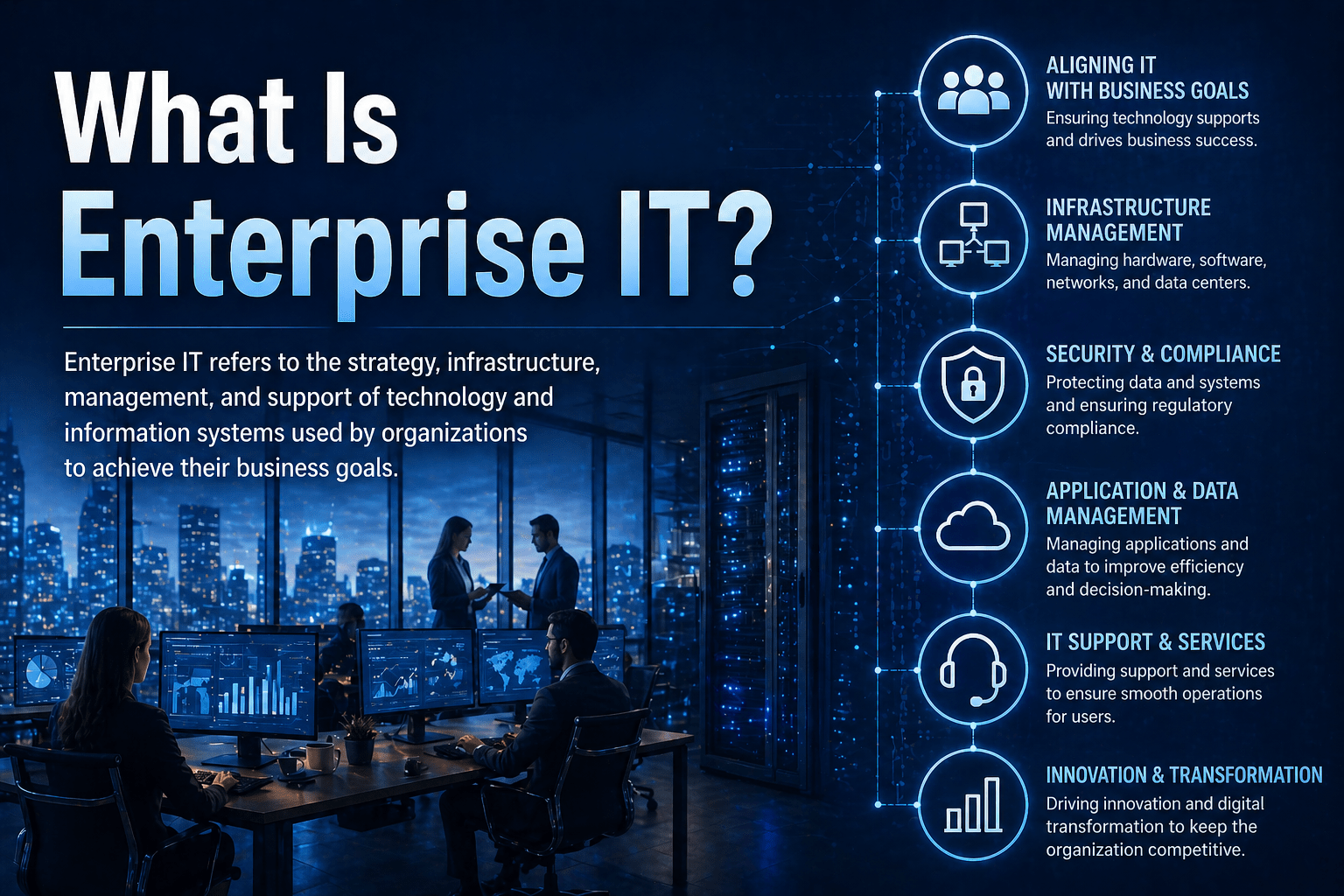
Enterprise IT refers to the organizational information technology function — the people, processes, systems, and infrastructure that plan, deploy, manage, and protect the technology environment a business depends on. It is both the technology itself (the infrastructure, applications, and security systems) and the function that manages it (the IT department, managed services provider, or combination of both).
In a small business context, enterprise IT may be delivered entirely through a managed IT services provider. In a mid-sized organization, it may be a combination of an internal IT team and external providers handling specialized functions. In a large enterprise, it is a full department with dedicated staff across infrastructure, security, applications, and strategy.
The core outcome enterprise IT delivers is the same regardless of how it is resourced: a reliable, secure, and strategically aligned technology environment that supports the organization’s operations and growth.
The Core Functions of Enterprise IT
Infrastructure management: maintaining the hardware and software foundation — servers, network, storage, cloud platforms — that the business runs on. This includes availability monitoring, capacity planning, and lifecycle management of aging infrastructure.
End-user support: the helpdesk and support function that assists employees with technology problems, provisions new accounts, manages devices, and resolves the issues that prevent people from doing their work.
Security management: the ongoing operational practice of keeping the environment secure — EDR deployment and monitoring, patch management, access control, email security, and incident response.
Application management: managing the business applications the organization relies on — Microsoft 365, NetSuite, line-of-business applications — including licensing, configuration, updates, and user administration.
Strategic planning: the IT strategy function that plans the evolution of the technology environment — what to invest in, what to replace, how to align technology decisions with business goals. Often delivered through a virtual CIO (vCIO) relationship.
Compliance and governance: ensuring the IT environment meets the regulatory and policy requirements applicable to the organization, generating audit evidence, and maintaining the documentation that compliance requires.
The 5 Why’s
- Why is enterprise IT important enough to be a dedicated function rather than something each department handles independently? Because consistent, secure, and reliable technology requires centralized management. Departments that independently choose and manage their own tools produce environments with incompatible systems, inconsistent security, no central visibility, and no ability to respond to incidents that span departments. Enterprise IT provides the coherence that departmental self-management cannot.
- Why do many SMBs underinvest in enterprise IT relative to their actual needs? Because the IT function is not directly revenue-generating, it is easy to defer investment until a failure makes underinvestment visible. Businesses that have not experienced a significant IT incident often underestimate what a professional IT function prevents. The visible cost of managed IT services is more obvious than the invisible cost of IT incidents that managed IT prevents.
- Why does the distinction between break/fix IT support and enterprise IT management matter? Because break/fix support responds to failures after they occur. Enterprise IT management prevents them through proactive monitoring, patching, and configuration management. The cost structure is different, the outcomes are different, and the experience of technology as a daily business asset versus a recurring problem source is fundamentally different.
- Why is IT strategy specifically a component of enterprise IT rather than just IT operations? Because technology decisions compound. An IT function that only maintains current systems and responds to failures never evaluates whether those systems are the right ones, whether the architecture supports the organization’s growth direction, or whether security posture is keeping pace with the threat environment. IT strategy ensures the IT function is aligned with where the business is going, not just where it has been.
- Why is co-managed IT specifically valuable for organizations with internal IT staff? Because internal IT teams often have strong organizational knowledge but limited specialization in security, cloud architecture, compliance, or 24/7 monitoring. Co-managed IT provides specialized depth alongside internal team knowledge — combining the advantages of both rather than choosing between them.
Final Takeaway
Enterprise IT is the organizational function that plans, deploys, manages, and protects the technology environment a business depends on. It encompasses infrastructure, support, security, application management, strategy, and compliance. How it is resourced varies by organization size; what it must deliver does not.
Enterprise IT Services From Mindcore Technologies
Mindcore delivers enterprise IT services — managed infrastructure, security, helpdesk, strategic advisory, and compliance support — for businesses that need a complete IT function without building large internal teams. Our managed IT services and co-managed IT options fit organizations at every stage of IT maturity.

