

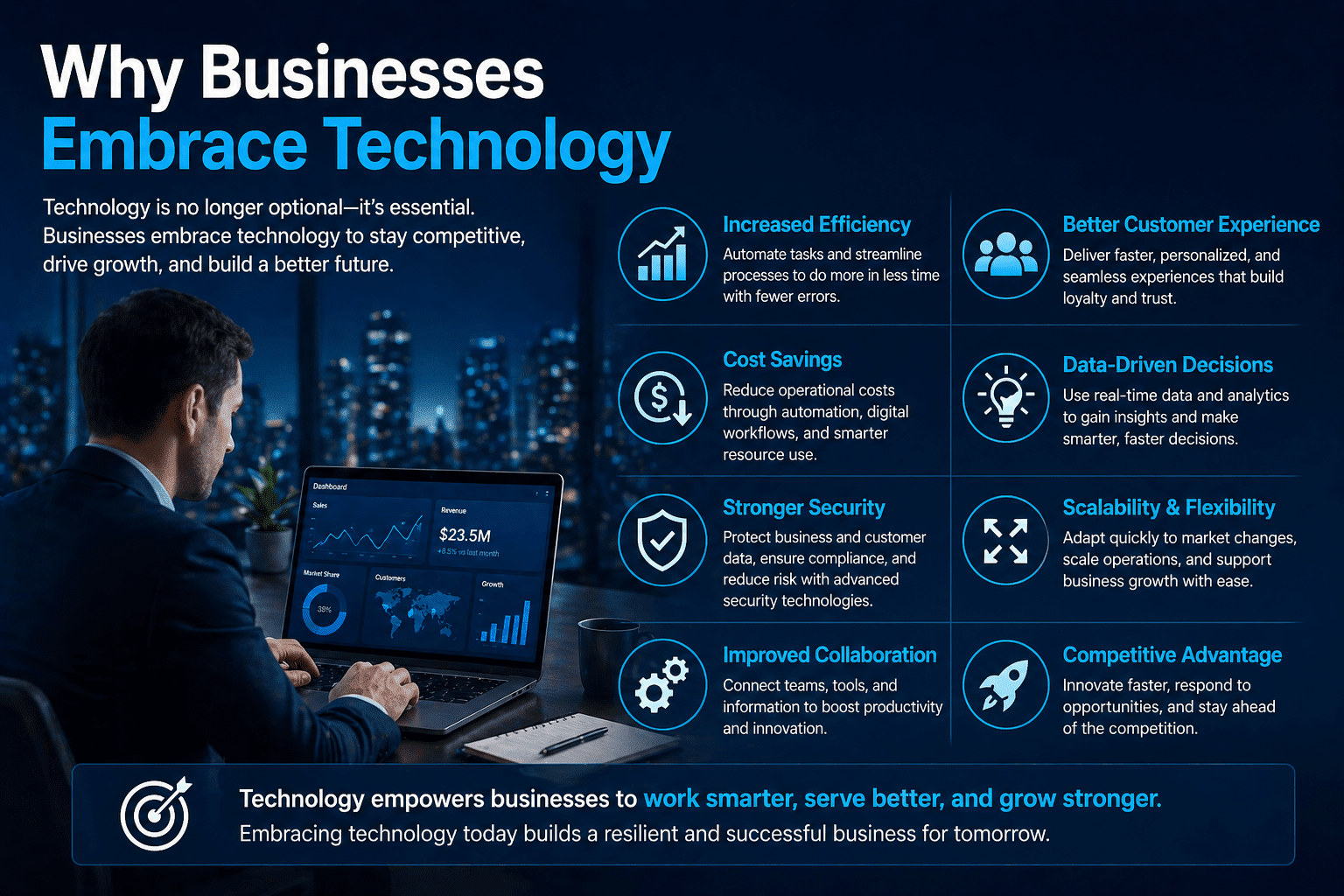
Businesses embrace technology for concrete, practical reasons: it reduces operating costs, enables growth that headcount alone cannot, improves customer experience, reduces risk, and allows smaller organizations to compete effectively with larger ones. The framing of “digital transformation” and “technology adoption” sometimes obscures these straightforward business rationales with language that sounds more strategic than operational.
The honest answer to why businesses embrace technology is that the businesses that do not fall behind the ones that do — in efficiency, customer experience, security posture, and operational scale.
For businesses working with managed IT services providers and IT consulting teams, understanding the actual business drivers for technology investment helps align IT decisions with business outcomes rather than with technology preferences.
The Real Reasons Businesses Adopt Technology
Cost Reduction Through Automation
Automated processes cost less per execution than manual processes and are not subject to human error rates. Software that processes invoices, manages inventory, generates reports, or routes workflows does those tasks at a fraction of the labor cost of manual equivalents. Technology adoption that replaces costly manual processes produces ROI that is measurable and often fast.
Competitive Capability
Markets reward organizations that serve customers faster, with more accuracy, and at lower cost. Technology investment that enables these outcomes produces competitive advantage. Organizations that have not adopted the technology their competitors use are competing at a structural disadvantage.
Revenue Growth Without Proportional Headcount Growth
Technology enables revenue and operational scale without requiring equivalent headcount increases. A business that adopts an ERP system can manage significantly more operational complexity with the same staff. An organization that deploys automation handles more transactions with the same team. Technology creates the leverage that allows revenue to grow faster than cost.
Risk Reduction
Cybersecurity technology reduces the probability and cost of security incidents. Backup technology reduces the cost of data loss events. High-availability infrastructure reduces downtime cost. Technology adoption in the risk management dimension produces value through incidents that do not happen — less visible but equally real.
Customer Expectation Satisfaction
Customers expect capabilities that require technology to deliver: online ordering, real-time status updates, digital payments, responsive service through multiple channels. Businesses that cannot deliver these capabilities lose customers to those that can. Technology adoption in customer-facing systems is often driven by what the market requires, not what the organization chooses.
Compliance Requirement
Regulated businesses adopt specific technology — audit logging systems, encryption tools, access management platforms — because compliance frameworks require them. Technology adoption in these cases is not discretionary.
Final Takeaway
Businesses embrace technology because the operational, competitive, financial, and risk management outcomes it produces are better than the alternatives. The specific drivers vary by organization; the general direction — toward more capable, more secure, and more automated technology environments — is consistent across industries and sizes.
Technology Investment Advisory From Mindcore Technologies
Mindcore’s IT consulting services help businesses identify where technology investment produces the highest business returns — whether in managed IT, cybersecurity, automation, or cloud platforms.
Talk to Mindcore Technologies About Technology Investment That Produces Business Outcomes

