

Every layer of your security stack can be bypassed given enough time and access.
Firewalls get misconfigured. Endpoint detection tools miss novel variants. Credentials get compromised. Multi-factor authentication gets social engineered.
Air-gapped backups are different.
A backup that is physically disconnected from every network cannot be reached by ransomware regardless of what credentials are compromised, what vulnerabilities are exploited, or how long the attacker has been in your environment.
There is no software control to bypass, no credential to steal, and no network path to follow.
The data is physically unreachable.
That physical separation is why air-gapped backups are considered the last line of defense against ransomware.
When every other layer has failed, the air gap is what determines whether recovery is possible without paying.
This guide explains how air-gapped backups work, where they fit in a complete backup strategy, how to implement them practically, and what alternatives exist for organizations where traditional air gapping creates operational challenges.
Organizations strengthening ransomware resilience should evaluate layered cybersecurity services, backup architecture, and recovery planning before an active attack occurs.
What Air-Gapped Means
An air gap is a physical separation between a system or storage device and any network.
A truly air-gapped backup has:
- No network connection
- No wireless interface
- No remote access pathway
The term is sometimes used loosely for backups that are offsite, stored on a separate network segment, or protected by strong access controls.
Those configurations are not truly air-gapped.
An attacker with sufficient network access and compromised credentials can still reach them.
True air gapping means the backup media is physically disconnected.
It is not on the network. It cannot be reached remotely. It can only be accessed by someone physically handling the media.
That distinction matters because ransomware groups specifically target backup infrastructure during the dwell period before encryption.
Organizations improving backup resilience should also review ransomware protection services.
How Air-Gapped Backups Work in Practice
The operational model for air-gapped backups involves a connection cycle.
The backup media is connected to perform the backup, then disconnected and stored offline until the next backup window or restoration event.
The connection cycle creates a brief exposure window during the backup process.
Managing that window is the primary operational consideration in air-gapped backup architecture.
Tape Backup
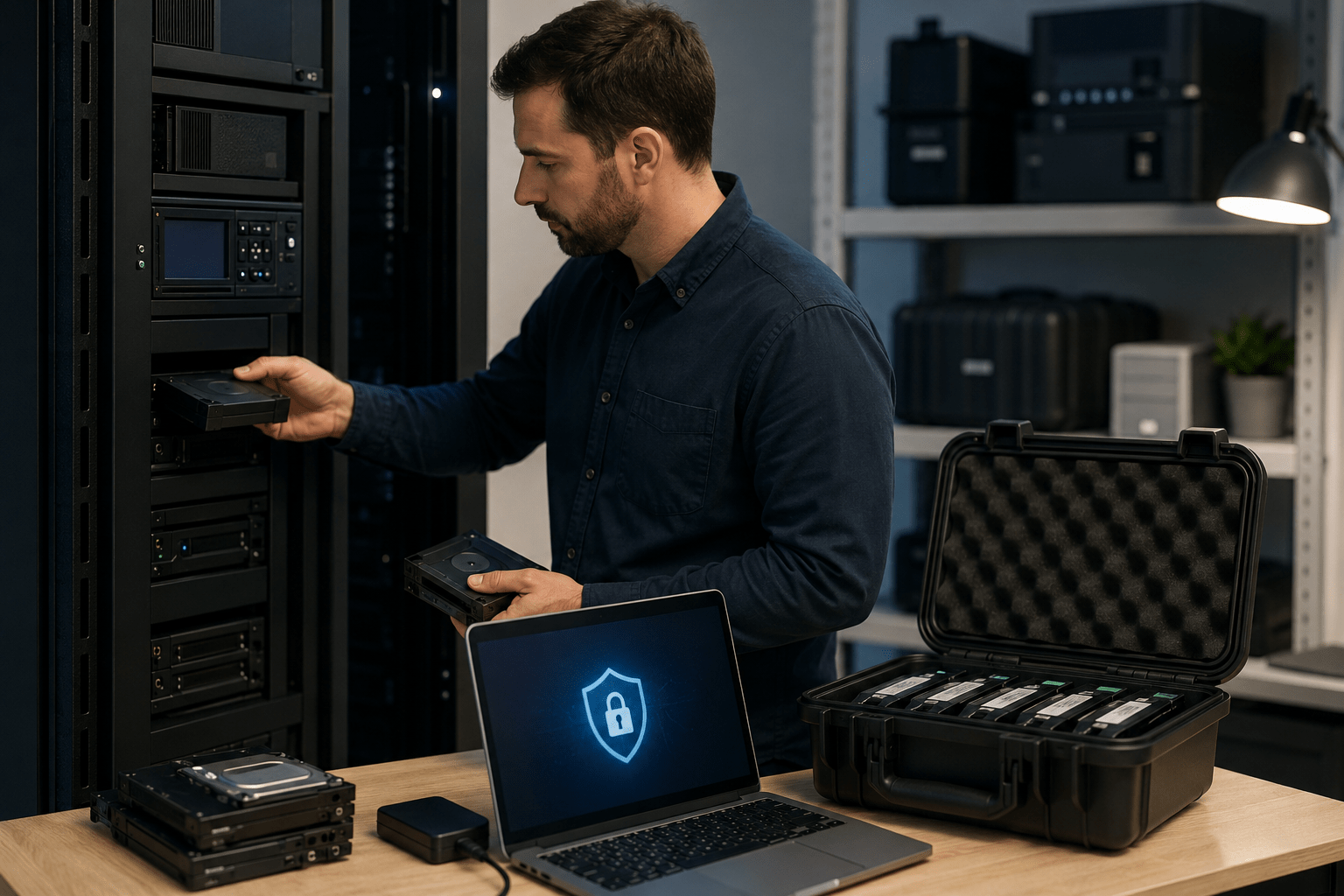
Magnetic tape is the traditional air-gapped backup medium and remains widely used in enterprise environments.
Backup data is written to tape cartridges, which are then physically removed and stored offline either onsite or offsite.
Tape provides true air gapping because cartridges are physically separate from network-connected systems when not in the drive.
Modern tape formats such as LTO-8 and LTO-9 store multiple terabytes per cartridge at low cost per gigabyte.
Operational requirements include:
- A tape library or standalone tape drive
- A media rotation schedule
- Secure physical storage
- Environmental controls
- Offsite storage for geographic redundancy
Removable Drive Rotation
For smaller environments, rotating external hard drives or USB drives can provide air gapping without the infrastructure requirements of a tape library.
A set of drives rotates through a backup cycle:
- One drive connects for backup
- That drive is disconnected and stored offline
- Another drive takes its place during the next backup window
This model requires operational discipline.
A drive left connected after backup becomes vulnerable to ransomware.
Dedicated Offline Backup Appliance
Some backup appliance vendors provide solutions with physically isolated vault components.
A connected component performs backup jobs, transfers data to the vault, and the vault disconnects from the network between backup cycles.
This provides the operational convenience of automation while maintaining physical isolation during offline periods.
Organizations improving backup program management should also evaluate managed IT services.
The Connection Window: Managing the Only Exposure Point
The brief period when backup media is connected is the only time ransomware could theoretically reach an air-gapped backup.
Managing that connection window is essential.
Best Practices for the Connection Window
- Use a dedicated backup system – The system should not be domain-joined or used for other business functions
- Run minimal software – Reduce attack surface during backup operations
- Vary backup timing where practical – Avoid predictable windows attackers can exploit
- Scan backup data before disconnecting – Reduce the risk of preserving active malware
- Minimize connection duration – Prepare jobs before connecting media
- Physically secure the process – Limit who can connect, disconnect, and handle backup media
Organizations improving operational monitoring should also review network security monitoring.

Air-Gapped Backups in a Complete Backup Architecture
Air-gapped backups are not a replacement for a complete backup strategy.
They are the final tier in a layered backup architecture that provides recovery options at different speeds and for different scenarios.
Tier One: Operational Backups
These are frequent backups, often daily or more often, of critical systems.
They support fast recovery from:
- Hardware failures
- Accidental deletions
- Software corruption
- Localized operational issues
Tier Two: Immutable Cloud Backups
Immutable cloud backup copies prevent deletion or modification for a defined retention period.
This provides protection against ransomware attempts to delete backup data through compromised credentials.
Tier Three: Air-Gapped Backups
Air-gapped backups are offline, physically disconnected copies unreachable regardless of network compromise.
This is the recovery option of last resort when higher-speed backup tiers are compromised or unavailable.
The 3-2-1-1 backup rule captures this architecture:
- Three copies of data
- Two different media types
- One offsite copy
- One immutable or air-gapped copy
Organizations modernizing recovery architecture should also evaluate Zero Trust security models and secure workspace infrastructure.
Immutable Cloud Storage as a Logical Air Gap
For organizations where physical air gapping creates operational challenges, immutable cloud storage provides a logical equivalent for one major ransomware threat: attacker deletion or encryption of backup data.
Immutable storage with object lock prevents modification or deletion during the retention window.
Even if attackers compromise cloud credentials, they cannot delete or overwrite protected backup data.
This is not a true air gap because data remains network-accessible.
An attacker may still be able to read or exfiltrate data depending on permissions.
But for protecting backup data from destruction, immutable object storage provides strong ransomware resilience at lower operational cost than traditional physical air gapping.
Major cloud providers offering immutable storage options include:
- Microsoft Azure Blob Storage
- AWS S3
Organizations using immutable cloud storage should still maintain at least one physically air-gapped copy for critical systems where recovery assurance is essential.
Organizations improving cloud resilience should also review cloud services.
Operational Considerations for Air-Gapped Backup Programs
Recovery Time Impact
Air-gapped backups are typically slower to restore from than cloud or network-connected backups.
Physical media may need to be:
- Retrieved
- Transported
- Connected
- Validated
before restoration can begin.
Organizations should model the restoration timeline against their recovery time objective.
Media Management and Rotation
A functional air-gapped backup program requires detailed tracking of:
- Which media contains each backup generation
- Where each media set is physically stored
- When media should rotate
- Which backups have been validated
Without this tracking, backup programs degrade over time.
Physical Security
Offline backup media is portable and contains sensitive organizational data.
Physical security should include:
- Access controls
- Environmental protection
- Chain-of-custody tracking
- Secure offsite storage where appropriate
Restoration Testing
Air-gapped backups must be tested through actual restoration.
Testing confirms:
- Media is readable
- Data is complete
- The restoration process works
Air-gapped backup restoration should be included in quarterly recovery testing.
Organizations improving recovery validation should also evaluate business continuity planning.
When Air-Gapped Backups Are Most Critical
Healthcare Organizations
Healthcare organizations hold protected health information and face HIPAA breach notification obligations.
Downtime can also affect patient care.
Air-gapped backups provide recovery assurance when clinical continuity matters most.
Financial Services Organizations
Financial firms face regulatory and reputational consequences from extended downtime.
Air-gapped backups support both operational resilience and compliance readiness.
Legal Organizations
Law firms hold privileged client data and have professional responsibility obligations related to confidentiality and data protection.
No-pay recovery options become especially important when sensitive client data is involved.
Manufacturing Organizations
Manufacturers face production downtime costs that accumulate quickly.
Air-gapped backups can materially reduce recovery uncertainty when operational technology environments are affected.
Organizations Subject to CMMC
Organizations pursuing CMMC compliance need documented backup and recovery capabilities.
Air-gapped or immutable backup architecture supports recovery documentation and control maturity.
Organizations operating in regulated sectors should also evaluate cybersecurity compliance services and CMMC consulting.
Frequently Asked Questions
Are air-gapped backups still relevant when cloud backups are available?
Yes. Cloud backups are valuable for fast recovery and hardware failure scenarios, but cloud backups without immutable storage and isolated credentials can still be vulnerable to ransomware. Air-gapped backups provide recovery capability independent of any network-accessible infrastructure.
How much does an air-gapped backup solution cost?
Cost depends on environment size and backup method. Tape solutions have higher upfront infrastructure costs but low storage cost at scale, while removable drive rotation is often more affordable for smaller environments.
Can ransomware infect backup data stored offline?
Ransomware cannot actively encrypt data that is physically disconnected. The risk is backing up already infected data before detection, which is why malware scanning and multiple backup generations matter.
How many generations of air-gapped backups should we maintain?
At minimum, three generations provide meaningful protection. Seven or more generations offer stronger recovery flexibility, especially when attacker dwell time may extend for days or weeks.
Do air-gapped backups eliminate the need for other cybersecurity controls?
No. Air-gapped backups support recovery after other controls fail. They do not prevent attacks, reduce lateral movement, or eliminate breach notification obligations after data exfiltration.
Actionable Steps
- Assess whether your current backups are truly air-gapped – Offsite or separate-network backups are not always physically isolated
- Add immutable or air-gapped storage to your backup architecture – Build a ransomware-resilient recovery tier
- Test restoration from offline backup media quarterly – Validate that recovery works under real conditions
- Separate backup credentials from production credentials – Reduce attacker access to recovery systems
- Document media rotation and storage procedures – Prevent operational drift over time
- Include air-gapped backups in incident response planning – Ensure recovery teams know when and how to use them
Organizations strengthening ransomware recovery should also evaluate incident response services, co-managed IT services, and virtual CISO consulting.
The Bottom Line
Every other security control in your environment can potentially be bypassed by a sufficiently patient attacker.
Air-gapped backups cannot be bypassed remotely because there is nothing remote to bypass.
The data is physically unreachable until someone handles the media.
That irreducible protection is why organizations recovering from serious ransomware incidents often prioritize air-gapped backup architecture during post-incident hardening.
They learn what the absence of that layer costs.
Mindcore Technologies helps organizations across healthcare, finance, legal, manufacturing, and other regulated industries assess backup architecture, implement air-gapped or immutable backup strategies, and manage recovery programs designed for real ransomware conditions.
If your current backup architecture does not include an immutable or air-gapped tier, now is the time to close that gap before a ransomware incident makes it urgent.
Schedule a consultation with Mindcore to evaluate your backup resilience, strengthen ransomware recovery readiness, and build a recovery layer attackers cannot reach remotely.

