

One of the first things I work on with business owners in my coaching practice is awareness. Not strategy. Not systems. Awareness. Specifically, awareness of what other people on your team are depending on you for, and whether you are actually delivering it.
Most owners I work with are sharp, driven, and genuinely committed to their businesses. But somewhere between $3M and $10M in revenue, a pattern shows up that quietly limits how far they can go. People on their teams are dropping the ball on communication. Updates are not coming. Loops are not being closed. And the owner is absorbing the cost of it, spending time and energy chasing information that should have arrived without asking.
For leaders exploring Firefighter Lesson plans, I teach this principle through a true story from before I ever ran a company. It comes from my time as a firefighter, and it is the most honest illustration I have found for what real ownership looks like under pressure.
What It Means to Work the Pump Panel
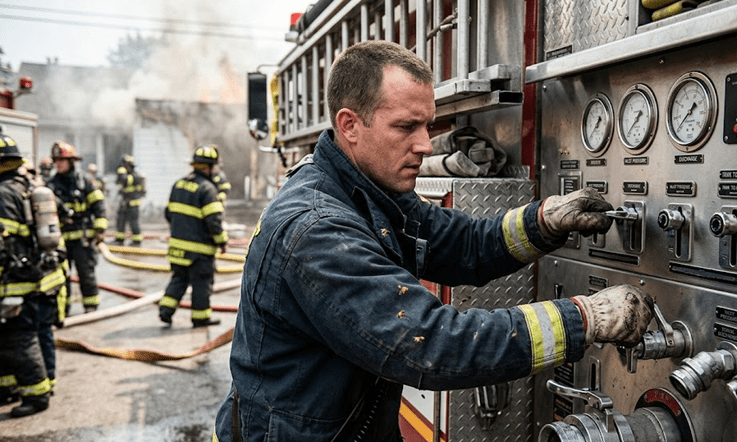
During an active fire, the person at the pump panel on the truck manages one of the most demanding roles on scene. You are not going inside. You are not pulling hose. You are standing at a control system managing the entire water supply in real time while multiple crews inside a burning building depend on you to hold every variable steady.
When I was at the panel, I was tracking everything at once. Water coming into the truck from the hydrant. Water going out through multiple hose lines to multiple crews in different positions. Whether the truck was still drawing from the onboard tank or had transitioned to the hydrant. Whether the hydrant connection was fully live and pressurized. Whether the tank needed to be refilled. Whether the incoming pressure was dropping.
Every single one of those variables mattered. Not in a general sense. If I missed one, firefighters inside a burning building could lose water pressure. Losing water pressure inside an active fire is not a recoverable situation. People can get hurt. People can die.
That is the weight of the panel. You do not get to zone out. You do not get to decide that one variable is probably fine without checking. Effective Firefighter Lesson plans reinforce that situational awareness is not merely part of the job; it is the job.
Then the Bees Came
The truck had disturbed a nest when we pulled up on scene. I did not notice it until they were already on me.
Bees everywhere. Inside my jacket, on my neck, on my hands. Sting after sting with no way to step back from the panel. The pain was immediate and relentless. I was getting swarmed while managing live water lines running to crews working inside an active fire directly in front of me.
Everything in my body said move. Get away. Get off the truck and find help. That instinct is not weakness. It is biology, and in that moment it was loud.
I did not leave.
I stayed because training had made the awareness automatic. I knew exactly what was happening on that panel. The truck was mid-transition from tank water to hydrant water. That transition had to be completed or the pressure to the interior crews would drop. The tank needed to be refilled once the hydrant was confirmed live. Walking away from an unstable system meant the people inside that building would pay the price for it.
So I finished the transition. I stabilized the system. I confirmed the hydrant was live and the tank was refilling. I called for someone to relieve me. I waited until that person was confirmed at the panel.
Then I stepped off the truck and got medical help.

What I Teach Business Owners From This Story
When I use this story in coaching and Firefighter Lesson plans, most business owners immediately recognize the same pattern within their teams. Not of the firefighting. Of the pattern.
They know what it feels like to be depending on someone who walked away from the panel too soon. A team member who finished their piece of the work and went quiet without closing the loop. A manager who missed the update that everyone downstream was waiting on. A key person who decided their communication could wait, while three other people sat idle not knowing what was happening.
That pattern, repeated across a team over months and years, is one of the most reliable limits on how far a business can scale. And it almost never gets diagnosed correctly. Owners treat it as a hiring problem, a personality issue, or just the cost of doing business with imperfect people. What it actually is, in most cases, is a culture that has never clearly defined what it means to complete something.
In my coaching practice, I work with owners to identify exactly where those breakdowns are happening and build the systems, expectations, and leadership habits that close them. But before we get to the systems, we have to get to the standard. And the standard starts with one question: do the people on your team understand that their job is not done when their task is done?
The Instinct Is Trainable
Here is what most people get wrong about high-performing teams. They assume that proactive communication is a personality trait. That some people just have it naturally and others do not, and your job as an owner is to find the ones who have it.
That is not how it works.
What I had at that pump panel was not an unusual personality. It was training that had been repeated until it became instinct. I knew the system. I knew the sequence. I knew what stable looked like and what the gap between stable and unstable could cost the people inside. When the bees hit, I was not making conscious decisions from scratch. I was operating from a foundation that training had built, a foundation that held even when everything around me was painful and chaotic.
The same thing is possible on your team. Firefighter Lesson plans demonstrate that proactive communication, situational awareness, and dependable execution are behaviors that can be trained. The instinct to know what needs to be escalated, what needs to be closed out, and who is waiting on you, that is trainable. It does not emerge on its own. It emerges from leadership that sets the standard clearly, models it consistently, and reinforces it until it becomes part of how the team operates.
This is a significant part of what I work on with the owners I coach. Not just the strategy of the business, but the operating culture. Because a business with a clear strategy and a team that cannot execute it cleanly will always underperform a business with a good enough strategy and a team that communicates and closes loops without being managed into it.
A Missed Update Is a Leadership Problem, Not an Admin Problem
I want to reframe the way most owners think about communication failures on their teams, because the default framing keeps them from solving it.
When someone misses an update, the instinct is to treat it as a small thing. An administrative issue. A reminder to send emails more consistently. But that framing misses what is actually happening.
A missed update is a failure to assign proper weight to what other people are depending on. It is a failure of awareness. And awareness, as I learned at that pump panel, is not soft. It is the job.
When you allow that framing to persist, that missed updates are minor issues, you are teaching your team that other people’s time and momentum do not carry enough weight to require attention. You are building a culture where people complete tasks in isolation without thinking about who is downstream waiting on the result. And you are creating a ceiling on your business that no strategy, no hiring, and no software tool will break through, because the ceiling is cultural.
The business owners I coach who scale past it are the ones who take communication seriously as a leadership discipline, not as a nice-to-have. They build the expectation clearly. They model it personally. And they hold the standard with enough consistency that it eventually stops needing to be enforced because it has become instinct.
What Ownership Actually Looks Like
The central principle behind these Firefighter Lesson plans is that ownership does not end when your individual portion of the work is complete. Ownership ends when the people depending on you have what they need.
At the pump panel, my job was not done when I connected the hydrant. It was not done when the tank was refilling. It was done when the system was stable and a confirmed replacement was at the panel. That is when I stepped away. Not a moment before.
In your business, the equivalent is straightforward. Your team member’s job is not done when they finish the task. It is done when the person waiting on that task has received it and confirmed it. When the open question is closed. When the delay that was coming has been flagged early enough for someone to adjust. When the loop is closed, not just the work.
That standard, applied consistently across a team, changes how the business operates. It reduces the rework and the chasing. It builds the kind of trust between people that allows a company to move faster, not because everyone is working harder, but because the coordination friction has been removed.
This is the work I do with business owners who are serious about scaling. If you are at a point where your business is growing but your team’s execution is not keeping pace, or where you are spending too much of your own time managing communication that should be happening without you, that gap is closable. It requires clarity, consistency, and the right coaching to build it into the operating culture.
People’s Time Is on the Line
No one on your team is going to lose water pressure because of a missed update. The stakes in business are different from the stakes in a burning building, and I am not going to pretend otherwise.
But people’s time is on the line. Every hour spent waiting for information that should have arrived proactively is an hour that does not come back. Every project stalled by a communication gap is a cost the whole team absorbs. Every client relationship that cools because responsiveness slipped is a consequence that did not have to happen.
The business owners who build great teams understand that time is the one resource that cannot be recovered, and they build cultures that treat other people’s time as something worth protecting. That starts with the person at the top modeling what ownership looks like. And it grows from there.
If you are ready to build that kind of team and that kind of culture in your business, that is exactly what my coaching is designed to do. Book a free strategy call and let’s talk about where you are and what it would take to get your team operating at the level your business needs.
About Matt Rosenthal
Matt Rosenthal is the President and CEO of Mindcore Technologies and a business growth coach for owners running companies between $3M and $10M in annual revenue. Before building Mindcore, Matt served as a firefighter, an experience that continues to shape how he thinks about leadership, ownership, and performance under pressure. He works with business owners who are serious about building teams that execute, communicate, and scale without the owner holding everything together.
Frequently Asked Questions
What does Matt Rosenthal’s business coaching focus on?
Matt works with business owners doing between $3M and $10M in annual revenue who are ready to scale but are hitting execution, leadership, or team performance ceilings. His coaching addresses operating culture, communication standards, accountability systems, and the leadership habits that allow a business to grow without the owner carrying everything.
Why do growing businesses struggle with team communication?
Most communication failures on business teams are not personality issues. They are culture issues. When a team has never been given a clear standard for what it means to complete something, including closing the loop with the people depending on the result, communication gaps become the default. That culture can be changed, but it requires intentional leadership.
What is the firefighter lesson Matt teaches in his coaching?
Matt uses a true story from his time as a firefighter operating a pump panel during an active fire to illustrate what real ownership looks like under pressure. The core lesson is that responsibility means maintaining awareness of what others depend on you for, even when you are uncomfortable or stretched. In business, that translates directly to proactive communication and closing loops without being asked.
How does poor communication limit business growth?
When communication breaks down on a team, coordination friction increases across every function. People spend time chasing updates instead of doing work. Projects stall. Trust erodes quietly. Over time, the business hits a ceiling not because the strategy is wrong but because the team cannot execute cleanly enough to support growth. That ceiling is cultural and it is addressable.
How do I know if my business is ready for coaching with Matt?
If your business is growing but your team’s execution is not keeping pace, if you are spending significant time managing communication that should happen without you, or if you sense that your culture is limiting how far your company can go, those are the signals. Book a free strategy call to start the conversation.
What makes Matt Rosenthal’s coaching approach different?
Matt brings real operational experience to his coaching, including years running a scaled IT and cybersecurity firm and a background as a firefighter. He does not teach theory. He works with owners on the specific gaps in their teams and cultures that are limiting performance, and he builds the habits and systems to close them.
Let’s Talk About What This Means for Your Business
If this story resonated, it is probably because you have seen this pattern in your own business. Someone walked away from the panel too soon, and your team absorbed the cost. That pattern is fixable. Let’s talk about how.

