


Leading Managed IT Services Provider in New Jersey prioritize factory operations first, ensuring production continuity before office IT, aligning support with real-time manufacturing demands. Manufacturing IT Services NJ providers should measure success in production uptime, not ticket counts, because every minute of equipment downtime creates operational losses. For New Jersey plants tied to defense, aerospace, or pharmaceutical supply chains, that partner also has to handle regulated data and Cybersecurity Maturity Model Certification exposure. We built this guide around the two factors most local roundups skip: the real cost of line downtime and the handling of controlled data on a connected factory floor.
Why Manufacturing IT Differs From Office IT
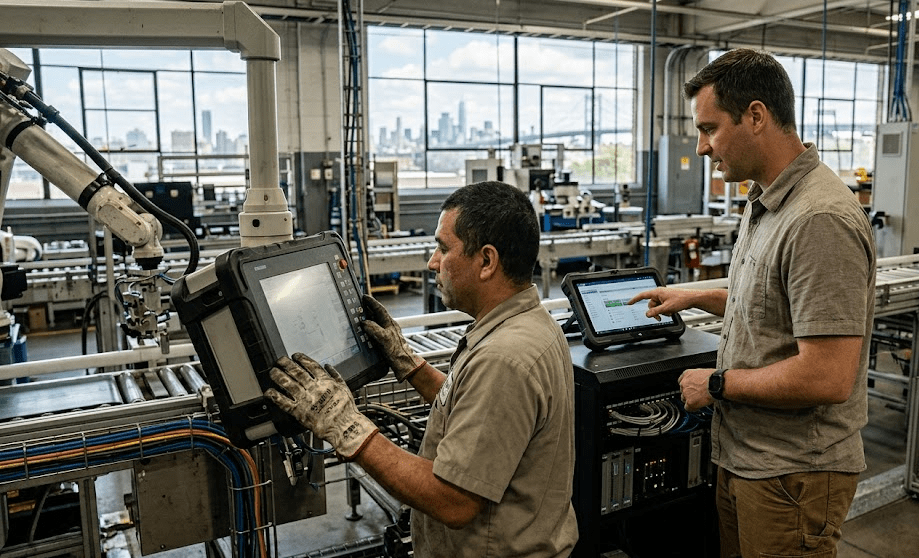
Manufacturing IT introduces unique operational risks that typical office-focused contracts cannot cover, which is why choosing a Managed IT Services Provider in New Jersey experienced with industrial systems is critical. When a sales team loses email for an hour, work pauses. When a coating line loses its supervisory control system for an hour, you scrap material, miss a customer ship date, and sometimes restart a batch from zero. Manufacturing IT Services NJ must support both information technology and operational technology to protect office systems and plant-floor production.
The Cost of Production-Line Downtime
In New Jersey manufacturing, line downtime escalates operational costs differently than office IT outages, making a specialized Managed IT Services Provider in New Jersey essential to reduce losses. A stalled assembly cell idles the operators standing next to it, backs up every station upstream, and pushes finished-goods commitments past their promised dates. We have walked plant floors in Bergen and Middlesex counties where a single switch failure in a mezzanine cabinet halted three lines at once. A provider who only monitors servers will not see that switch until an operator calls. The right partner instruments the floor network with the same care it gives the data center, so a degrading link raises an alert before it becomes a stoppage.
Operational Technology Lives on Its Own Rules
Operational technology gear runs on long lifecycles and fragile firmware that office IT habits can break. You cannot push a Patch Tuesday update to a control system mid-shift, and you cannot reboot a human-machine interface because a routine script says it is due. The U.S. Cybersecurity and Infrastructure Security Agency publishes guidance on protecting industrial control systems precisely because these devices need a different playbook. A capable Manufacturing IT Services NJ provider segments plant networks, schedules changes around production calendars, and tests updates before deploying them to production equipment.
Legacy Equipment Will Not Disappear
Most plants run a mix of new robotic cells and machines older than the technicians who maintain them. A press from 1998 may still be the most profitable asset on the floor, and it may run an operating system no vendor supports. The wrong answer is to rip it out. The right partner isolates that machine behind tight network controls, restricts who can reach it, and logs every connection, so an unsupported device stays productive without becoming the soft entry point an attacker walks through.
What CMMC and Regulated Data Mean for NJ Plants
For plants handling sensitive defense or regulated data, Managed IT Services Provider in New Jersey must ensure CMMC compliance to protect contracts and maintain eligibility. Manufacturing IT Services NJ should address CMMC requirements when a plant handles controlled unclassified information or operates within the Department of Defense supply chain. The Department of Defense maintains the program at its CMMC office, and the certification level you need depends on the data you touch. A provider who cannot speak to this leaves you guessing on a requirement that can pull a contract.
Know Which Level Applies Before You Shop
The first task is scoping which data your plant actually handles and at what certification level. A shop that only sees a purchase order needs far less than one storing engineering files for a weapons subsystem. We map every data flow first, from the email that carries a specification to the file server that stores it to the machine that reads it, then match that map to the right level. A good partner does this scoping with you instead of selling you a one-size package that over-builds in one area and leaves a gap in another.
The Evidence Trail Is the Real Deliverable
Top Managed IT Services Provider in New Jersey embed CMMC evidence trails into daily operations, ensuring audit-ready documentation without last-minute scrambling. You need records showing who accessed controlled data, when access changed, which controls were in place, and how you respond to an incident. Most plants discover at audit time that the controls existed but the evidence did not. The right managed IT partner builds that evidence trail into daily operations, so access reviews, configuration baselines, and incident logs accumulate as a byproduct of normal work rather than a frantic scramble in the weeks before an assessment.
Segmentation Shrinks the Audit Scope
Smart network segmentation lowers both your risk and your certification cost. If controlled data lives in one tightly fenced enclave instead of spread across the whole plant, the systems an assessor must examine drop sharply. We design that boundary so the office network, the general production network, and the controlled-data enclave stay separate, with logged and limited paths between them. A smaller scope means a faster, cheaper assessment and a smaller blast radius if something goes wrong.
How to Evaluate a Manufacturing IT Provider in New Jersey
Evaluate Manufacturing IT Services NJ providers based on proven plant-floor experience, operational technology expertise, compliance capabilities, and production recovery performance. Any vendor can list backup, monitoring, and a help desk. The ones worth your contract can describe how they kept a specific line running, how they isolated a control system, and how they walked a manufacturer through a compliance assessment. Ask for that detail, and the field narrows fast. The questions below separate a true manufacturing partner from a general office IT shop wearing a manufacturing label, and they overlap with what to look for in any managed cybersecurity partner.
Ask About Plant-Floor and OT Experience
Press hard on real operational technology work, because this is where general providers fold. Ask which control system platforms they have supported, how they handle a change window during a running shift, and how they segment a plant network. A strong answer names protocols and platforms and describes a concrete change they made without stopping production. A weak answer pivots back to servers and laptops. The U.S. National Institute of Standards and Technology offers a useful baseline for small business cybersecurity that a serious provider will already be applying to your floor.
Confirm Response Times Match Production Reality
Service commitments should be written in the language of production, not generic ticket priorities. A four-hour response is fine for a printer and unacceptable for a line stoppage. Ask whether the agreement defines a line-down event, what the response and resolution targets are for it, and whether someone can be on site when remote fixes fall short. Local matters here: a provider with technicians who can reach your New Jersey plant within the shift is worth more than a distant call center with a faster-sounding number.
Check Their Security and Recovery Posture
A manufacturer is a ransomware target because downtime pressure makes paying tempting, so recovery capability is not optional. Ask how they back up both office and production systems, how often they test a restore, and how fast they can rebuild a critical server. CISA’s StopRansomware resources outline the controls a mature provider should already have in place. The honest test is simple: ask when they last performed a full restore drill for a client and what they learned from it. Vague answers mean the plan has never been exercised.
Build the Shortlist the Right Way
A useful shortlist starts with fit for your plant, not with a ranking someone else published. Lists like the broader top managed service providers in New Jersey roundups are a fine starting point for names, but they rarely weigh OT depth or compliance handling, the two factors that decide a manufacturer’s outcome. Treat published lists as raw input, then filter against your own requirements.
Weigh Local Presence and Industry References
Give real weight to providers who already serve New Jersey manufacturers and can prove it. A partner who knows the region can stage spare hardware nearby, reach your floor during a shift, and speak to the specific regulatory pressures local plants face. We document our coverage across the state on our New Jersey IT service area page, and we encourage you to ask any candidate for manufacturing references you can actually call. If you operate plants in more than one state, ask how a provider handles consistency across sites, the same way we approach managed IT for manufacturers in Maryland.
Score the Finalists on the Factors That Matter
Once you have three or four finalists, score them on a short, weighted list: production uptime track record, operational technology depth, compliance and CMMC capability, response speed for a line-down event, and tested recovery. Weight those factors by what threatens your business most. A defense supplier weighs CMMC heavily, while a high-volume consumer-goods plant weighs uptime and recovery above all. The provider that wins on your weighted scorecard, not on a generic ranking, is the one to bring on site for a working assessment.
Frequently Asked Questions
What makes a managed IT provider a good fit for a manufacturer?
A good fit for a manufacturer is a provider that protects production uptime and understands operational technology, not just office systems. The partner should segment the plant network, schedule changes around shifts, support control systems and human-machine interfaces, and define service commitments in production terms such as a line-down response target. General office IT providers rarely do this, which is why manufacturers need a partner with proven plant-floor experience.
Do New Jersey manufacturers need CMMC compliance?
New Jersey manufacturers need CMMC compliance if they handle controlled unclassified information anywhere in a defense supply chain. If your plant makes parts for a prime contractor or stores controlled drawings and specifications, the Cybersecurity Maturity Model Certification rules likely apply, and the required level depends on the data you touch. A capable managed IT partner scopes your data flows first, then builds the controls and evidence trail an assessor will expect.
How much does managed IT for a manufacturing plant cost?
Managed IT for a manufacturing plant is usually priced on the number of users, devices, and the complexity of the production environment. A plant with extensive operational technology, multiple sites, or compliance requirements costs more than a small office because it needs network segmentation, control-system support, and a documented evidence trail. The honest way to get a real number is a working assessment of your floor, not a per-seat quote based on headcount alone.
Can a managed IT provider support older factory equipment?
A managed IT provider can support older factory equipment by isolating it rather than replacing it. The right approach segments an unsupported machine behind tight network controls, restricts who can reach it, and logs every connection, so a profitable legacy press or controller stays in service without becoming an open door for an attacker. Replacing productive equipment is rarely the answer; containing its risk is.
How fast should an IT provider respond when a production line goes down?
An IT provider should treat a production line stoppage as the highest-priority event, with a response measured in minutes, not hours. The service agreement should define a line-down event separately from routine tickets, set explicit response and resolution targets for it, and include the option of on-site help when a remote fix is not enough. A provider with local New Jersey technicians can usually meet that bar more reliably than a distant call center.
Choose a Partner That Protects Your Production
Choosing the right managed IT partner for your New Jersey plant comes down to one test: will they keep the line running and the contracts safe. Office-grade support looks cheaper on paper, but the first multi-line stoppage or failed compliance assessment erases that saving many times over. The providers worth your time can show their work on the factory floor, name the control systems they support, describe the change they made mid-shift without dropping production, and walk you through the evidence trail an assessor demands. That is the standard we hold ourselves to, and it is the standard you should hold every candidate to.
Our team approaches each manufacturer the same way. We start by walking your floor and mapping every data flow and every connected device, from the front-office file server to the controller running your most profitable machine. We separate the office network, the general production network, and any controlled-data enclave, so a problem in one place cannot spread to the others. We instrument the plant network so a degrading link raises an alert before it stops a line, and we build access reviews, configuration baselines, and incident logs into daily operations so your compliance evidence accumulates on its own. When a line does go down, you reach a technician who knows your plant, not a queue.
You do not have to commit to anything to find out where you stand. Bring us your toughest uptime worry or your nearest compliance deadline, and we will give you a clear, honest read on your current risk and what it takes to close the gaps. Book a free strategy call with our team, and let us show you what manufacturing-grade IT looks like for a New Jersey plant that cannot afford to stop.
New Jersey Manufacturing Managed IT and OT Security Expertise from Matt Rosenthal
Matt Rosenthal, CEO of Mindcore Technologies, has over 30 years of experience helping New Jersey manufacturers find managed IT partners who treat the shop floor as a production line first and an office network second, understanding that a switch failure in a mezzanine cabinet halting three lines at once is a fundamentally different emergency than a sales team losing email for an hour. He has seen firsthand how plants in Bergen and Middlesex counties run for years with general IT providers who monitor servers and laptops while the operational technology network goes uninstrumented, then discover a compliance gap when a prime contractor requests a CMMC evidence trail that was never built. Matt leads a team that walks the floor and maps every data flow and connected device before recommending a single control, segments office, production, and controlled-data networks so a problem in one cannot spread to the others, schedules changes around production calendars rather than Patch Tuesday windows, and builds the access reviews and configuration baselines that accumulate as a byproduct of daily operations rather than a scramble before an assessor arrives.

