

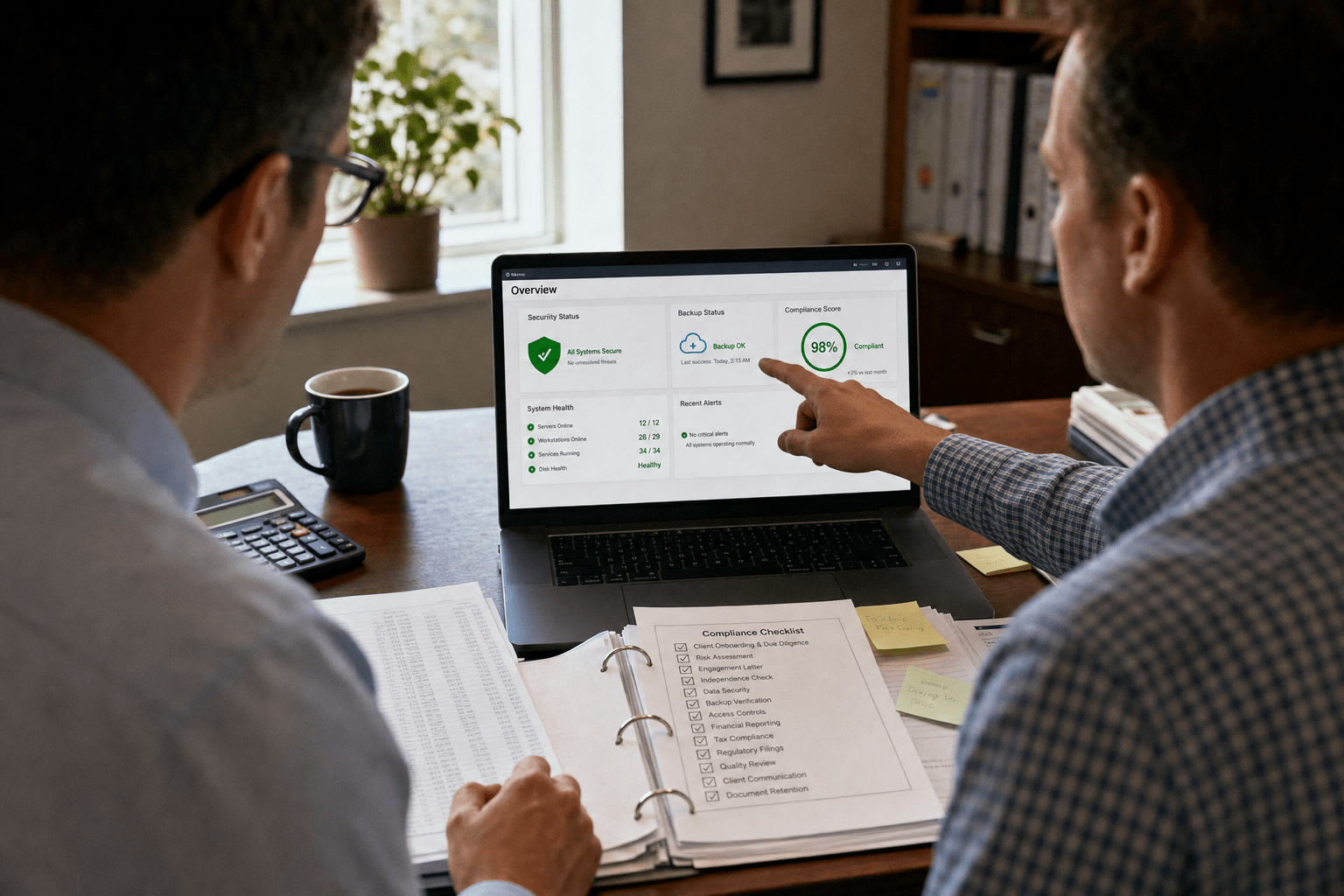
IT consulting for accounting firms is the work of building technology that survives the two moments that define the business: the crush of tax season when downtime is not survivable, and the audit-and-trust test when a client or regulator asks how their financial data is protected. A good consultant treats those as the same problem, because both come down to systems that stay up and data that stays safe. The right partner keeps your practice running at peak load, meets the security obligations that now apply to firms handling financial records, and plans technology around your busy calendar rather than reacting when something fails mid-return. IT Consulting for Accounting Firms should ensure your systems can withstand peak tax-season demand while meeting audit and security requirements.
The 5 Things Accounting Firms Should Check First
Choosing IT Consulting for Accounting Firms becomes easier when you prioritize uptime, compliance, data protection, industry expertise, and proactive planning. These five points separate a real partner from a general repair vendor.
- Uptime during tax season is non-negotiable. A firm cannot afford lost hours in the weeks that generate most of its revenue.
- Security is now a legal duty, not a nicety. The FTC Safeguards Rule applies to many accounting practices, and clients increasingly ask about it.
- Software specificity counts. A consultant should know how tax and accounting platforms behave under load, not just general office apps.
- Data protection is a client-trust issue. Firms hold Social Security numbers and full financials, which makes them a prime target.
- Planning beats reacting. Firms that map technology around their calendar spend less and panic less than firms that call only when systems break.
Why Accounting Firms Outgrow General IT Support
IT consulting for accounting firms has to be built around a calendar that spikes hard, and general support rarely accounts for that rhythm. A typical business runs at a steady pace all year, so a help desk sized for average demand fits. An accounting firm does not. It runs near capacity through tax season, when a half-day outage can mean missed deadlines, angry clients, and revenue that never comes back. Support that treats your firm like any other office will be understaffed at exactly the moment you need it most.
The reasonable counterargument is that many small firms run for years on basic support and cloud accounting without a crisis. That holds until the firm grows, a client demands proof of data protection, or a regulator comes calling. The IRS Security Summit has pushed hard on tax professionals to formalize data protection, and the expectation now reaches even small practices. Our team scopes support to your actual load and obligations, so a two-partner firm gets a plan sized to a two-partner firm, not enterprise overhead it does not need. Our IT consulting practice starts by mapping your busy season before recommending anything.
A practical test for IT Consulting for Accounting Firms is whether the provider has a documented plan for maintaining uptime during tax season. If they cannot describe how they keep you running at peak, they are the wrong partner for an accounting firm.
How Tax Season Uptime Should Be Engineered
Tax season uptime is engineered by building redundancy into the systems your firm cannot work without, so a single failure never stops the whole practice. The optimistic view is that cloud-based tax software already handles much of this, and for firms fully in the cloud that is largely true. The harder reality is that many practices still run local servers, aging workstations, or a mix, and those single points of failure are exactly what fail under heavy use.
We plan for peak by identifying what breaks the firm if it goes down: the tax platform, the document store, email, and internet access. Each gets a backup path, whether that is a redundant connection, a standby environment, or hardware refreshed before the season rather than during it. Then we load-test the setup ahead of time, because discovering a bottleneck in March is far more expensive than finding it in December.
How the FTC Safeguards Rule Applies to CPA Firms
The FTC Safeguards Rule applies to many accounting firms because they qualify as financial institutions handling customer financial information, and meeting it is now part of running a compliant practice. The rule requires a written information security program, a designated person to run it, risk assessments, access controls, encryption, and staff training. The full requirements are laid out in the FTC Safeguards Rule guidance, and the IRS Security Summit reinforces the same expectations for tax professionals.
There is nuance worth stating plainly. Not every firm interprets its obligations identically, and a very small practice may implement the controls more simply than a large one. That said, the direction is clear: documented security is no longer optional for firms holding client financials. We build the written program and the technical controls together, so a firm can show a client or regulator exactly how their data is protected rather than hoping the question never comes.
How Firms Should Protect Client Financial Data
Client financial data is protected by combining access controls, encryption, current backups, and trained staff, because accounting firms hold exactly the information criminals want most. On one side, the tools to do this are mature and affordable, and a well-configured setup covers most risk. On the other side, the weakest link is usually human: a convincing phishing email during a busy week can undo strong technical controls in one click.
Our approach pairs technology with habit. We enforce multi-factor logins on email and financial systems, encrypt data at rest and in transit, keep tested backups, and train staff to recognize the fraud that targets firms during tax season. For practices that need senior security oversight without a full-time hire, our CISO consulting provides that leadership on call. The point is not to buy more tools, it is to make the whole firm harder to breach.
Where Industry Experience Changes the Plan
IT Consulting for Accounting Firms should reflect direct experience with accounting platforms, tax-season workloads, compliance obligations, and financial data protection. A generalist can support any office, and for routine tickets that is fine. The gap shows in the details that matter to a CPA firm: how a tax platform behaves under load, how to keep document workflows compliant, and how to prepare for the questions an auditor asks.
We bring that context to the table. Because we support firms in the accounting industry, the plan reflects how these practices actually work rather than a template built for a different business. That experience is what lets us anticipate the March bottleneck or the client security questionnaire before it becomes a scramble.
How Planning Ahead Protects the Bottom Line
IT Consulting for Accounting Firms protects the bottom line by turning emergency technology expenses into planned upgrades aligned with the firm’s calendar. Reactive practices replace equipment when it dies, often at the worst moment and at rush prices, and they absorb the downtime that comes with a surprise. Firms with a roadmap know when workstations age out, when software renews, and how the next hire changes the setup, all mapped around the busy season.
The output is a plain budget an owner can defend: what you will spend, when, and why, tied to your calendar and your compliance duties. That predictability is worth as much as the uptime itself, because it lets partners plan the practice instead of reacting to it. A consultant who cannot give you that plan is selling repairs, not strategy.
Frequently Asked Questions
What does IT consulting for accounting firms include?
IT consulting for accounting firms covers technology strategy, tax-season uptime planning, cybersecurity, compliance with the FTC Safeguards Rule, data protection, and ongoing support built around your calendar. The work centers on keeping the firm running at peak and proving that client data is secure. A good engagement starts by mapping your busy season and your obligations before recommending anything.
Does my accounting firm have to follow the FTC Safeguards Rule?
Many accounting firms do, because they handle customer financial information and qualify as financial institutions under the rule. It requires a written security program, a designated owner, risk assessments, access controls, encryption, and training. A consultant familiar with the rule can build both the documentation and the technical controls so you can answer a regulator or client with confidence.
How do I keep my firm running during tax season?
You keep the firm running by engineering redundancy into the systems you cannot work without, then testing that setup before the season rather than during it. Identify what stops the practice if it fails, give each of those a backup path, and refresh aging hardware early. Load-testing in December is far cheaper than discovering a bottleneck in March.
Why are accounting firms targeted by cyberattacks?
Accounting firms are targeted because they hold concentrated financial data, Social Security numbers, and full client records, which is exactly what criminals monetize. Attacks often arrive as phishing or payment fraud timed to the busy season when staff are stretched. Multi-factor logins, encryption, tested backups, and trained staff stop most of what reaches a firm.
How much does IT consulting cost for a CPA firm?
Cost depends on firm size, whether you run local servers or full cloud, and your compliance needs, so an honest range starts with a conversation. Firms that plan ahead almost always spend less than firms that only call during emergencies. A free strategy call is the fastest way to get a realistic figure for your practice.
Build IT That Passes April and an Audit
IT consulting for accounting firms comes down to a partner who keeps you running when the workload peaks, proves your client data is protected when someone asks, and plans technology around your calendar instead of reacting to failures. That is the difference between IT that threatens a deadline and IT that quietly carries the firm through its hardest weeks. Our team builds these plans with the accounting calendar and the Safeguards Rule in view from the start, so the recommendations fit how your practice actually runs. If you want to see what a tax-season-ready plan looks like for your firm, book a free strategy call and we will map it with you.

