

A healthcare data breach investigation usually takes months, and the slowest part is rarely the forensic work that finds the attacker. It is the data review that follows: working out which files were taken, which patients appear in them, and what information each record holds. Two recent cases reported by The HIPAA Journal show the pattern clearly. Casper Orthopedic Associates in Wyoming discovered a cyberattack on May 23, 2026, finished its investigation by June 11, and then spent until September 2 reviewing data before mailing letters to 56,197 people. Atlantic Digestive Specialists in New Hampshire saw unauthorized access on March 16 and 17, 2026, and did not begin notifying patients until September 30. In both cases, the attacker was gone within days. The months went to sorting the practice’s own files. That gap is something a practice can shrink long before anyone breaks in.
Five Points Every Practice Leader Should Take From This
Before the detail, here is what we tell practice administrators and IT managers at medical groups of 20 to 300 staff when they ask why breach response drags on.
- The forensic phase is usually fast. Investigators can often confirm how an attacker got in and what they touched within two to four weeks.
- The data review is usually slow. Turning “these folders were copied” into a list of named patients and data types is manual work, and it scales with how messy your file shares are.
- Unknown data is the real cost driver. Scanned referrals, old exports and spreadsheets on shared drives hold Social Security numbers and diagnoses nobody remembers storing.
- The 60-day HIPAA clock starts at discovery. Under the HIPAA Breach Notification Rule, notice is due without unreasonable delay and no later than 60 days after discovery, so a slow review eats a deadline that is already running.
- Preparation is mostly inventory work. Knowing where protected health information (PHI, the patient data HIPAA covers) lives, and keeping less of it, does more for response speed than any single security tool.
Why a Healthcare Data Breach Investigation Stalls After Containment
The process stalls after containment because the questions change from “how did they get in” to “whose data did they take,” and the second question depends on records the practice rarely keeps in order.
Our team sees the same arc in the wild. The first week is loud: the alert, the outside incident response firm, password resets, maybe a ransom note. Then the forensic report lands and says something like “the threat actor accessed the file server and may have exfiltrated data from three shares.” That sentence is where the slow part begins. Somebody now has to open every file in those shares, identify each person named, and classify what was exposed. At Atlantic Digestive Specialists, the exposed categories ran from names and Social Security numbers to passport numbers, payment card data, diagnosis and prescription details, Medicare numbers, and even login credentials and electronic signatures. Every one of those categories has to be mapped to a person before a letter can go out.
Is the delay a sign the practice did something wrong?
Not necessarily. A long review can reflect a careful one, and regulators would rather receive an accurate notice than a fast list that misses half the affected patients. On the other side, the Office for Civil Rights has fined organizations for notices that arrived well past 60 days without a documented reason. The honest reading is that a slow review is defensible only when you can show the work, and most practices cannot show it because they never planned for it. Our view is that the delay is rarely misconduct and frequently avoidable.
Who actually does the data review?
In most incidents, a specialist “data mining” or document review vendor does it, often hired through the practice’s breach counsel or cyber insurer. Those vendors run automated scans for patterns such as Social Security numbers, then send ambiguous files to human reviewers. Their speed depends almost entirely on what they are handed. Clean, labeled data moves quickly. Ten years of unlabeled PDFs, faxed referrals and duplicated exports does not.
Why does it matter if the attacker left weeks ago?
Every week of review is a week patients do not know their data is circulating. Identity theft and medical identity fraud do not wait for your letter. A shorter review also lowers what the incident costs, because review vendors bill by volume and hours.
The First Three Delays: Data Nobody Knew Was There
The first three delays all come from data the practice did not know it held, which means they are fixed with inventory and retention work rather than new tools.
Delay 1: File shares with no owner
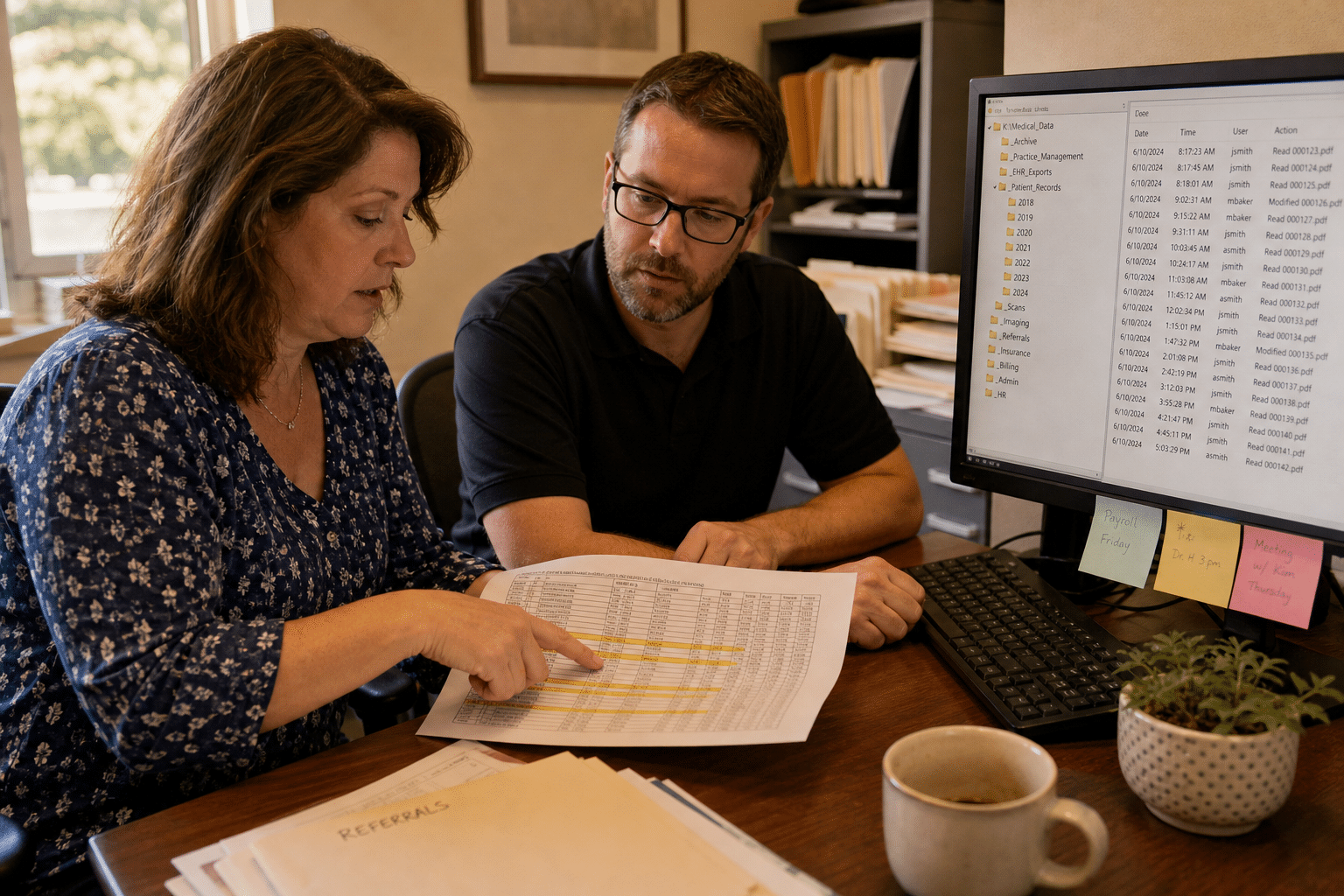
Almost every practice we assess has a shared drive that grew without rules. Billing staff save remittance exports there. Front desk teams scan insurance cards into it. A departed office manager left a folder of patient lists from a 2019 recall campaign. When an attacker copies that share, every one of those files enters scope. We recommend a simple test: ask who owns each top-level folder on your file server. If nobody can answer for a folder, that folder will slow your review. Our healthcare data management work starts exactly there, assigning an owner and a purpose to each location that holds PHI.
Delay 2: Retention that never ends
HIPAA requires certain documentation to be retained for six years, and state medical record laws set their own periods. Neither requires a practice to keep a 2014 appointment export on a live server forever. Old data that should have been archived offline or deleted is the single biggest source of avoidable review volume we see. Set retention periods per data type, move expired data to offline archives, and delete what no law requires you to keep. Each file you no longer hold is a file nobody has to review.
Delay 3: Unstructured documents and images
Structured data in an EHR is easy to scope because the system knows which field holds a Social Security number. Scanned images are the opposite. A faxed referral saved as a TIFF or PDF holds a name, birth date, insurance number and diagnosis, and a pattern scanner may miss all of it without optical character recognition. Review vendors then route those files to human reviewers, which is the slowest and most expensive path. Reducing scans saved outside the EHR, and filing the ones you keep into the patient chart instead of a shared folder, removes the worst of this delay.
The Last Three Delays: Decisions Nobody Made in Advance
The last three delays come from decisions a practice could have made calmly in advance but instead makes under pressure in the middle of an incident.
Delay 4: No logs to narrow the scope
Investigators can only narrow what was taken if logs show it. Without file access auditing on the server, or with logs that roll over after a few days, the forensic report has to assume every file the attacker could reach was taken. That assumption multiplies review volume. Turning on file auditing for PHI locations and keeping at least 90 days of logs in a separate system lets investigators say “these 4,000 files” instead of “this entire server.” We cover the logging and access controls that matter most in our guide to data breach prevention controls that cut SMB risk.
Delay 5: No pre-selected incident partners
Practices that start their search for breach counsel, a forensic firm and a review vendor after the attack lose one to three weeks before any real work begins. Check whether your cyber insurance policy already names approved vendors, and get their contact details into your incident response plan now. If you have no plan, start with our checklist on what to do immediately after a data breach, then build out the roles. A retained data breach incident response partner who already knows your network skips the discovery phase entirely.
Delay 6: No address and contact data ready for mailing
Once the review produces a list of affected people, the practice still has to match each one to a current mailing address, identify minors and deceased patients, and decide on credit monitoring. Patient addresses in a practice management system drift out of date quickly. Knowing in advance how you will pull a clean address export, and who approves the notice letter text, prevents a final two to three weeks of delay after the review is already finished. At Casper Orthopedic, letters went out six days after the review closed; at Atlantic Digestive, it took about three weeks.
How Practices Shorten a Healthcare Data Breach Investigation Before It Starts
Practices shorten the process by doing the review’s preparation work in peacetime: mapping where PHI lives, cutting what they keep, and making sure investigators will have the logs to narrow scope.
What does a PHI data inventory actually look like?
A useful inventory is a spreadsheet, not a project. List every system and storage location that holds patient data: the EHR, the practice management system, file shares, Microsoft 365 mailboxes and OneDrive, scanners, fax servers, backup sets, and any third-party portals. For each, record the data types, the owner, the retention period, and whether access logging is on. Some practices find this exercise takes two afternoons. Others find a server nobody knew still held patient records, which is the point of doing it.
Should practices encrypt data at rest to avoid notification?
Encryption helps more than most practices realize. Under HHS guidance, PHI encrypted to an approved standard, with keys that were not compromised, is not “unsecured,” so its exposure may not trigger notification at all. That is a strong reason to encrypt file servers, laptops and backups, as covered in our healthcare data encryption standards guide. The opposing view deserves weight too: encryption at rest does nothing when an attacker steals credentials and reads files through a logged-in session, which is how many intrusions work. Treat encryption as one control that shrinks scope, not as a substitute for inventory.
How often should the plan be tested?
Run a tabletop exercise at least once a year, and use a scenario that forces the data question. Do not stop at “ransomware encrypted the server.” Ask “the forensic firm says three shares were copied; how long until we know which patients are affected?” If nobody in the room can answer, you have found your longest delay. Our work with healthcare organizations includes exactly this kind of exercise, alongside the ransomware playbooks in our piece on protecting patient data from ransomware.
What Regulators Look For in the Investigation Timeline
Regulators reviewing a breach response look less at how long it took and more at whether each delay was documented, reasonable and necessary to give patients accurate information.
What does “without unreasonable delay” mean in practice?
The Breach Notification Rule treats 60 days as an outer limit, not a target. The Office for Civil Rights has said that waiting until day 60 when the facts were known earlier can itself be unreasonable. When a review legitimately runs past 60 days, practices generally notify based on what they know and supplement later, or document why the full picture was not available. Neither path works without a written record of the review’s progress.
Do state laws add their own deadlines?
Yes. Many states set separate notice periods for Social Security numbers, driver’s license numbers and financial account data, and some require notice to the state attorney general. A breach that touches residents of several states can carry several overlapping clocks. Breach counsel tracks these, but the practice supplies the data, so a clean inventory speeds the legal work as well.
What should the practice document during the review?
Keep a dated log of each milestone: discovery, containment, forensic findings, review start, review completion, address matching and mailing. Record the reason behind any gap of more than a week. Our guide on what a company should do after a data breach walks through the records that hold up when a regulator asks.
Frequently Asked Questions
How long does a healthcare data breach investigation usually take?
A breach investigation at a medical practice commonly runs two to six months from discovery to patient notice. The forensic phase often closes within a few weeks, while the data review that identifies affected patients takes most of the remaining time. Practices with a current PHI inventory and good access logs tend to finish faster.
Does the HIPAA 60-day deadline pause during the data review?
No, the 60-day outer limit runs from the day the breach is discovered, regardless of how long the review takes. Practices whose review will run longer should consult breach counsel about notifying on known facts and supplementing later. Document the reason for any delay as it happens.
Who pays for the post-breach data review?
Cyber insurance often covers data review costs when the vendor is on the insurer’s approved panel. Without coverage, the practice pays directly, and review vendors usually bill by data volume and reviewer hours. Less stored data means a smaller bill.
Can a small practice do the data review itself?
A small practice can scope its own data if the volume is low and the data is structured, but most rely on specialist vendors. Manual review by office staff is slow and prone to missing patients, which can lead to a second round of notices. Breach counsel usually directs the review to keep it privileged.
What is the single best step to speed up a future investigation?
Build a PHI data inventory and delete data you are not required to keep. That one step shrinks the volume a review has to cover and tells investigators where to look first.
Who Is Behind This Advice
Mindcore Technologies has spent years helping medical, dental and specialty practices prepare for and respond to security incidents, from building PHI inventories to standing up file auditing and incident response plans that hold up under regulator review. The guidance here comes from that field work, and the goal is simple: you run your practice, and we make sure the next incident costs you weeks instead of months. Mindcore is led by CEO Matt Rosenthal, whose focus is helping healthcare and regulated organizations treat security as an operational discipline rather than a one-time project.
Get Your Practice Ready Before the Next Breach
The lesson from Casper Orthopedic Associates and Atlantic Digestive Specialists is not that breaches happen, because every practice already knows that. It is that the months between discovery and patient notice are mostly spent untangling a practice’s own data, and that work can be done now, calmly, at a fraction of the cost. Map where your PHI lives, assign an owner to every location, set and enforce retention, turn on file access logging, pick your incident partners in advance, and keep a clean path to current patient addresses. Each of those steps removes a delay a future investigator would otherwise hit. If you want a second set of eyes on where your practice stands, book a free strategy call with our team and we will walk through your data map and response plan with you.

