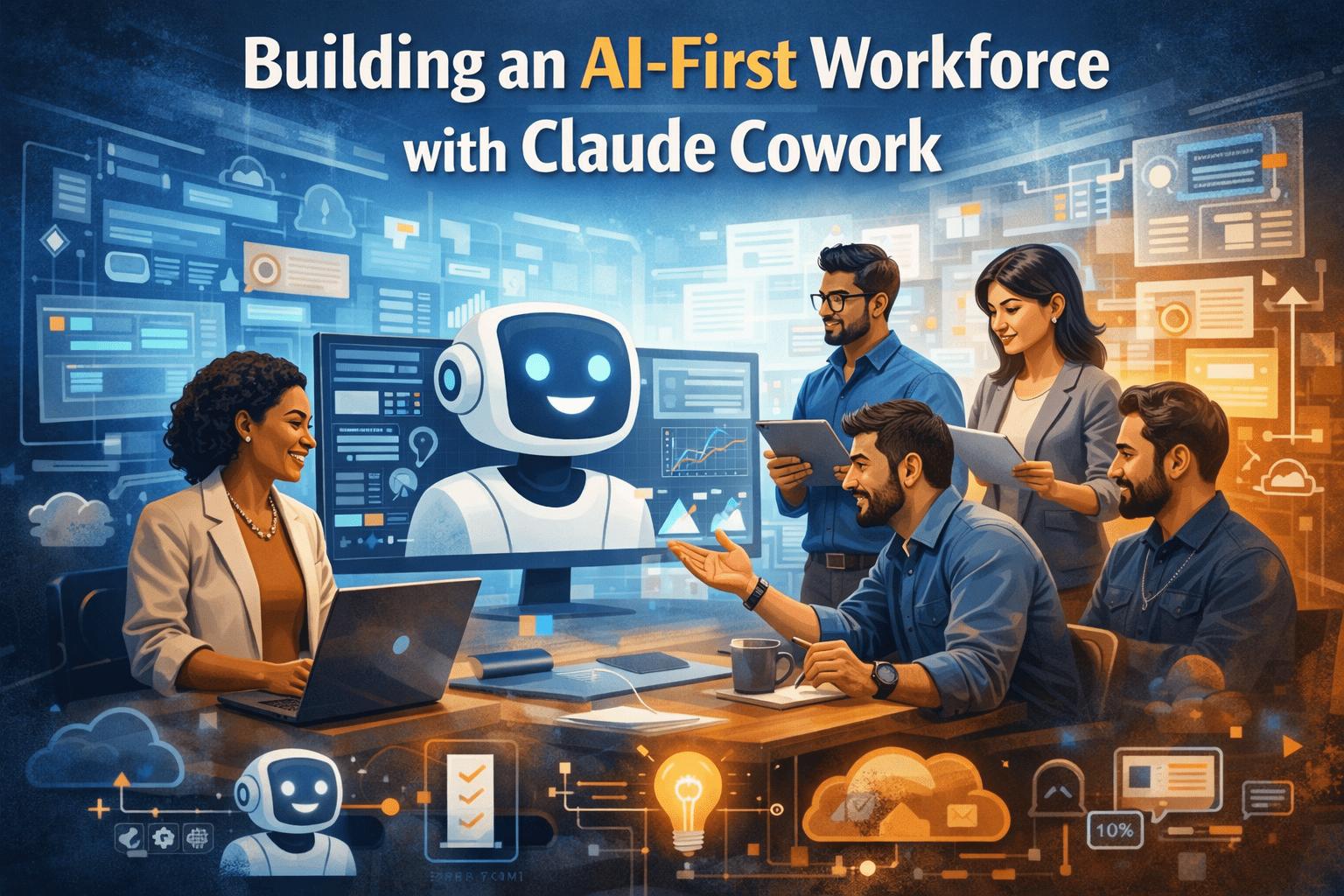
An AI-first workforce is not one where every employee uses an AI chatbot. It is one where AI is embedded in the work itself — running alongside employees, handling execution tasks automatically, and freeing human attention for the work that actually requires it.
Most organizations are not there yet. They have AI access. They do not have AI integration. The gap between those two states is the difference between an organization that has adopted AI as a productivity tool and one that has rebuilt its operational model around it.
Claude Cowork is the product that closes that gap at the workforce level — giving every operational employee direct access to desktop-level automation, without technical barriers, without IT dependency, and without changing the platforms they already use.
Overview
Building an AI-first workforce requires more than deploying AI tools to knowledge workers. It requires reaching every employee who manages high-frequency operational work — and giving them automation capability that runs persistently, executes independently, and adapts to their specific workflows without requiring technical configuration to set up or maintain.
- An AI-first workforce embeds automation at the operational layer, not just the knowledge layer
- Cowork operates as a desktop agent that runs persistently across the full work environment
- Non-technical staff access AI automation independently — no IT tickets, no developer dependencies
- Workforce transformation scales when every operational employee can deploy automation, not just technical staff
- The AI-first transition is an operational decision, not a technology procurement decision
The 5 Why’s
- Why is AI tool adoption not the same as building an AI-first workforce? Tool adoption means employees have access to AI outputs when they ask for them. An AI-first workforce means AI is running as part of the operational structure — executing tasks, managing files, and coordinating workflows without requiring employee prompts for every cycle.
- Why has AI-first adoption stalled at the knowledge worker layer? The tools that exist for AI automation were built for technical users. Operational staff — the employees managing the highest volume of repetitive work — have been excluded from AI-first capability by configuration barriers that knowledge worker tools were never designed to address.
- Why does building an AI-first workforce require desktop-level deployment? The operational work that defines daily workforce output lives in the local environment — desktop files, task systems, coordination tools. AI that cannot reach that environment cannot transform it. Desktop-level access is the prerequisite for AI-first operational impact.
- Why does non-technical accessibility determine whether the AI-first transition scales? An AI-first workforce is an organization-wide condition, not a department-level one. If automation requires technical resources to deploy, it will always reach a fraction of the workforce. Plain-language configuration is what makes AI-first adoption possible at the scale of the full operational team.
- Why is the AI-first transition an operational decision rather than a technology decision? The tools are available. The decision is whether to restructure the operational model around them — replacing manual execution defaults with automated ones across the full workforce, not just the departments that already have technical automation access.
What an AI-First Workforce Looks Like in Practice
An AI-first workforce has one defining characteristic: AI handles the work that does not require human judgment, and humans handle the work that does. That boundary is not theoretical — it is enforced at the operational level by automation that runs persistently, handles execution tasks independently, and adapts to workflow conditions without manual intervention.
With Claude Cowork deployed across an operational workforce, that looks like:
- File management runs automatically — files are organized, named, archived, and routed before employees engage with them
- Task workflows execute without manual logging — tasks are created, updated, and closed based on defined conditions
- Coordination handoffs happen on schedule — outputs are routed and follow-up actions triggered automatically
- Recurring processes run end-to-end — multi-step workflows that previously required manual re-triggering at each stage complete without intervention
- Audit trails generate by default — every automated action is logged, timestamped, and attributable
The workforce is still doing the same jobs. The work that consumed their attention for low-complexity execution no longer does.
Why the AI-First Transition Starts With Operational Staff
The instinct in most AI-first strategies is to start with the highest-value employees — executives, knowledge workers, technical staff. That instinct misidentifies where the most automatable work actually sits.
Operational staff — project coordinators, administrative teams, operations managers, team leads — manage a disproportionate share of the high-frequency, rule-consistent work that AI automation handles best. They are also the employees who have received the least benefit from AI investment to date. Starting the AI-first transition with this population is not a compromise. It is where the return per deployment is highest.
Why Persistent Execution Defines the AI-First Standard
An AI-first workforce is defined by AI that runs continuously, not AI that is consulted intermittently. The difference is not semantic. A tool that requires a prompt for every cycle produces returns proportional to how often employees use it. An agent that operates persistently based on defined conditions produces returns continuously — including when employees are focused on other work, in meetings, or offline.
Cowork’s desktop agent model meets that standard. Workflows run on conditions, not prompts. The agent operates across the full workday without requiring employee attention to trigger each execution cycle. That persistence is what separates an AI-first operational model from an AI-assisted one.
Why Configuration Accessibility Is the Workforce Transition Enabler
Every AI-first transition eventually encounters the same question: who can actually set up and modify the automation? If the answer is “the IT team” or “someone with developer skills,” the transition stalls at the technical perimeter of the organization.
Cowork’s plain-language configuration makes every operational employee the answer to that question. Automations are defined in terms that operational staff understand — what to do with this type of file, when to create this task, how to route this output. The IT team is not in the critical path. Adoption scales across the full workforce without a corresponding increase in technical workload.
Building the AI-First Workforce: The Deployment Path
- Map the manual work — identify where operational staff spend the most time on high-frequency, rule-consistent tasks across file management, task coordination, and execution workflows
- Start with highest-volume workflows — deploy Cowork automations for the operational tasks that consume the most daily time before expanding to lower-frequency ones
- Enable self-service configuration — train operational staff to build and modify their own workflows using Cowork’s plain-language interface, removing IT from the routine automation cycle
- Expand across operational teams — scale Cowork adoption to every team managing significant manual execution volume, not just the initial pilot population
- Measure output and attention shift — track how automated execution changes where employee time and attention goes, not just how many automations are running
A Simple AI-First Readiness Check
Your workforce is not yet AI-first if:
- AI tools are in use but operational execution workflows are still running manually
- Automation access is concentrated in technical teams, not distributed across operational staff
- Workflow automation requires IT or engineering resources to configure or modify
- Employees use AI for generation tasks but not for task execution or file management
- AI adoption is measured by tool licenses, not by the share of routine work that executes automatically
These are the gaps that separate AI-assisted from AI-first.
Final Takeaway
An AI-first workforce is not built by deploying more AI tools. It is built by restructuring the operational model so that AI handles the execution work that does not require human judgment — persistently, consistently, and across the full operational workforce, not just the technical one.
Claude Cowork is the deployment vehicle for that transition. A desktop agent that reaches every operational employee, runs automation persistently without prompt dependency, and scales across the full workforce without IT as the bottleneck at every step.
The organizations that build AI-first workforces in the next two years will not be the ones that adopted AI earliest. They will be the ones that deployed it deepest — into the operational layer where the most manual work lives and the most automation return exists.
Build Your AI-First Workforce With Mindcore Technologies
Mindcore Technologies works with enterprise teams to map the operational work that defines their AI-first opportunity — and deploy Claude Cowork in a way that reaches every employee who needs it, not just the technical staff who already have automation access.
Talk to Mindcore Technologies About Building an AI-First Workforce →
Contact our team to assess where your current workforce is still operating manually — and what the AI-first transition looks like for your specific operational environment.