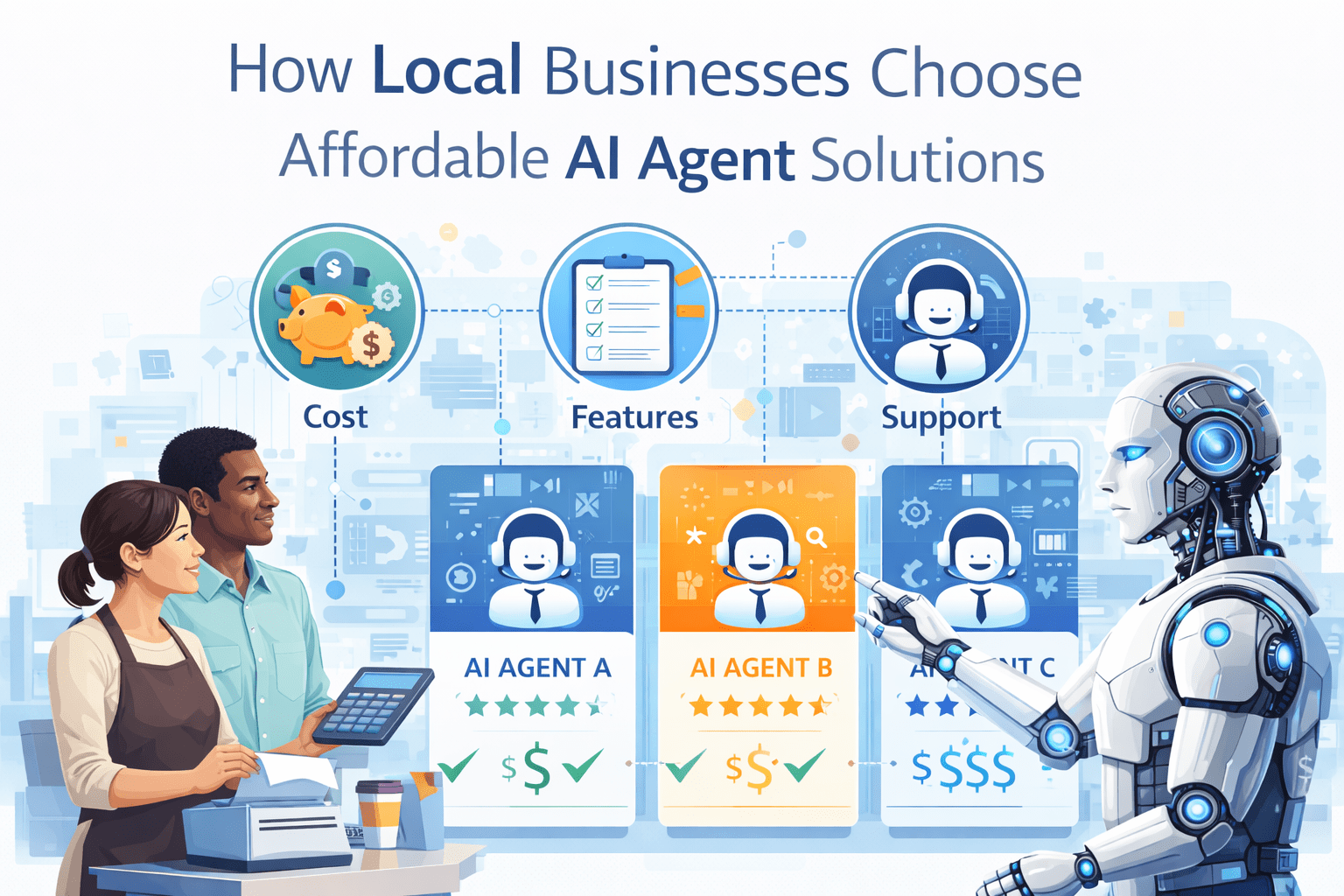
Small businesses do not need the most powerful AI platform on the market. They need the right one for their size, budget, and operational pain points. Choosing affordable AI agent solutions is not about selecting the lowest subscription fee. It is about selecting automation that reduces workload immediately and produces measurable value within weeks, not years.
The broader automation context is introduced in AI Agents for Local Businesses: Small Business Automation Guide, where AI is positioned as operational leverage for small teams.
Affordability must align with impact.
Step 1: Identify High-Impact, Low-Complexity Workflows
Before comparing tools, local businesses should identify repetitive tasks that consume the most time.
Focus areas often include:
• Customer inquiry follow-ups
Prevent missed leads and delayed replies.
• Appointment confirmations
Reduce no-shows and scheduling errors.
• Invoice reminders
Improve cash flow speed.
• Basic CRM data entry
Eliminate manual logging.
Strategic prioritization is expanded in Local Business AI Strategy: Starting Small and Scaling Up.
Step 2: Compare DIY vs. Guided Solutions
Small businesses often choose between self-managed tools and professional implementation.
DIY tools may offer:
• Lower upfront cost
• Immediate setup
• Flexible experimentation
However, risks include:
• Poor system integration
• Limited scalability
• Hidden time costs
• Lack of troubleshooting support
The trade-off is examined further in AI Automation for Small Business: Professional vs. DIY Approaches.
Step 3: Validate Integration Compatibility
Affordable AI must work with existing tools.
Confirm compatibility with:
• Accounting software
Avoid reconciliation headaches.
• CRM systems
Ensure seamless customer data updates.
• Email platforms
Maintain communication flow.
• Scheduling tools
Prevent booking conflicts.
Integration pitfalls are addressed in Local Business AI Integration: Overcoming Common Implementation Challenges.
Step 4: Understand True Cost Structure
Low monthly pricing can hide long-term expenses.
Review:
• Usage-based pricing tiers
Prevent unexpected overage fees.
• Add-on feature costs
Avoid surprise expansions.
• API access restrictions
Ensure future scalability.
• Support and onboarding charges
Clarify total investment.
Provider comparisons are detailed in AI Agent Providers for Small Business: Comparing Cost-Effective Options.
Step 5: Evaluate Simplicity and Ease of Use
Small businesses do not have full IT teams.
Look for:
• Clear dashboards
Reduce training time.
• Simple workflow builders
Minimize configuration errors.
• Accessible customer support
Resolve issues quickly.
• Quick onboarding timelines
Limit downtime.
Deployment sequencing is structured in AI Agent Implementation for Local Businesses: Step-by-Step Guide.
Step 6: Prioritize Measurable ROI
AI adoption must show results quickly.
Track:
• Hours saved weekly
• Faster response times
• Increased appointment bookings
• Reduced late payments
• Lower administrative overhead
Measurement discipline is expanded in Small Business AI ROI: Measuring Success with Limited Budgets.
Common Mistakes to Avoid
• Choosing based solely on price
• Automating too many workflows at once
• Ignoring integration compatibility
• Underestimating setup time
• Failing to monitor AI output accuracy
Affordable does not mean careless.
Key Takeaways
Local businesses choose affordable AI agent solutions by identifying high-impact repetitive tasks, validating system compatibility, comparing DIY versus guided approaches, understanding total cost structure, ensuring ease of use, and tracking measurable ROI from the start. When affordability is defined by operational value rather than subscription price alone, AI becomes a sustainable efficiency multiplier that strengthens cash flow, improves customer experience, and reduces administrative strain without overwhelming limited budgets.