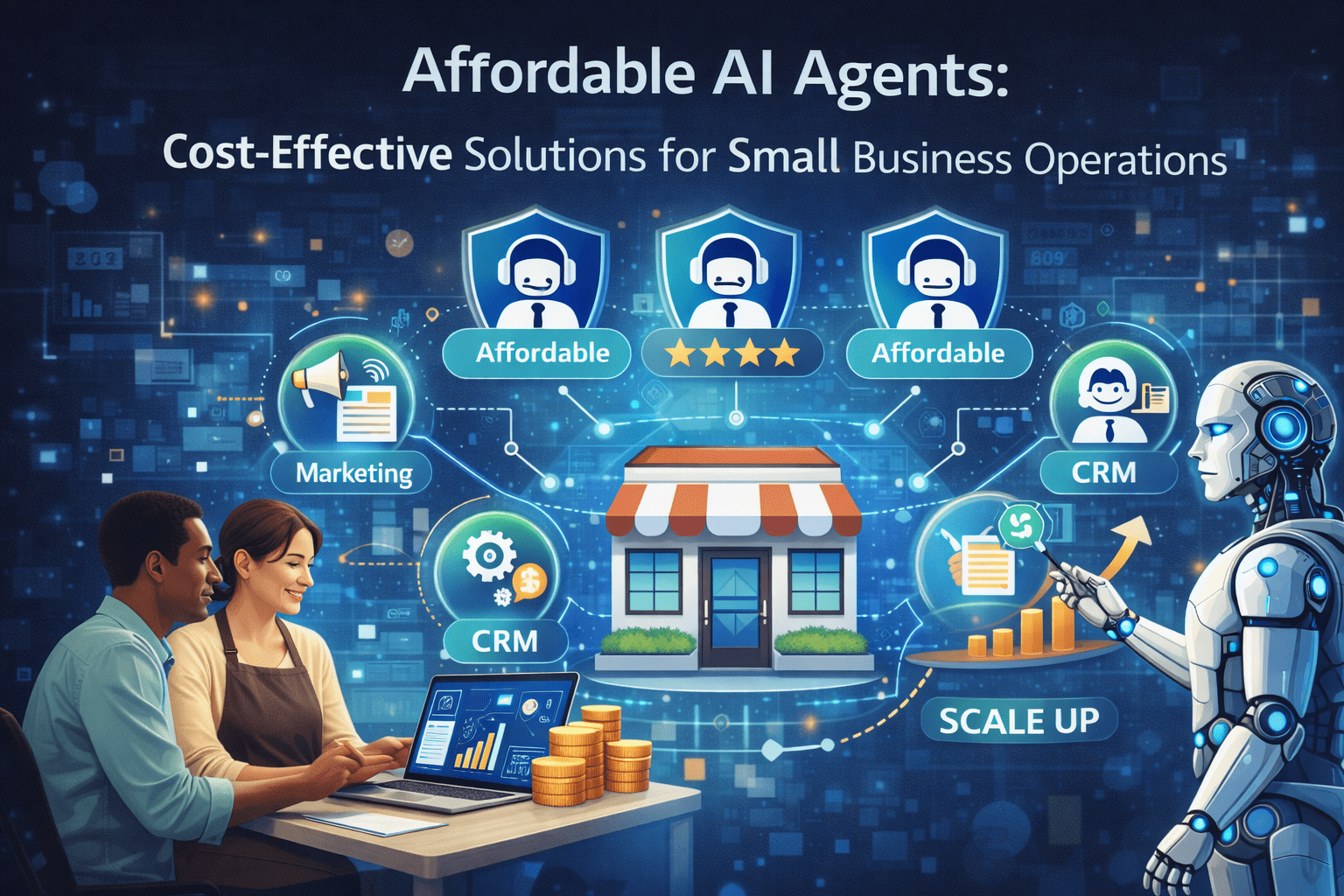
For small businesses, affordability is not about the lowest monthly subscription. It is about maximizing operational impact per dollar spent. Affordable AI agents are solutions that reduce administrative workload, improve revenue consistency, and streamline daily operations without requiring enterprise budgets or in-house technical teams.
The strategic foundation for automation is introduced in AI Agents for Local Businesses: Small Business Automation Guide, where AI is positioned as a practical efficiency tool for lean teams.
Cost-effective automation must balance price, integration simplicity, and measurable ROI.
What “Affordable” Really Means in AI Adoption
Affordable AI agents should:
• Solve one clear operational pain point
Avoid paying for unused features.
• Integrate with existing small business tools
Prevent expensive system replacements.
• Require minimal technical setup
Reduce hidden time costs.
• Scale gradually
Avoid premature tier upgrades.
Selection discipline is reinforced in How Local Businesses Choose Affordable AI Agent Solutions.
Types of Cost-Effective AI Agents for Small Businesses
Customer Communication Agents
These automate inquiries and follow-ups.
• Auto-respond to website or social inquiries
Capture leads instantly.
• Schedule appointments automatically
Reduce administrative workload.
• Send confirmation reminders
Lower no-show rates.
Integration challenges are addressed in Local Business AI Integration: Overcoming Common Implementation Challenges.
Financial Workflow Agents
These improve cash flow management.
• Automated invoice reminders
Shorten payment cycles.
• Basic expense tracking alerts
Improve financial awareness.
• Payment follow-up sequences
Reduce late accounts.
ROI measurement is expanded in Small Business AI ROI: Measuring Success with Limited Budgets.
Marketing Support Agents
These maintain visibility without constant effort.
• Social media scheduling
Maintain consistent posting.
• Basic customer segmentation
Improve targeted promotions.
• Email follow-up automation
Strengthen retention.
Strategic rollout discipline is outlined in Local Business AI Strategy: Starting Small and Scaling Up.
Operational Tracking Agents
These improve internal efficiency.
• Inventory threshold alerts
Prevent stock shortages.
• Basic CRM update automation
Reduce manual entry.
• Reporting summaries
Improve visibility into business performance.
Implementation sequencing is detailed in AI Agent Implementation for Local Businesses: Step-by-Step Guide.
Balancing DIY Tools and Guided Solutions
Affordable AI does not always mean self-managed.
DIY tools may:
• Reduce upfront costs
• Allow quick experimentation
However, professional guidance may:
• Prevent integration errors
• Improve long-term scalability
• Save time troubleshooting
Approach comparison is covered in AI Automation for Small Business: Professional vs. DIY Approaches.
Avoiding Hidden Costs
Affordable AI becomes expensive when:
• Subscription tiers increase unexpectedly
• Multiple overlapping tools are purchased
• Data inconsistencies require manual correction
• Integration issues cause downtime
Provider evaluation frameworks are detailed in AI Agent Providers for Small Business: Comparing Cost-Effective Options.
Signs You Selected the Right Affordable AI Agent
• Administrative workload decreases within weeks
• Customer response time improves immediately
• Invoice payments accelerate
• Data consistency improves
• Monthly cost remains predictable
• Scaling options remain flexible
Affordable automation should feel lighter, not heavier.
Key Takeaways
Affordable AI agents for small business operations deliver measurable efficiency gains without excessive complexity or unpredictable costs. By focusing on high-impact workflows, validating integration compatibility, balancing DIY and professional support appropriately, and tracking ROI consistently, local businesses can implement cost-effective automation that strengthens cash flow, improves customer responsiveness, and supports gradual, sustainable growth without overwhelming limited resources.