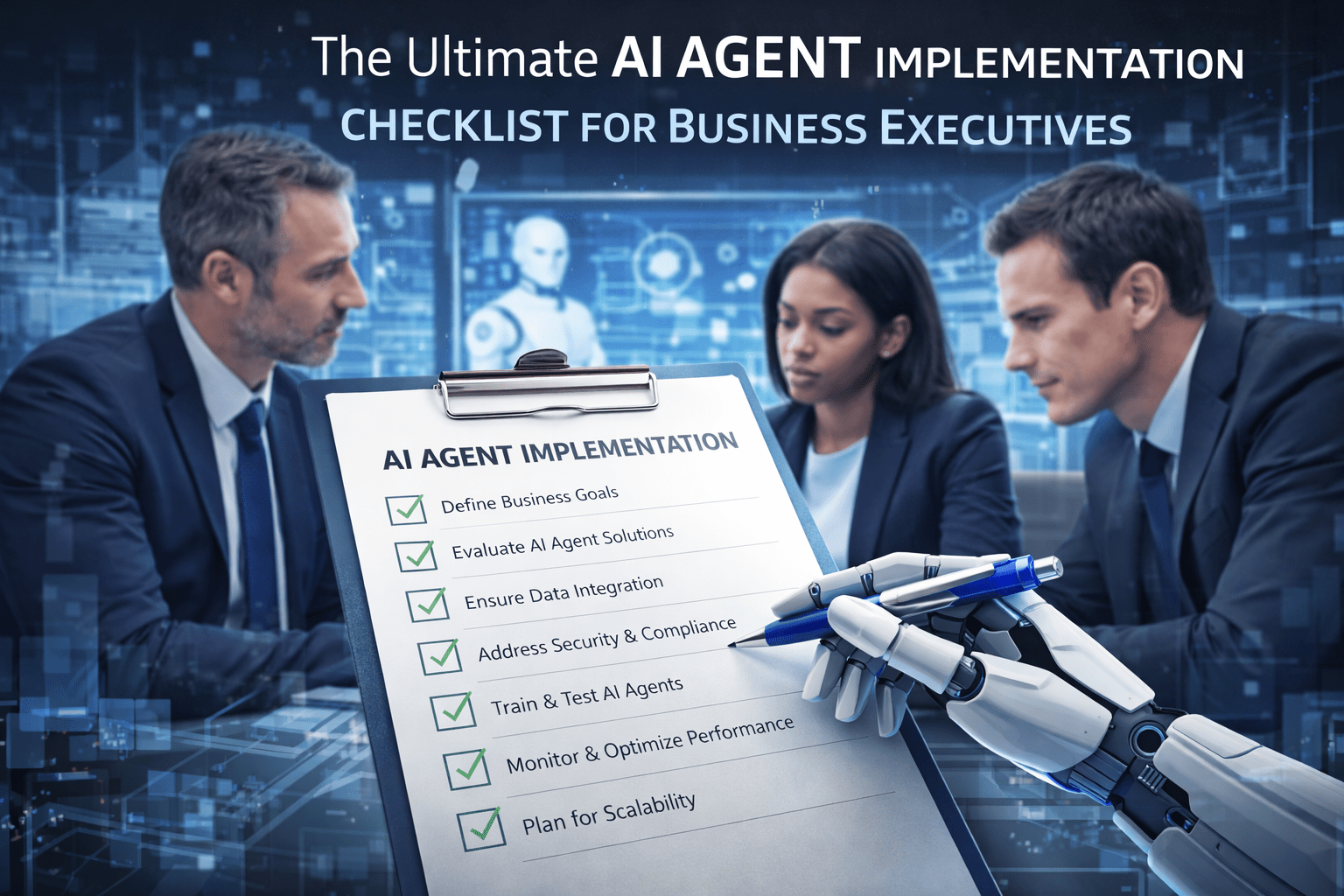
AI agents should never be deployed as isolated pilots without governance. Enterprise AI implementation is not a technology rollout. It is an operational architecture transformation. Without structured sequencing, organizations risk data leakage, workflow inconsistency, compliance exposure, and uncontrolled automation.
The broader framework for enterprise AI adoption begins in The Complete Guide to AI Agents for Enterprise Business Operations, where AI agents are positioned as infrastructure rather than experimental tools.
This executive checklist ensures AI deployment is controlled, scalable, and defensible.
Phase 1: Operational Readiness Validation
Before deploying AI agents, executives must validate foundational readiness.
Checklist validation:
• Have core workflows been mapped and documented?
Prevent automation of undefined processes.
• Have repetitive high-volume tasks been identified?
Prioritize measurable ROI opportunities.
• Have reporting bottlenecks been documented?
Target executive dashboard acceleration.
• Has data classification been completed?
Protect sensitive information before integration.
Workflow mapping principles are expanded in AI Agents for Business: A Comprehensive Guide to Automated Operations.
Phase 2: Security and Access Governance Controls
AI agents require system-level access. Governance must precede integration.
Checklist validation:
• Are AI agents operating under Role-Based Access Control (RBAC)?
Restrict data visibility.
• Are API permissions scoped and documented?
Prevent over-permissioning.
• Are encrypted communication channels enforced?
Protect data in transit.
• Is AI agent activity logged and auditable?
Preserve defensibility.
Security architecture discipline is reinforced in Enterprise AI Compliance: Securing AI Agents in Corporate Environments.
Phase 3: Integration Architecture Design
AI agents must integrate cleanly into enterprise systems.
Checklist validation:
• Are ERP, CRM, HRIS, and BI integrations clearly documented?
Maintain architectural clarity.
• Is centralized SIEM monitoring integrated?
Consolidate activity logs.
• Is anomaly detection enabled for AI behavior?
Identify misuse or drift.
• Is cross-system orchestration tested in staging environments?
Prevent production disruption.
Integration risk mitigation is detailed in Top AI Integration Challenges Facing Enterprise Organizations Today.
Phase 4: Governance and Oversight Alignment
AI deployment must align with leadership cycles.
Checklist validation:
• Is there a defined AI governance owner?
Clarify accountability.
• Are quarterly AI oversight briefings scheduled?
Institutionalize reporting rhythm.
• Are executive dashboards integrated with AI outputs?
Strengthen visibility.
• Is compliance documentation automated where possible?
Reduce manual strain.
Strategic governance alignment is explored in How to Build AI-Powered Enterprise Operations Strategy.
Phase 5: Scalability and Vendor Validation
Enterprise AI must scale across departments.
Checklist validation:
• Can the AI agent orchestrate multi-department workflows?
Confirm cross-functional support.
• Is the provider architecture extensible via APIs?
Preserve long-term flexibility.
• Are logs exportable to enterprise monitoring systems?
Maintain centralized visibility.
• Does the vendor provide governance advisory support?
Sustain compliance alignment.
Vendor evaluation criteria are outlined in AI Agent Providers: What Business Leaders Should Look for in Partners.
Phase 6: Risk Simulation and Exception Handling
AI systems must operate within defined boundaries.
Checklist validation:
• Have exception-handling workflows been defined?
Maintain human oversight.
• Are escalation triggers configured?
Prevent autonomous decision errors.
• Is model behavior tested under edge-case conditions?
Validate reliability.
• Are rollback procedures documented?
Preserve operational control.
Solution comparison considerations are detailed in AI Agent Solutions for Enterprises: Comparing Options and Finding the Best Fit.
Enterprise Outcomes of Structured Implementation
Organizations that follow this checklist observe:
• Reduced deployment friction
• Controlled API access discipline
• Faster automation scalability
• Improved compliance documentation
• Strengthened executive oversight
• Sustainable AI governance integration
Implementation discipline determines enterprise resilience.
Key Takeaways
Enterprise AI agent implementation requires operational workflow mapping, strict access governance controls, secure integration architecture, centralized monitoring alignment, defined governance ownership, vendor scalability validation, and structured exception handling protocols. By following a sequenced implementation checklist rather than deploying AI opportunistically, business executives transform automation into defensible infrastructure that enhances efficiency, strengthens compliance posture, and supports long-term enterprise scalability.