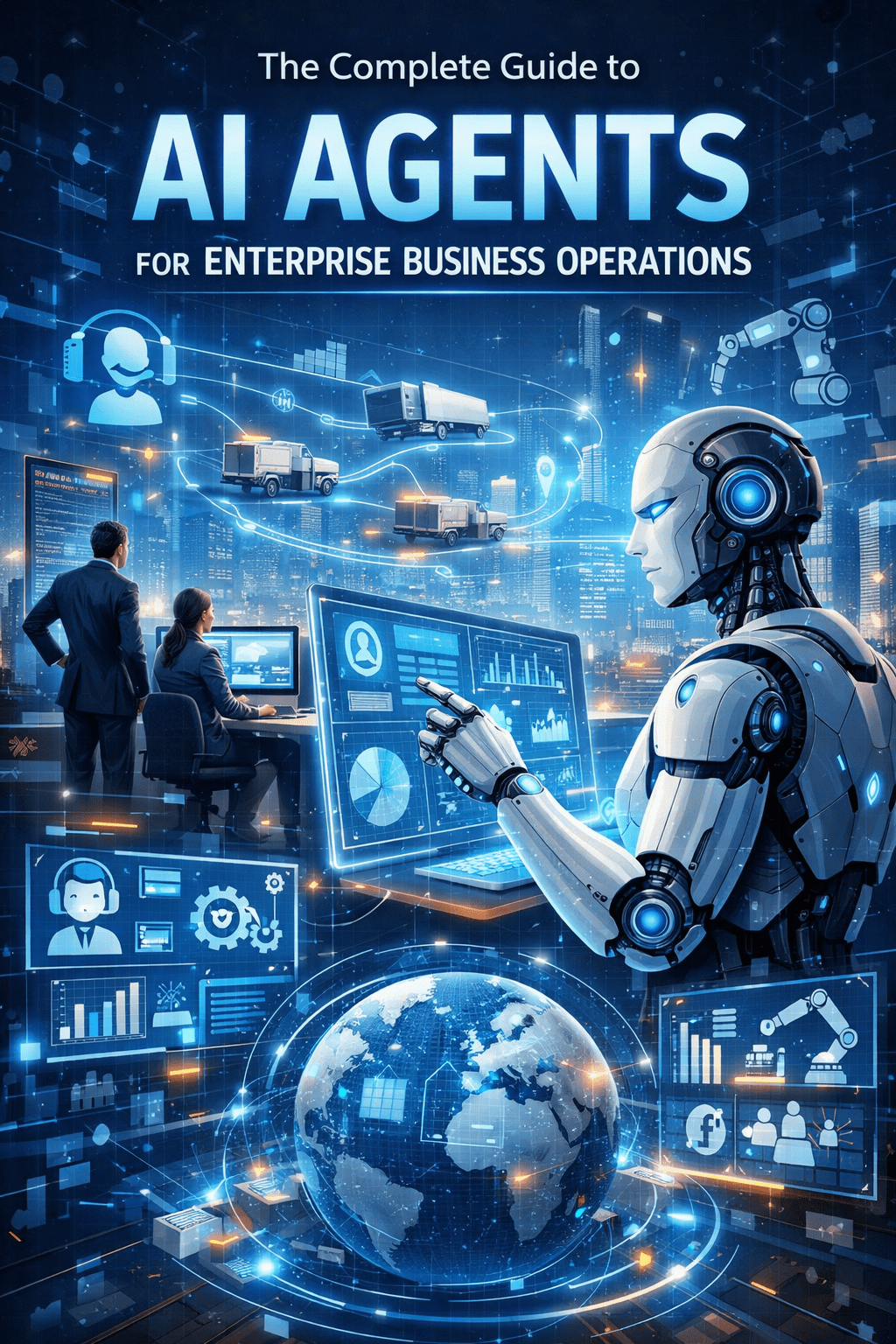
Enterprise organizations are no longer asking whether to adopt AI. They are asking how to operationalize AI safely, strategically, and at scale. The conversation has moved beyond chatbots and productivity assistants. The real transformation is happening through AI agents capable of autonomous task execution, workflow orchestration, decision support, and cross-system integration.
The Complete Guide to AI Agents for Enterprise Business Operations addresses the architectural, strategic, governance, and compliance considerations that executive leaders must evaluate before deploying AI agents across enterprise environments.
AI agents are not tools. They are operational multipliers. When implemented correctly, they reduce manual workload, improve process efficiency, accelerate reporting, and strengthen decision-making discipline. When deployed poorly, they introduce data leakage risk, compliance exposure, and operational fragmentation.
Enterprise AI success depends on structured integration.
What Are AI Agents in Enterprise Context?
AI agents differ from basic automation scripts.
They can:
• Execute multi-step workflows autonomously
• Access structured and unstructured data sources
• Integrate with enterprise platforms (CRM, ERP, HRIS, BI tools)
• Trigger conditional actions based on real-time inputs
• Learn from interaction patterns
These operational capabilities are explored in AI Agents for Business: A Comprehensive Guide to Automated Operations.
Why Enterprises Are Deploying AI Agents
Enterprise adoption is driven by operational pain points:
• Manual data aggregation across departments
Slow executive reporting cycles.
• Redundant administrative workflows
Increase operational cost.
• Delayed compliance documentation generation
Strain audit readiness.
• Inconsistent decision-making frameworks
Reduce organizational alignment.
Strategic selection considerations are detailed in How to Choose the Right AI Agents for Your Enterprise Organization.
Core Categories of Enterprise AI Agents
AI agents in business operations typically fall into:
• Workflow automation agents
Execute predefined process sequences.
• Data aggregation and reporting agents
Consolidate cross-platform metrics.
• Compliance monitoring agents
Detect anomalies and generate documentation.
• Customer and service response agents
Handle structured communication workflows.
• Internal knowledge retrieval agents
Accelerate information access.
Enterprise comparison frameworks are discussed in AI Agent Solutions for Enterprises: Comparing Options and Finding the Best Fit.
Top Enterprise AI Integration Risks
AI agent deployment introduces structured risk:
• Data privacy exposure
• Model hallucination risk
• API over-permissioning
• Inadequate access controls
• Lack of governance oversight
• Compliance documentation gaps
Integration challenges are examined in Top AI Integration Challenges Facing Enterprise Organizations Today.
Governance and Compliance Requirements
Enterprise AI must align with:
• Data privacy regulations
• Internal access control policies
• Audit documentation standards
• Security architecture principles
• Vendor risk management processes
Security frameworks for AI agents are detailed in Enterprise AI Compliance: Securing AI Agents in Corporate Environments.
Executive-Level AI Strategy Alignment
AI agent adoption must support:
• Operational efficiency targets
• Risk reduction objectives
• Reporting acceleration goals
• Workforce productivity optimization
• Long-term enterprise scalability
Strategic alignment frameworks are explored in How to Build AI-Powered Enterprise Operations Strategy.
Implementation Sequencing for Enterprise AI Agents
Successful deployment requires:
• Workflow mapping before automation
• Access governance validation
• Data classification review
• API permission restriction
• Monitoring and anomaly detection integration
• Executive reporting integration
Detailed sequencing is provided in The Ultimate AI Agent Implementation Checklist for Business Executives.
Evaluating AI Agent Providers
Selecting the right partner requires evaluation of:
• Enterprise security integration capability
• Compliance documentation support
• Scalability architecture
• Custom workflow orchestration capability
• Ongoing governance advisory support
Vendor evaluation criteria are explored in AI Agent Providers: What Business Leaders Should Look for in Partners.
Executive Outcomes of Structured AI Deployment
When AI agents are integrated strategically, enterprises observe:
• Reduced manual workload
• Faster reporting cycles
• Lower operational friction
• Improved decision-making clarity
• Stronger compliance documentation
• Scalable automation architecture
AI becomes infrastructure rather than experimentation.
Key Takeaways
Enterprise AI agent deployment requires structured workflow mapping, governance alignment, secure integration architecture, compliance enforcement, and strategic provider evaluation. By embedding AI agents into enterprise operations with controlled access, centralized monitoring, and executive-level reporting integration, organizations transform automation into scalable operational infrastructure that enhances efficiency, strengthens compliance posture, and supports sustainable enterprise growth.