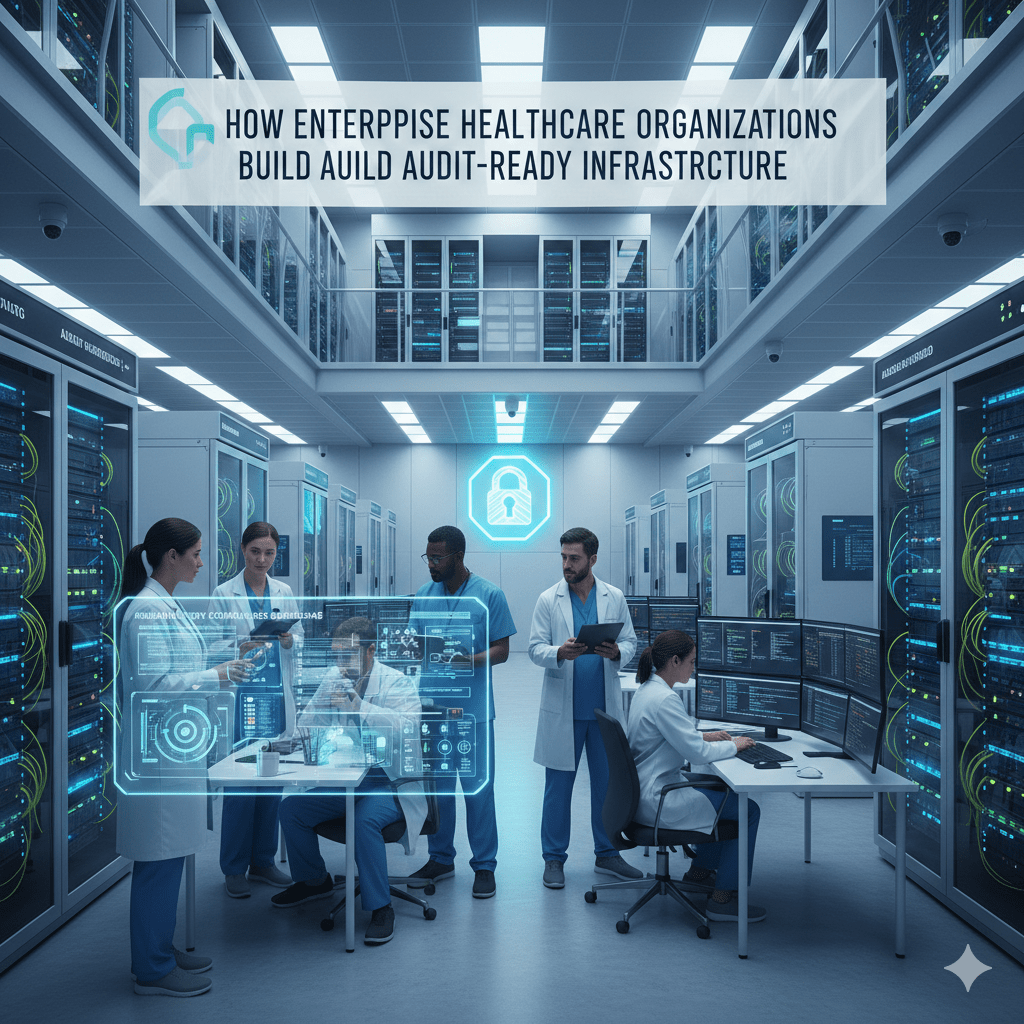
Audit readiness is not a binder. It is not a compliance folder prepared the week before an inspection. For enterprise healthcare organizations, audit readiness is a permanent operational state. Regulators expect immediate access to structured documentation, access logs, risk assessments, and enforcement evidence. If producing that evidence requires weeks of manual effort, infrastructure is not audit-ready.
Enterprise systems operating across multiple facilities, cloud environments, telehealth platforms, and vendor integrations require architectural discipline. As outlined in The Complete Guide to Healthcare Compliance Solutions for Enterprise Organizations, compliance must be engineered into system design rather than layered onto existing environments.
Audit readiness depends on automation, segmentation, encryption enforcement, centralized monitoring, and structured documentation workflows.
What Audit-Ready Infrastructure Actually Means
An audit-ready organization can immediately demonstrate:
• Comprehensive risk assessment documentation
Updated annually and aligned with infrastructure changes.
• Centralized, timestamped access logs
Clearly documenting user activity.
• Verified encryption enforcement reports
Demonstrating PHI protection at rest and in transit.
• Structured incident response records
Showing documented containment actions.
• Vendor governance documentation
Maintaining updated Business Associate Agreements.
These components reinforce operational controls detailed in The Ultimate HIPAA Compliance Checklist for Healthcare Executives.
Core Architectural Components of Audit Readiness
1. Centralized Log Aggregation and SIEM Integration
Fragmented logging creates audit chaos.
• Aggregate logs from cloud, endpoints, servers, and clinical systems
Eliminate visibility gaps.
• Automate compliance reporting dashboards
Provide structured executive summaries.
• Maintain log retention policies with timestamp integrity
Support regulatory defensibility.
• Deploy AI-driven anomaly detection tools
Reduce manual oversight limitations.
Centralized monitoring is also a critical element of Enterprise Healthcare Cybersecurity: A Comprehensive Guide for 500+ Employee Organizations, where detection speed determines breach containment.
2. Healthcare Data Encryption Across All Environments
Encryption must be universal and verifiable.
• Encrypt PHI at rest across all storage platforms
Protect stored records.
• Encrypt PHI in transit across all communication channels
Prevent interception.
• Encrypt disaster recovery repositories
Protect contingency systems.
• Audit encryption key management regularly
Maintain cryptographic integrity.
Encryption consistency strengthens containment architecture explored in ShieldHQ vs Traditional Healthcare Security: Comparing Enterprise Solutions.
3. Strong Identity Governance and Access Discipline
Access control must be precise and automated.
• Implement Role-Based Access Control (RBAC)
Restrict PHI exposure by job function.
• Deploy phishing-resistant MFA enforcement
Reduce credential compromise risk.
• Automate privilege revocation processes
Eliminate orphaned accounts.
• Conduct quarterly access audits
Validate enforcement accuracy.
Identity governance supports sustainable compliance frameworks described in How to Choose the Right HIPAA Compliance Solution for Your Healthcare Organization.
4. Network Segmentation and Secure Workload Isolation
Flat networks undermine audit defensibility.
• Segment clinical, administrative, and vendor systems
Limit lateral movement.
• Isolate high-risk workloads into secure enclaves
Reduce breach scope.
• Restrict backup network pathways
Protect recovery systems.
• Enforce zero-trust access models
Validate every session continuously.
Containment architecture reduces systemic exposure and strengthens governance accountability highlighted in Healthcare Compliance Challenges Facing Executive Leaders Today.
5. Automated Documentation Workflows
Manual documentation introduces errors.
• Automate risk assessment record updates
Maintain compliance accuracy.
• Centralize policy version control
Track regulatory alignment.
• Generate automated audit evidence reports
Reduce preparation time.
• Store documentation in secure centralized repositories
Ensure accessibility during investigations.
Documentation automation enhances executive reporting transparency.
6. Vendor Risk Integration Within Infrastructure
Third-party exposure must be structurally controlled.
• Maintain updated Business Associate Agreements
Ensure contractual HIPAA compliance.
• Limit vendor network access privileges
Reduce unnecessary PHI exposure.
• Monitor vendor session logs continuously
Detect unusual behavior early.
• Conduct annual vendor risk reviews
Evaluate evolving vulnerabilities.
Vendor governance integration strengthens broader Healthcare Compliance Solutions strategies.
Common Infrastructure Weaknesses That Undermine Audit Readiness
• Decentralized logging systems
• Unpatched legacy infrastructure
• Inconsistent encryption coverage
• Overbroad access privileges
• Unmonitored vendor activity
• Manual compliance reporting processes
Each weakness increases regulatory vulnerability.
Establishing a Continuous Audit-Readiness Rhythm
Audit readiness must be sustained.
• Quarterly internal compliance reviews
Validate safeguard enforcement.
• Annual formal risk reassessments
Reflect system evolution.
• Quarterly access privilege audits
Maintain RBAC integrity.
• Encryption enforcement validation cycles
Confirm consistent protection.
• AI anomaly detection trend reviews
Identify emerging patterns.
These structured review cycles create defensibility during regulatory inquiries.
Executive Alignment and Technical Leadership
Audit-ready infrastructure requires alignment between governance and architecture.
Technical strategy must support executive oversight, as detailed in Healthcare Compliance Solutions: What CTOs and CIOs Need to Know.
When infrastructure design and executive governance align, compliance becomes sustainable rather than reactive.
Key Takeaways
Audit readiness is not a documentation milestone; it is an architectural condition created by enforced controls and continuous validation. Enterprise healthcare organizations must centralize logs and monitoring systems to ensure unified visibility across cloud, endpoints, servers, and clinical applications. PHI must be encrypted universally, both at rest and in transit, without gaps across backup or archival systems. RBAC and phishing-resistant MFA must be enforced to secure identity governance and eliminate privilege drift. Networks must be segmented to reduce lateral movement and contain potential breaches. Documentation workflows should be automated to preserve evidence integrity and streamline audit response. Vendor governance must be integrated directly into system design, restricting and monitoring third-party connectivity. Structured quarterly compliance reviews should be established to validate safeguard consistency and address configuration drift proactively.
Infrastructure must continuously enforce compliance safeguards to remain defensible.