

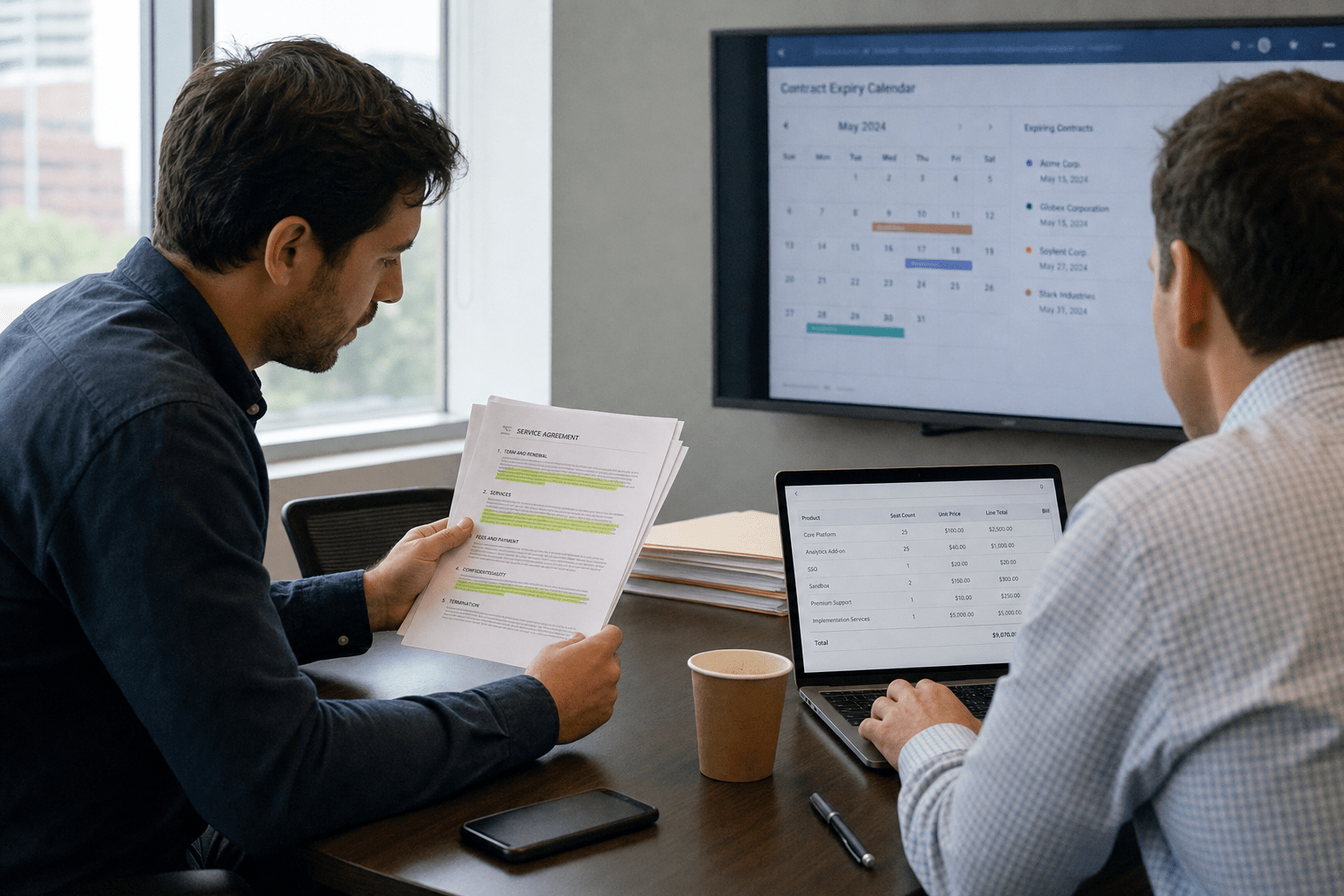
Contract renewal analysis is a reconciliation problem wearing a reading problem’s clothes. The signed agreement says 120 seats at an agreed rate with a defined scope. The professional services automation platform has been billing 141 seats, three of the services listed were quietly absorbed into the base rate two years ago, and nobody has looked at the SLA credit history since the contract was signed. The document is not the hard part. Comparing what it promises against what the systems have actually been doing is the hard part, and it is where the tools in this category either pay for themselves or produce a very polished summary of a document you already understood.
Overview: 5 Things Renewal Analysis Has to Answer
- What did we agree to supply, and what are we actually supplying. Scope drift accumulates quietly and only becomes visible when somebody compares the agreement to the ticket record.
- What are we billing against the agreed seat count. Seat counts move constantly and true-up clauses are often unenforced, in both directions.
- When does it auto-renew, and when does the notice window open. A missed window locks in another term at the old rate, which is the single most expensive administrative error in this business.
- What has the SLA actually cost us. Credits owed but never claimed by the client are a liability sitting in your ticket history.
- How does this contract compare to the rest of the book. One agreement in isolation tells you little. The distribution across 80 clients tells you where the margin is.
Why Renewal Analysis Gets Skipped Until It Is Urgent
Renewals get handled reactively because the analysis is genuinely tedious and the deadline is soft until suddenly it is not. Each agreement is a PDF, each client’s terms differ slightly, and reconciling any one of them against the billing record takes an hour that nobody has scheduled. The result is renewals that roll on unchanged for years, with margin eroding a little in each one. Our enterprise AI integration practice usually begins this work by connecting the contract repository to the PSA rather than by improving how anyone reads.
Auto-renewal notice windows are the deadline nobody tracks
Most managed services agreements renew automatically unless either party gives notice, typically 60 or 90 days before the term ends. That creates a short window, often years after anyone read the contract, in which a rate change or a scope correction is possible. Outside it, the terms lock for another full term.
The argument for leaving this alone is that auto-renewal is usually what both sides want. A stable client on a fair rate does not need an annual negotiation, and opening one invites a conversation about price that the client may win.
The counter is that the window is optional to use and mandatory to know about. Extracting the term end and notice period from every agreement, then putting both on a calendar with an owner, costs one pass through the repository and removes a recurring source of avoidable loss. This is the least glamorous application of document intelligence in this category and reliably the highest returning one. Clients thinking about the same clause from the other side will find our piece on evaluating an MSP before signing useful, since the notice window matters equally to both parties.
Seat counts drift and true-up clauses go unexercised
An agreement priced per user assumes the user count stays roughly accurate. In practice staff join and leave, a client acquires a small competitor, a department is outsourced, and the billed count follows only if somebody reconciles it. Drift runs in both directions, and MSPs discover under billing about as often as clients discover over billing.
There is a fair argument for tolerating small drift. Chasing a three seat variance costs more in goodwill and administration than it recovers, and clients notice a provider that invoices with a calculator in hand.
The threshold is what matters rather than the principle. Set a variance level below which nobody acts and above which it is reconciled at renewal, then measure the variance automatically so the decision is informed rather than avoided. Comparing the contracted count against the identity provider and the PSA agreement record is a three way check that software does well and people do once a year at best.
Definitions cause more variance than headcount does. A contract priced per user and a directory counting enabled accounts will disagree the moment shared mailboxes, service accounts, contractors, and disabled but unremoved accounts enter the picture. Two honest parties can produce numbers 15 percent apart from the same tenant. Write the counting rule into the agreement at renewal, naming the source system and the exclusions, so next year’s reconciliation is arithmetic rather than a negotiation about what a user is.
Scope drift lives in the ticket history, not the contract
Every long running client relationship accumulates work that was never in scope. A quarterly report somebody started producing, a second site added informally, an application supported because the previous engineer knew it. None of it appears in the agreement, all of it consumes hours, and at renewal the provider argues for a rate increase without being able to show what changed.
Some providers treat absorbed work as relationship investment, which is defensible where it is deliberate and small. The problem is that it is rarely either, since absorbed scope tends to be invisible to the people setting the price.
Classifying tickets against contracted service categories turns that invisible work into a number you can put in front of a client. That conversation is far easier with evidence: a list of recurring out of scope requests with hours attached changes a rate discussion from an assertion into a reconciliation. Where the relationship is beyond repair, our guide on ending an underperforming provider relationship covers the exit side of the same analysis.
Where AI Earns Its Place in a Renewal Cycle
Three uses justify the tooling for a provider with more than about 30 agreements. Below that, a well maintained spreadsheet genuinely competes.
Clause extraction across a whole book of agreements
The first pass is the valuable one: read every agreement in the repository and produce a structured record of term dates, notice periods, rate escalation clauses, termination rights, liability caps, and data handling obligations. What was 80 PDFs becomes a table you can sort, and the outliers are visible immediately.
The limitation is that extraction quality falls on amended agreements. A master agreement with four addenda, two of which supersede clauses in the first, is exactly where a model gets confident and wrong. Insist on the tool linking each extracted value back to the page it came from, so a reviewer can confirm the source in seconds rather than re-reading the file.
What the first pass usually reveals is not a bad clause but an inconsistent book. Providers who grew through acquisition, or who changed template three times in a decade, end up with liability caps that differ by an order of magnitude between clients of similar size, and notice periods ranging from 30 days to a full quarter. None of that is visible one agreement at a time. Sorted into a table it becomes a short list of the agreements to prioritise at renewal, which is a better use of the analysis than perfect extraction on any single document.
Comparing the agreement against the billing and ticket record
This is the reconciliation that produces money. Contracted services against billed lines, contracted seats against invoiced seats, contracted response times against measured first response. Each comparison is simple and each requires data from two systems that were never designed to be compared.
Expect integration work rather than a switch. Most PSA platforms expose the agreement and invoice data through an API, and the practical constraint is how consistently your own team has recorded service categories. A tool comparing against inconsistent ticket categorisation returns noise, which is a reason to clean the categories rather than to skip the comparison.
SLA measurement is the comparison most often skipped, and it runs in the client’s favour rather than yours. Response and resolution targets are written into the agreement, the ticket system holds the actual times, and almost nobody joins the two except when a client complains. Running that comparison monthly gives you two things: an early warning where service is slipping before anyone raises it, and an honest position at renewal when a client argues performance. If credits are owed, it is better to know and offer them than to have a client calculate them during a negotiation. Check that the tool can read your ticket timestamps directly rather than relying on a summary report, since business hours calendars and paused ticket states are exactly where two honest calculations diverge. Our overview of managed IT services software covers how those systems fit together.
Drafting the renewal position, with a human owning the number
Once the analysis exists, generating the renewal summary is quick: what changed, what it cost, what is proposed, with the supporting figures attached. The draft saves an hour per client and produces a more consistent document than each account manager writing their own.
What must stay human is the number itself. Pricing a renewal involves judgement about the relationship, the client’s budget cycle, and what a competitor would quote, none of which the analysis knows. There is also a sequencing point worth holding to: send the evidence before the number, ideally in a separate conversation, so the client absorbs what changed before being asked to react to a price. Presenting both at once turns a reconciliation into a negotiation, and the reconciliation is the part that was in your favour. Treat the generated summary as the evidence pack and keep the decision with the person who owns the account. The wider question of where assistance helps and where it does not is covered in our comparison of AI assistants and classic office tools.
How to Compare AI Tools for MSP Contract Renewal Analysis
Four questions. Does it link every extracted value to its source page. Does it handle a master agreement with amendments, or only standalone documents. Which PSA platforms does it integrate with, at what depth, and can it read agreement records rather than only invoices. What does it do with a clause it cannot parse, and is that visible or silent.
The fourth question separates the products worth trusting. A tool that silently returns nothing for an unparsed termination clause leaves you with a table that looks complete, and a gap you will find at the worst possible moment. For anyone reviewing supplier agreements more generally, the same discipline applies to connectivity and vendor contracts, which we covered in our piece on questions to ask before signing an internet contract, and the structural considerations in choosing a managed IT services contract.
Frequently Asked Questions
Can these tools read our existing signed PDFs?
Yes, including scanned ones, though accuracy on a scanned signature page is lower than on a born digital file. The practical requirement is that every extracted value links back to its source page so a person can verify quickly rather than re-reading the agreement.
How do they handle master agreements with amendments?
Unevenly, and this is the weakest point in the category. Ask specifically how the product resolves a clause superseded by a later addendum, and test it with your most amended client agreement rather than a clean template.
Is this worth it for a provider with 20 clients?
Probably not for extraction alone, since 20 agreements can be tabulated by hand in a day. The reconciliation against billing still has value at that size, and a simpler approach of a maintained spreadsheet plus a calendar reminder captures most of the benefit.
Will it integrate with our PSA?
Most connect to the major platforms, with depth varying by vendor. Confirm it reads agreement records and not only invoices, because the agreement record is where contracted seat counts and service categories live.
Who should own the renewal analysis?
Whoever owns the client relationship, supported by whoever owns the data. The analysis is finance adjacent but the conversation is commercial, and separating the two is how a technically correct renewal position damages a working relationship.
The Team Behind This Guidance
Our team works on both sides of these agreements, running managed services and helping clients assess the ones they already hold, which means we see where the analysis usually stops. It stops at the document, and the document is the part everybody has already read. The reconciliation against billing and ticket history is what changes a renewal conversation, and it is the part that needs systems talking to each other rather than better reading. Matt Rosenthal, our chief executive, keeps the practice focused on operational resilience for growing firms, which here means a renewal cycle that reflects what is actually being delivered.
Start With the Next Three Renewals
Pick the three agreements renewing soonest and run the full analysis by hand: term dates and notice window, contracted versus billed seats, contracted versus delivered scope, SLA performance against the promise. It will take a day and it produces two things worth more than a vendor demonstration. You will know what your current process misses, and you will have a concrete test to give any tool you evaluate.
If you want a second opinion on that first pass, or help connecting your contract repository to your PSA so the comparison runs continuously, book a free strategy call with our team.

