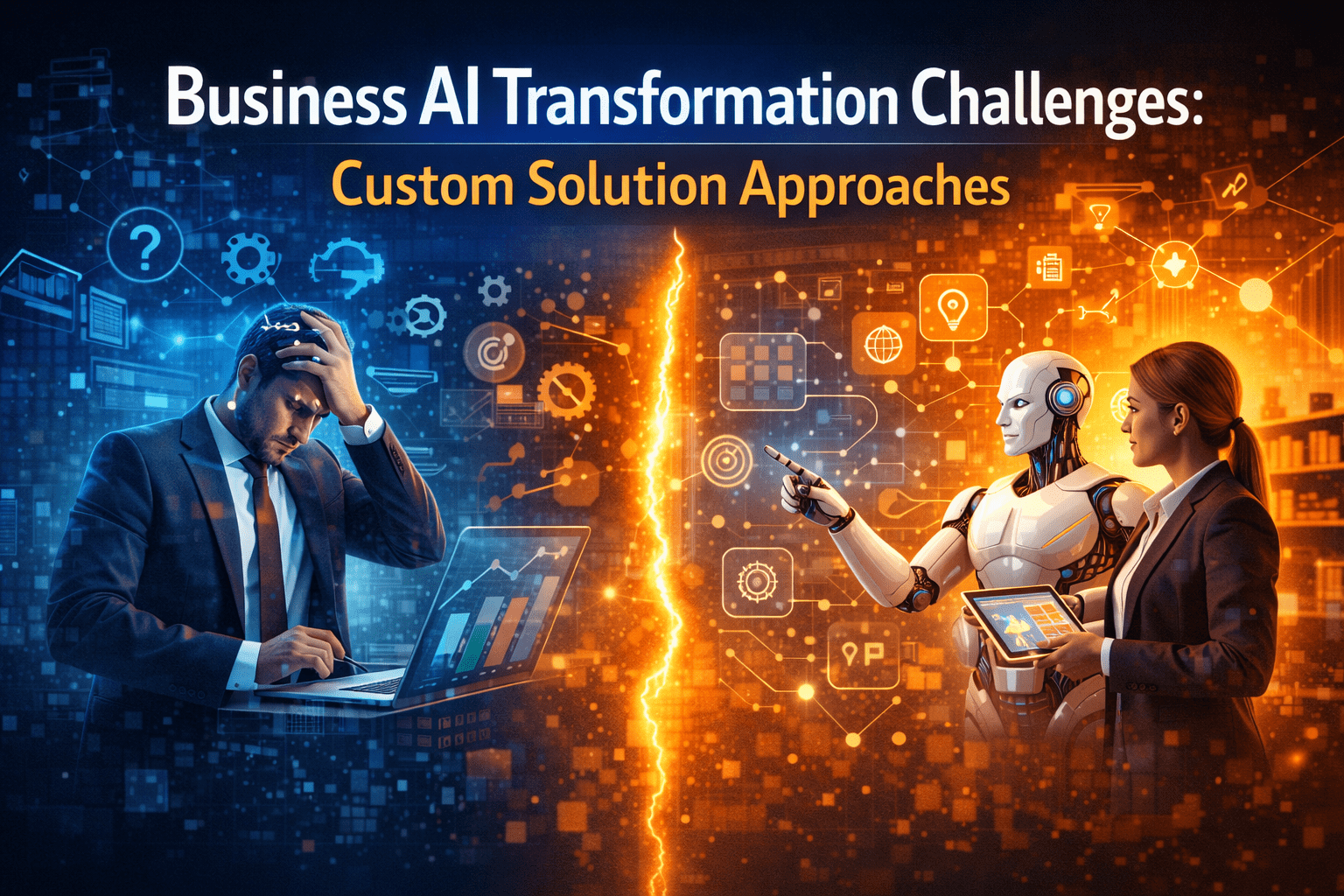
AI transformation rarely fails because of technology. It fails because organizations underestimate structural complexity. Custom AI introduces new architecture layers, workflow redesign, integration dependencies, and governance requirements. Without disciplined planning, automation creates friction instead of efficiency.
The transformation foundation is outlined in Custom AI Solutions for Business: Complete Transformation Guide, where AI is positioned as operational redesign rather than incremental improvement.
Understanding transformation challenges prevents costly disruption.
Challenge 1: Undefined Operational Architecture
Businesses often attempt AI deployment without process clarity.
Common issues include:
• Fragmented workflow ownership
No clear accountability.
• Overlapping software systems
Duplicate functionality increases confusion.
• Manual approval chains embedded in culture
Resistance to structural change.
Solution:
• Conduct operational audits before development
Identify workflow dependencies.
• Redesign inefficiencies before automation
Prevent digitizing poor structure.
Architecture planning depth is expanded in How to Build AI-Driven Business Operations from Scratch.
Challenge 2: Integration Complexity
Custom AI must integrate seamlessly with core systems.
Typical obstacles:
• Legacy ERP limitations
• API permission misconfiguration
• Data synchronization inconsistencies
• Incomplete documentation of existing systems
Solution:
• Prioritize integration mapping early
• Validate system compatibility before development
• Implement staged integration testing
Security reinforcement is detailed in AI Integration Security: Protecting Custom Solutions in Business Environments.
Challenge 3: Unrealistic ROI Expectations
Organizations often expect immediate transformation.
Risks include:
• Underestimating redesign time
• Ignoring employee adaptation period
• Measuring success too early
Solution:
• Establish phased ROI milestones
• Measure operational overhead reduction
• Track reporting acceleration
• Monitor revenue cycle improvement
ROI validation frameworks are outlined in Business AI ROI: Measuring Custom Solution Success.
Challenge 4: Leadership Misalignment
AI transformation impacts multiple departments.
Without alignment:
• IT prioritizes integration
• Operations focus on workflow speed
• Finance demands cost justification
• HR worries about workforce disruption
Solution:
• Create cross-functional steering groups
• Define shared performance metrics
• Align executive oversight with implementation milestones
Partner alignment discipline is covered in How Businesses Choose Custom AI Development Partners.
Challenge 5: Workforce Resistance
Employees often interpret AI as replacement.
Common resistance drivers:
• Fear of job elimination
• Lack of training clarity
• Poor communication from leadership
Solution:
• Position AI as workload reduction tool
• Provide transparent workflow visibility
• Offer structured onboarding for AI systems
Agent-level deployment sequencing is reinforced in Custom AI Agent Development: Business Implementation Guide.
Challenge 6: Security and Governance Gaps
Custom AI introduces new risk surfaces.
Vulnerabilities may include:
• API data exposure
• Inadequate permission enforcement
• Insufficient monitoring dashboards
• Weak anomaly detection systems
Protection strategies are detailed in AI Integration Security: Protecting Custom Solutions in Business Environments.
Enterprise vs Small Business Challenge Differences
Enterprises face:
• Multi-layer governance complexity
• Large integration ecosystems
• Formal compliance requirements
Small businesses face:
• Limited internal IT resources
• Budget constraints
• Need for rapid measurable impact
Transformation scale considerations are explained in Custom AI Solutions: Enterprise and Small Business Transformation Guide.
Key Takeaways
Business AI transformation challenges arise from undefined operational architecture, integration complexity, unrealistic ROI expectations, leadership misalignment, workforce resistance, and security oversight gaps. Custom solution approaches must begin with structured process audits, phased implementation, measurable performance milestones, cross-functional governance alignment, and secure system integration. When organizations address these structural challenges deliberately, AI transformation becomes sustainable infrastructure rather than experimental disruption.