

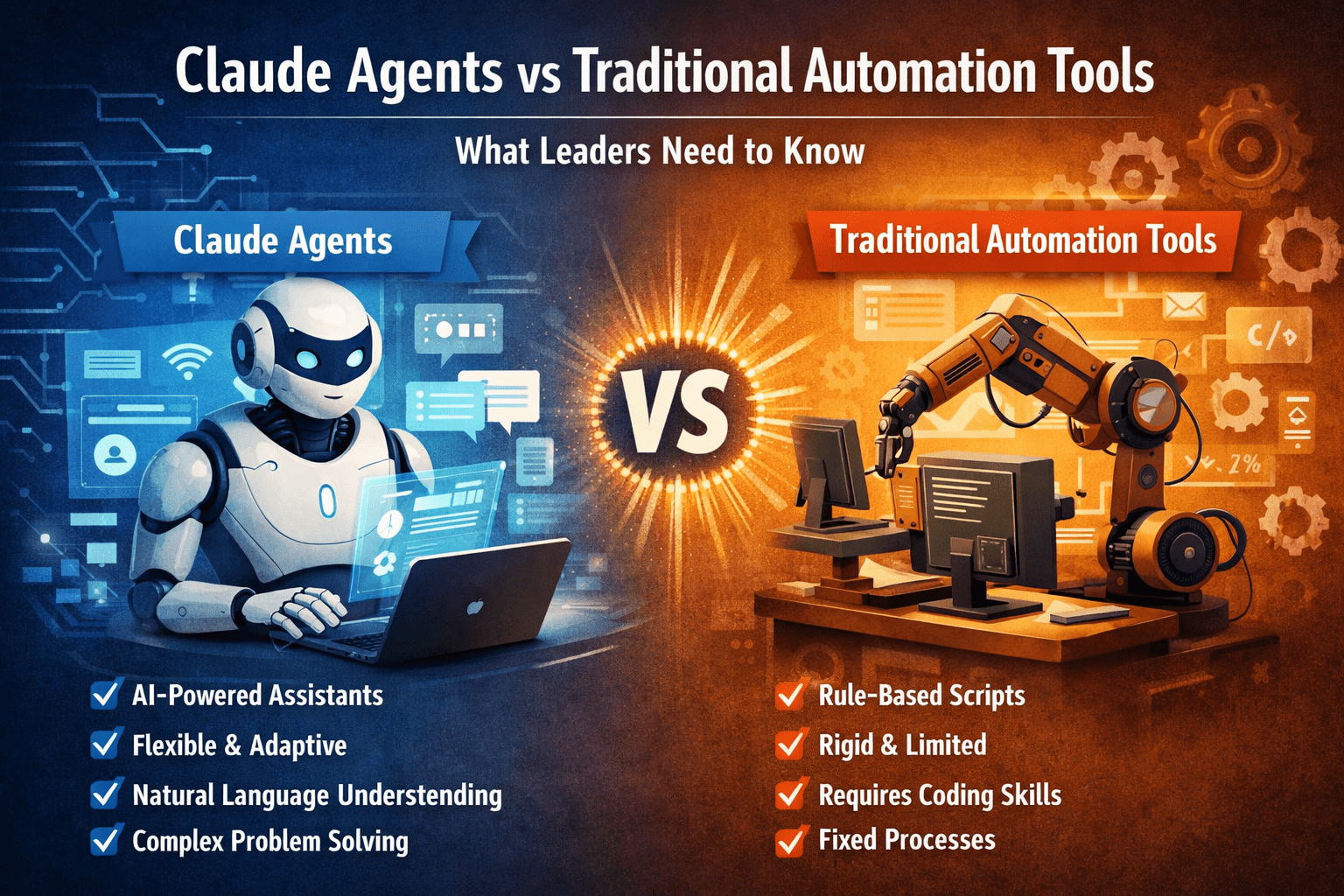
Traditional automation tools have served enterprise operations well for the work they were designed to automate — structured, rule-based, deterministic processes where every step is defined in advance and the inputs conform to expected formats.
Claude Agents handle the work that does not fit that description: variable inputs, multi-step workflows that require judgment at intermediate steps, processes where the path from start to finish depends on what is found along the way. That is not a description of exotic edge cases. It is a description of most complex enterprise workflows.
For leaders evaluating where each capability belongs in their automation architecture, the comparison is not about which is better. It is about which handles which work — and whether the current automation strategy reaches all of it.
Overview
Traditional automation tools and Claude Agents differ in three fundamental ways: how they handle variability in inputs and conditions, whether they can reason about what they encounter during execution, and how they are configured for new workflows. Those differences determine the task types each handles well and the deployment economics of each for different workflow categories. Enterprise leaders who understand both build automation architectures that reach the full operational automation opportunity — not just the portion that fits traditional automation’s design constraints.
- Traditional tools execute defined processes on structured inputs with deterministic, pre-defined logic
- Claude Agents execute toward defined goals on variable inputs with reasoning-based adaptive logic
- Traditional tools require process definition for every scenario; agents handle novel scenarios through reasoning
- Traditional tools are faster and more cost-efficient for structured, stable workflows; agents handle complexity that traditional tools cannot
- The strategic deployment model uses both — and getting the boundary between them right determines how much of the automation opportunity each enterprise captures
The 5 Why’s
- Why do traditional automation tools fail specifically on complex enterprise workflows? Complex workflows involve conditions that were not fully anticipated when the process was defined. Rules-based automation that encounters an unanticipated condition either fails, routes to exception handling, or produces an incorrect result. Agents reason about unanticipated conditions and respond appropriately without requiring the condition to have been anticipated and programmed for in advance.
- Why is reasoning capability the defining difference, not processing speed or accuracy? Traditional automation tools can be faster and more accurate than agents for the specific structured tasks they were designed for. The limitation is not speed or accuracy — it is the inability to reason about conditions that fall outside the predefined rule set. Reasoning capability is what extends automation reach to complex, variable, judgment-dependent workflows.
- Why does goal-directed operation change what automation can handle? Step-directed automation requires every step to be defined and triggered. Goal-directed operation requires only the objective to be defined — the agent determines the steps required to achieve it. That difference is what makes agents capable of handling workflows where the optimal path depends on what is encountered along the way.
- Why is the maintenance comparison important for enterprise automation strategy? Traditional automation requires maintenance when processes change, systems update, or new scenarios are encountered. That maintenance burden scales with workflow complexity and organizational change rate. Agents handle process variation and system changes more gracefully because their logic is reasoning-based rather than rule-based — reducing the maintenance cost that complex, frequently changing workflows generate for traditional automation tools.
- Why does the “which is better” framing miss the strategic question? Neither tool is universally better. Each is better for specific task types. The strategic question is whether the current automation architecture deploys each tool for the task types it handles best — and whether the workflows that fall outside traditional automation’s capability are being reached by agents or left unautomated.
The Operational Comparison
Traditional Automation Tools: The Correct Use Cases
Traditional automation tools are the right choice when:
- The workflow process is fully defined — every step, every condition, every output path
- Inputs are structured and consistent — the automation can be relied upon to encounter inputs that match its configuration
- The workflow is stable — process changes are infrequent and can be managed through controlled maintenance cycles
- Speed is paramount — traditional tools process structured workflows faster than reasoning-based agents
- Cost efficiency at very high volume is a priority — per-execution cost for traditional automation is lower than for agent execution at comparable volume
Traditional automation is operationally mature, well-understood, and appropriate for the structured, stable workflows it was designed for.
Claude Agents: The Correct Use Cases
Claude Agents are the right choice when:
- The workflow involves variable inputs that do not conform to a consistent structure
- Intermediate steps require judgment — the correct next action depends on what was found in the current step
- Novel conditions are common — the workflow encounters scenarios that were not fully anticipated when the process was defined
- Multi-system coordination is required — the workflow involves taking sequential actions across multiple enterprise systems within a single operation
- Complex decision logic would require unwieldy rule sets — the conditions that determine workflow paths are more naturally expressed as reasoning criteria than as exhaustive rules
Where Neither Alone Is Sufficient
Some enterprise workflows require both: structured, high-speed processing at defined steps where traditional tools excel, and adaptive reasoning at the steps where variable conditions require judgment. Integrated architectures that use traditional automation for the structured steps and Claude Agents for the reasoning-dependent steps produce outcomes that neither tool achieves alone.
The Strategic Deployment Decision for Leaders
For enterprise leaders making automation deployment decisions:
- Audit the unautomated workflow portfolio — identify the workflows that have not been automated and understand why. If the reason is “too complex for our current automation tools,” that is an agent deployment candidate.
- Assess maintenance cost for existing traditional automation — high-maintenance traditional automation deployments on complex, frequently changing workflows may produce better outcomes as agent deployments.
- Identify the reasoning-dependent steps in current automated workflows — steps that route to human exception handling frequently may be candidates for agent handling.
- Do not over-engineer stable structured workflows — workflows that traditional tools already handle well do not benefit from agent replacement.
Final Takeaway
The automation architecture decision is not Claude Agents versus traditional automation tools. It is identifying which workflows require which capability and ensuring the architecture deploys both correctly. Traditional automation handles structured, stable, high-speed workflows. Claude Agents handle complex, variable, reasoning-dependent workflows. The enterprise that gets that boundary right automates more of its operations, reduces more manual labor, and builds more durable automation infrastructure than the enterprise still trying to solve complex workflow automation problems with tools designed for structured ones.
Build the Right Automation Architecture With Mindcore Technologies
Mindcore Technologies works with enterprise leaders to assess the full automation opportunity, determine where traditional tools and Claude Agents each apply, and design the integrated architecture that automates the complete operational workflow portfolio — not just the portion that fits any single tool’s design constraints.
Talk to Mindcore Technologies About Your Enterprise Automation Architecture →
Contact our team to audit your current automation coverage and identify where Claude Agents extend it into workflows that traditional tools cannot reach.

