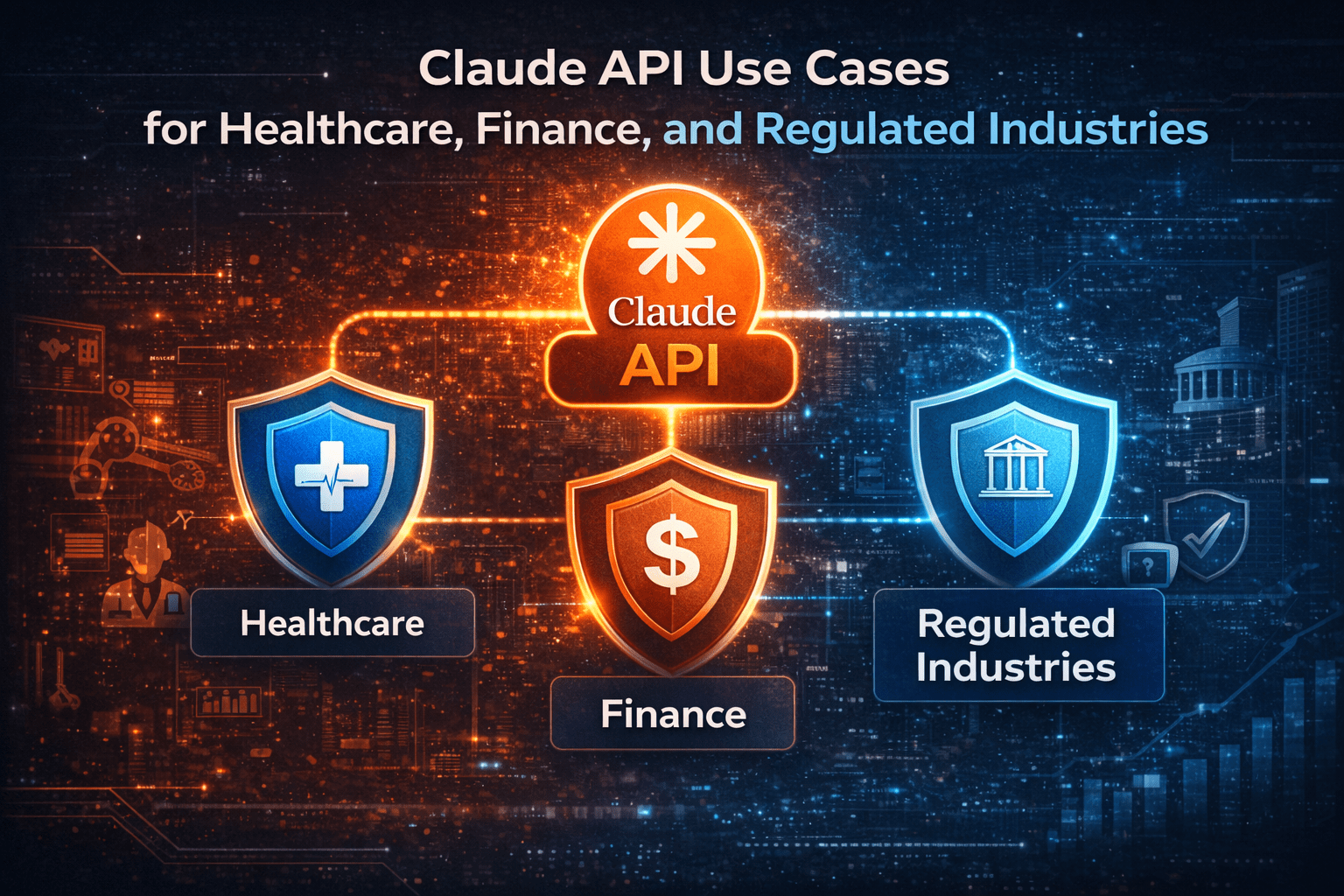
Regulated industries are not harder AI deployment environments because the technology is less capable there. They are harder because the stakes are higher, the compliance obligations are specific, and the consequences of getting it wrong — patient harm, regulatory violation, legal exposure — are more severe than in general enterprise contexts.
The Claude API use cases that produce the most value in regulated industries are also the ones with the clearest compliance requirements. Getting both the use case design and the compliance architecture right simultaneously is the work. This is where the highest-value, most compliance-aligned applications live.
Overview
Healthcare, finance, and other regulated industries operate under data protection, accuracy, and documentation requirements that shape every AI deployment decision. The Claude API use cases that succeed in these environments are not adapted from general enterprise use cases — they are designed from the start with regulatory requirements, minimum necessary data access, audit trail generation, and human oversight at the points where regulation requires it.
- Regulated industry API use cases must be designed with compliance requirements as first-order design constraints, not afterthoughts
- High-value use cases exist across clinical documentation, financial analysis, legal review, and compliance monitoring
- Data minimization — using only the data required for the AI task — reduces regulatory exposure and simplifies compliance architecture
- Human review remains in the workflow for outputs that affect clinical decisions, financial determinations, or legal interpretations
- Audit trail generation is a mandatory infrastructure component, not an optional compliance enhancement
The 5 Why’s
- Why do regulated industries represent the highest-value Claude API deployment opportunity? The workflows that consume the most professional time in regulated industries — clinical documentation, compliance review, contract analysis, financial reporting — are exactly the workflows where AI can reduce handling time, improve consistency, and maintain the quality standards that professional practice requires. The value of time saved in these contexts is high, and the consistency benefit has direct compliance implications.
- Why must compliance requirements be first-order design constraints, not afterthoughts? A use case designed for maximum capability and then constrained for compliance produces a compromised result — capability that does not meet compliance requirements or compliance controls that limit the capability to the point of insufficient value. Designing with compliance as a first-order constraint produces use cases that are both capable and deployable in production regulatory environments.
- Why does data minimization matter specifically in regulated industry API use cases? The less regulated data flows through an AI processing pipeline, the smaller the compliance surface area. Use cases designed to process the minimum data required for the AI task — not full records when fields suffice, not identified data when de-identified data produces the same result — reduce regulatory risk while producing comparable outputs.
- Why does human review remain necessary in regulated industry AI workflows even for well-performing use cases? Regulation, professional liability, and patient or client safety require human accountability for decisions in clinical, legal, and financial contexts. AI handles the processing and preparation. The accountable professional remains in the decision loop. That design is not a limitation of the technology — it is the correct design for the regulatory context.
- Why is audit trail generation more critical in regulated industries than in general enterprise contexts? Regulated industries are subject to audits that require evidence of how decisions were made, what data was considered, and who was accountable for each determination. AI-processed workflows that cannot produce that evidence create audit gaps. Those that generate structured audit trails as a standard output of every processing cycle are audit-ready by design.
Healthcare Use Cases
Clinical Documentation Assistance
Clinical documentation — physician notes, discharge summaries, care plans, referral letters — is time-intensive, accuracy-critical, and subject to documentation quality standards that affect reimbursement, continuity of care, and liability. Claude API integration in clinical documentation workflows can:
- Draft structured clinical notes from dictation or structured input
- Extract relevant clinical information from unstructured notes for structured fields in the EHR
- Generate discharge summaries from inpatient documentation sets
- Flag documentation gaps that would affect coding accuracy or care plan completeness
Compliance requirements: PHI handling under HIPAA, minimum necessary access, de-identification where AI processing does not require identified data, audit trails for all PHI-touching API calls, and physician review before any AI-drafted documentation enters the official record.
Prior Authorization and Utilization Review
Prior authorization requests require extracting clinical criteria from case documentation, matching against payer criteria, and producing determination recommendations — a high-volume, high-variability process that consumes significant clinical and administrative staff time.
Claude API integration can extract the relevant clinical criteria, apply the matching logic against authorization criteria, and produce structured determination recommendations for clinician or utilization review specialist review — reducing handling time while keeping the determination decision with the accountable reviewer.
Compliance and Quality Monitoring
Clinical quality monitoring — identifying documentation that does not meet quality standards, flagging coding inconsistencies, monitoring for regulatory reporting requirements — can be automated through API-integrated monitoring workflows that apply consistent review logic at scale across clinical documentation sets.
Financial Services Use Cases
Regulatory Document Analysis
Financial institutions process enormous volumes of regulatory documents — SEC filings, compliance reports, audit findings, regulatory guidance updates. Claude API integration can:
- Extract key provisions and requirements from regulatory guidance documents
- Identify changes between regulatory document versions
- Flag compliance implications of regulatory updates for specific business lines
- Generate structured summaries of regulatory filings for analyst and compliance officer review
Compliance requirements: data handling under applicable financial regulations, accuracy standards that require analyst review for regulatory interpretation outputs, and audit trails for regulatory document processing workflows.
Credit and Risk Analysis Support
Credit underwriting and risk assessment involve analyzing complex, unstructured information — business plans, financial statements, market analyses — alongside structured financial data. Claude API integration can extract the relevant factors from unstructured analysis documents, apply defined risk criteria frameworks, and produce structured risk assessment inputs for underwriter review.
Anti-Money Laundering and Fraud Monitoring
Transaction monitoring and suspicious activity identification involve applying pattern recognition and contextual reasoning to high-volume transaction data and customer behavior information. API-integrated monitoring workflows can flag transactions and patterns that meet defined suspicious activity criteria for investigator review — reducing the manual review volume while maintaining the analyst accountable for Suspicious Activity Report determinations.
Legal and Professional Services Use Cases
Contract Review and Risk Flagging
Contract review involves applying standard review criteria — non-standard clause identification, missing provision flagging, risk factor assessment — to high volumes of agreements that vary in structure and complexity. Claude API integration can perform first-pass review against defined criteria sets and produce structured review outputs for attorney review and approval.
Regulatory Compliance Monitoring
Organizations in regulated industries must monitor their operations against applicable regulatory requirements on an ongoing basis. API-integrated compliance monitoring workflows can apply regulatory requirement logic to operational documentation, transaction records, and communications — flagging potential compliance issues for compliance officer review before they become regulatory findings.
A Simple Regulated Industry Use Case Readiness Check
A regulated industry Claude API use case is ready for production deployment if:
- Compliance requirements for the data type and workflow have been fully mapped and infrastructure components designed to meet them
- Human review points have been explicitly designed into the workflow for outputs that affect regulated decisions
- Data minimization has been applied — the API processes only the data required for the specific AI task
- Audit trail infrastructure generates the evidence required for regulatory audit purposes for every API processing cycle
- Legal and compliance teams have reviewed and approved the use case design and data handling architecture before production deployment
Final Takeaway
Regulated industries are not environments where AI API deployment is too risky to pursue. They are environments where the design requirements are more specific, the compliance architecture is more rigorous, and the value of getting it right is higher than in general enterprise contexts.
The Claude API use cases that succeed in healthcare, finance, and legal environments are the ones designed with those requirements as first-order constraints — producing AI automation that is capable, compliant, and production-ready from the first deployment rather than revised repeatedly to address compliance gaps discovered after the fact.
Deploy Regulated Industry Claude API Use Cases With Mindcore Technologies
Mindcore Technologies works with healthcare, financial, and legal enterprise teams to design and deploy Claude API use cases that meet industry-specific regulatory requirements — compliance architecture, data handling controls, human review workflow design, and audit trail infrastructure built in from the start.
Talk to Mindcore Technologies About Claude API for Regulated Industries →
Contact our team to map your highest-value regulated industry AI use cases and build the compliance-first deployment architecture they require.