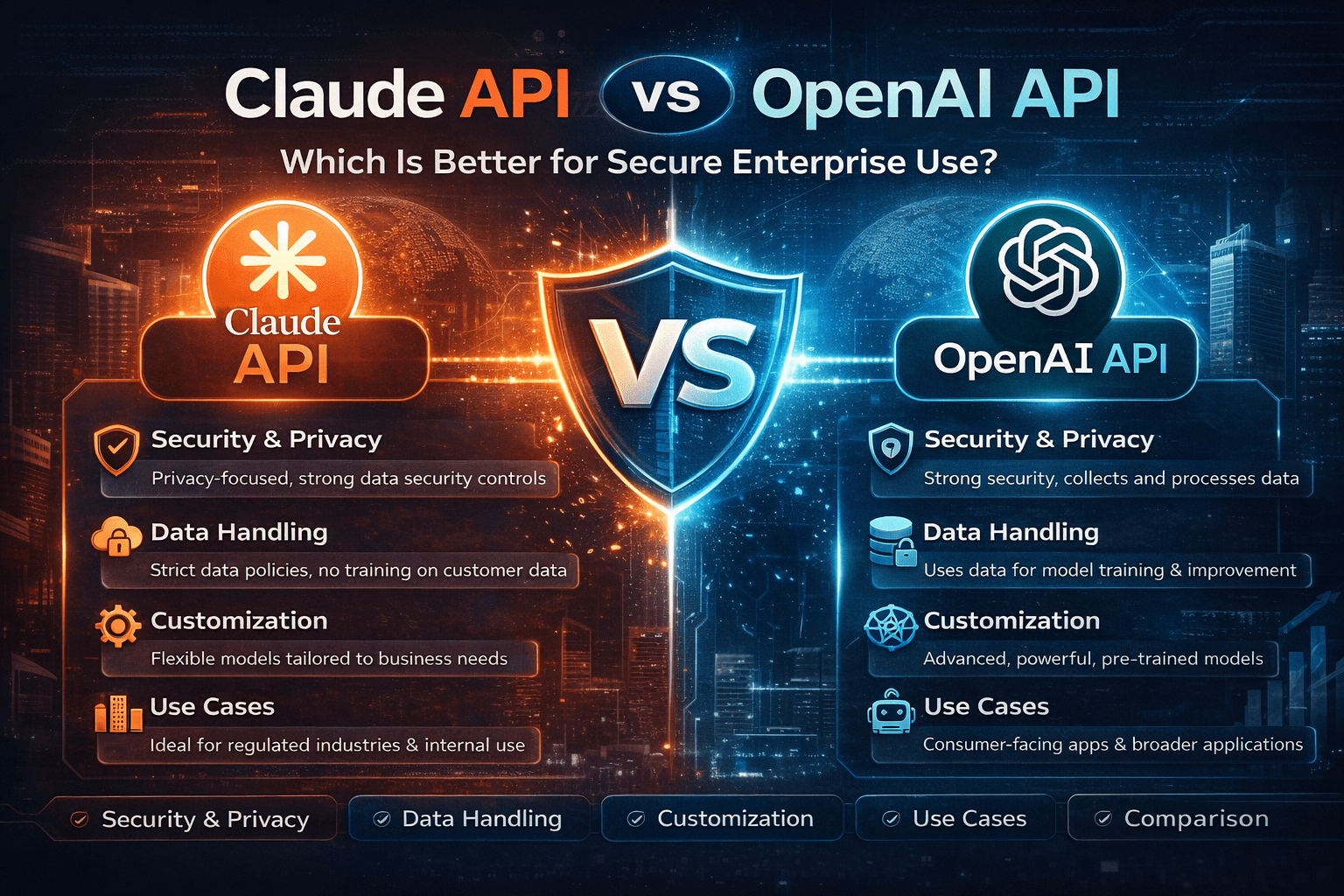
Capability benchmarks tell part of the story. For enterprise security and compliance teams, the more important comparison is about data handling, security posture, deployment flexibility, and how each API behaves when the use case involves sensitive information, regulated data, or audit requirements.
Both Claude and OpenAI offer powerful API access. For general developer use, the differences are marginal enough that individual preference and ecosystem familiarity often determine the choice. For enterprise deployments in regulated industries — healthcare, finance, legal, government — the comparison changes. Security architecture, data residency, usage policy, and compliance tooling become the criteria that matter most.
Overview
The Claude API and OpenAI API comparison for enterprise security use is not primarily a reasoning quality debate. Both models produce capable outputs for the broad range of enterprise use cases. The enterprise security comparison turns on data handling policies, deployment architecture options, safety and refusal behavior, compliance documentation availability, and the organizational philosophy behind how each platform approaches enterprise trust. Those are the dimensions where the right choice for regulated enterprise use becomes clear.
- Enterprise API selection for regulated use cases requires security and compliance criteria, not just capability benchmarks
- Data handling policies — how inputs and outputs are used, retained, and accessed — are a first-order enterprise security decision
- Deployment architecture options, including on-premises and private cloud, affect data residency and regulatory compliance
- Safety and refusal behavior affects how each API handles sensitive content in regulated industry contexts
- Compliance documentation availability determines how quickly enterprise security and legal teams can complete due diligence
The 5 Why’s
- Why is capability comparison insufficient for enterprise API selection in regulated industries? In healthcare, finance, and legal contexts, the output quality of the AI is one evaluation criterion. The data handling policies, security architecture, regulatory compliance posture, and audit support of the platform are equally or more important — because a capable model with inadequate data governance creates regulatory exposure regardless of output quality.
- Why does data handling policy matter more than model performance for compliance-sensitive enterprise use? If API inputs containing PHI, PII, or confidential business data are retained by the provider for training purposes, or accessible to provider staff under certain conditions, those policies may violate HIPAA, GDPR, or contractual data protection obligations regardless of how good the outputs are. Data handling policy is the threshold requirement.
- Why does Anthropic’s Constitutional AI approach produce different safety behavior than RLHF-based approaches? Claude’s training incorporates Constitutional AI — a framework that builds safety principles into the model’s reasoning rather than applying them only through post-training filters. For enterprise use cases that involve sensitive or dual-use content, that difference in safety architecture produces more predictable and contextually appropriate behavior than filter-based approaches.
- Why does deployment architecture flexibility matter for regulated enterprise deployments? Some regulated enterprises cannot send data to shared cloud infrastructure, regardless of the provider’s security posture. Deployment options that include private cloud, VPC, or on-premises configurations determine whether the API can be used at all for specific regulatory contexts.
- Why does enterprise compliance documentation availability affect the selection timeline? Security and legal due diligence for enterprise AI API deployments requires documentation — data processing agreements, security certifications, audit reports, privacy notices, and usage policy documentation. Providers with comprehensive, accessible enterprise compliance documentation reduce the time to deployment approval. Those without it extend the approval timeline or create compliance gaps.
The Enterprise Security Comparison
Data Handling and Training Policies
Both Anthropic and OpenAI offer enterprise API tiers that do not use customer inputs for model training by default. The enterprise comparison focuses on what those policies cover explicitly, how they are documented, and what contractual protections are available.
Key questions for either API in a regulated enterprise context:
- Are API inputs and outputs retained by the provider, and if so, for how long and under what access conditions?
- Is a Data Processing Agreement available that covers applicable regulations (GDPR, HIPAA, CCPA)?
- Can the organization obtain contractual commitments on data handling that go beyond the standard terms of service?
- Are there provisions for data residency that match applicable regulatory requirements?
Both providers offer enterprise agreements that address these questions. The evaluation should be conducted against the specific regulatory requirements of the deployment context — general comparison is insufficient for compliance sign-off.
Safety and Refusal Behavior in Regulated Contexts
For enterprise deployments in healthcare, legal, and financial contexts, AI safety behavior is not just about preventing harmful outputs. It is about how the model handles sensitive professional content — clinical information, legal analysis, financial advice — in ways that are contextually appropriate and predictable.
Claude’s Constitutional AI foundation produces safety behavior that reasons about context rather than applying uniform filters. In enterprise deployments where the use case involves professional-grade content that requires nuanced handling, that contextual reasoning produces more operationally useful behavior than filter-based approaches that may refuse legitimate professional content or pass borderline content inconsistently.
Deployment Architecture Options
For enterprises with strict data residency or network isolation requirements, deployment architecture options determine feasibility. The comparison should evaluate:
- Availability of private cloud or VPC deployment options
- Data residency configuration for specific geographic regulatory requirements
- Network architecture options that support air-gapped or restricted-network deployment contexts
- Support for customer-managed encryption keys
Compliance Documentation and Certification
Enterprise security teams require documentation that supports internal risk assessments, vendor due diligence, and regulatory audit requirements. The practical comparison for security teams evaluating either API is the availability and accessibility of:
- SOC 2 Type II reports
- ISO 27001 certification
- Data Processing Agreements with regulatory-specific provisions
- Security questionnaire response availability for accelerated due diligence
- Usage policy documentation that can be reviewed and approved by legal teams
Where Claude API Has Specific Advantages for Regulated Enterprise Use
- Constitutional AI safety architecture — safety behavior grounded in reasoning rather than filters produces more predictable, contextually appropriate handling of sensitive professional content
- Enterprise compliance posture — Anthropic’s enterprise agreements include provisions designed for regulated industry requirements
- Context window depth — longer context windows enable processing of complex, lengthy documents — contracts, clinical records, financial filings — without chunking that introduces analytical gaps
- Instruction following precision — consistent adherence to complex, multi-part instructions is critical for enterprise automation workflows where output format and content requirements are strict
What the Decision Should Be Based On
For enterprise security and compliance leaders making this decision:
- Evaluate data handling policies against your specific regulatory requirements — not against general best practice
- Require enterprise agreement review before deployment — standard API terms are insufficient for regulated industry use
- Test safety behavior for your specific use case content — not general benchmarks
- Assess compliance documentation against your internal due diligence requirements — not provider marketing materials
- Evaluate deployment architecture options against your network and data residency constraints — shared cloud may not be an option for all use cases
Final Takeaway
The Claude API vs OpenAI API comparison for secure enterprise use is not a capability race. Both are capable. The decision turns on the security, compliance, and governance dimensions that regulated enterprise deployments require — data handling policy, safety architecture, deployment flexibility, and compliance documentation availability.
For enterprise security leaders making this decision for healthcare, finance, legal, or government contexts, the right answer is the provider whose enterprise agreements, data handling policies, and deployment architecture options match the specific regulatory requirements of the deployment. That evaluation cannot be completed from a capability benchmark. It requires security and legal review of the enterprise terms, deployment options, and compliance documentation each provider offers.
Evaluate Claude API for Your Enterprise With Mindcore Technologies
Mindcore Technologies works with enterprise security, legal, and IT teams to evaluate Claude API deployment against specific regulatory requirements — conducting the technical and compliance due diligence that regulated industry API deployments require before production deployment is approved.
Talk to Mindcore Technologies About Evaluating Claude API for Secure Enterprise Use →
Contact our team to begin the evaluation process for your specific regulatory context and deployment requirements.