

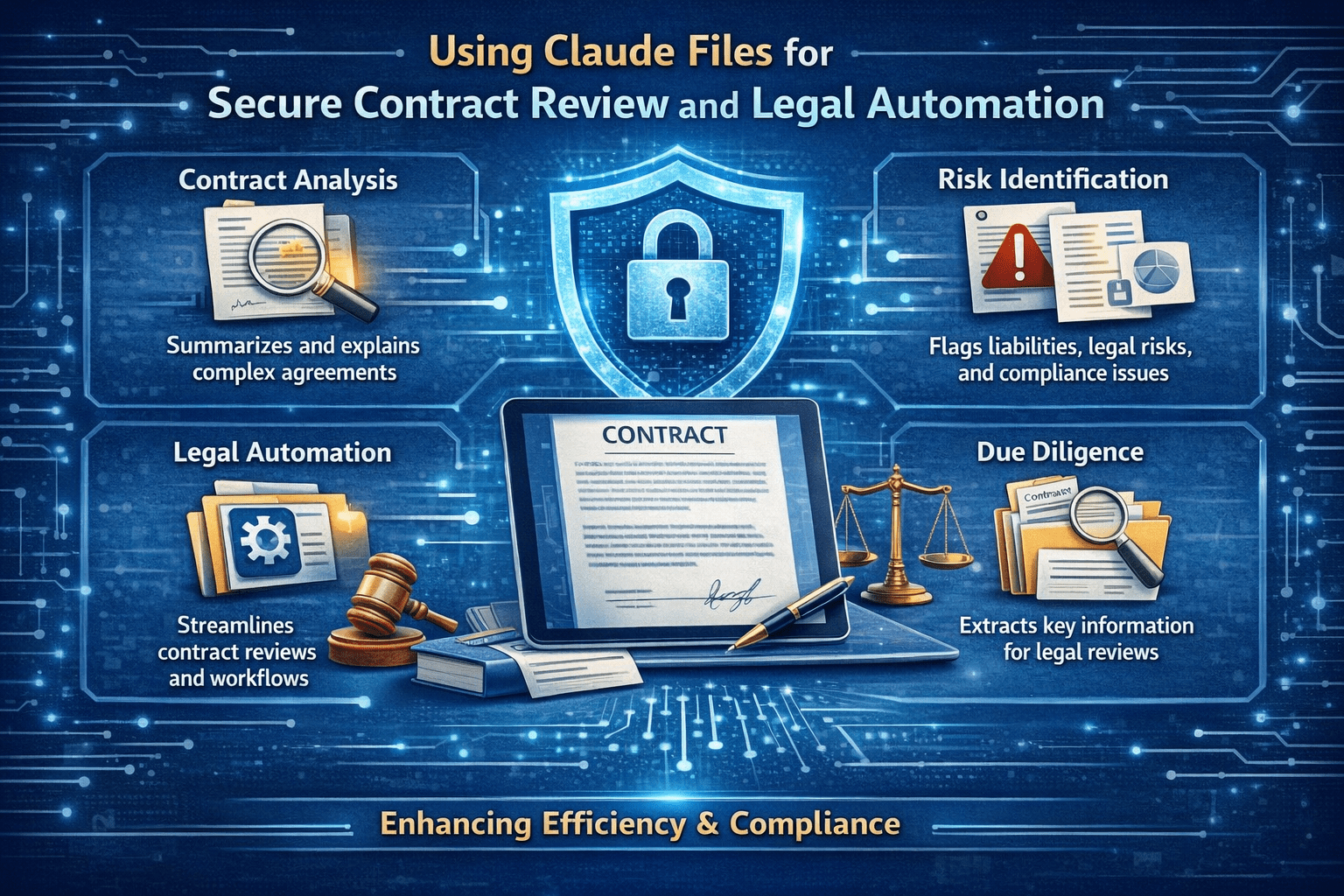
Contract review is one of the highest-volume, highest-cost document tasks that enterprise legal teams handle. Hundreds or thousands of agreements per year, each requiring review against standard terms, compliance obligations, and risk criteria that are largely consistent across the contract portfolio. The work is important. Most of it does not require the senior attorney billing rate that routinely gets applied to it.
Claude Files changes the economics of contract review by handling the analytical preparation that currently consumes the majority of review time — identifying non-standard clauses, flagging compliance concerns, verifying required provision presence, and summarizing key terms — so attorney time concentrates on the judgment-dependent determinations that benefit from that expertise.
The security architecture is the other half of the equation. Legal documents are among the most sensitive in the enterprise. Privileged communications, confidential commercial terms, and strategic transaction details require data handling that keeps document content within defined boundaries throughout the analysis process.
Overview
Claude Files enables AI-assisted contract review and legal document automation with security architecture that protects privileged and confidential document content throughout analysis. The attorney retains accountability for legal determinations. Claude Files handles the first-pass review, provision identification, risk flagging, and summary generation that precedes those determinations — reducing per-contract review time and improving consistency across the review portfolio.
- First-pass contract review identifies non-standard clauses, missing provisions, and risk factors before attorney review
- Standard term comparison highlights deviations from defined playbook positions that require negotiation attention
- Compliance obligation extraction structures the obligation tracking that contract management requires
- Summary generation produces structured contract abstracts for review, approval, and reference purposes
- Security architecture maintains attorney-client privilege and confidentiality protections throughout document processing
The 5 Why’s
- Why is contract review a high-priority target for AI document analysis? Contract review is high-volume, defined-criteria work that consumes significant attorney and paralegal time. The criteria applied — non-standard clause identification, provision verification, compliance assessment — are largely consistent across the contract portfolio. That combination of high volume, defined criteria, and consistency makes it among the highest-value document analysis automation targets in the legal function.
- Why does first-pass review quality determine the value of AI-assisted contract analysis? Attorney review time spent on a well-prepared first-pass analysis — where non-standard provisions are already flagged, standard term deviations are already identified, and key terms are already summarized — is focused on legal judgment. Attorney review time spent on raw contracts is split between finding the relevant provisions and applying judgment to them. First-pass quality determines how much of the attorney’s time goes to the second activity versus the first.
- Why does privileged document handling require specific security architecture rather than general data protection? Attorney-client privilege is a legal protection that can be waived if privileged communications are disclosed to unauthorized parties. Document processing workflows that expose privileged content to systems, processes, or personnel outside the privilege scope can create inadvertent waiver arguments. Security architecture that maintains explicit privilege scope controls throughout the analysis process protects against that risk.
- Why does standard term comparison require playbook integration, not just contract reading? Contract review against standard terms requires knowing what the standard terms are — not just reading the contract in isolation. Claude Files contract review integration loads the organization’s contract playbook positions as reference criteria for the analysis — enabling comparison between what the contract says and what the standard position requires, not just extraction of what the contract says.
- Why does obligation tracking from contract analysis produce compounding operational value? Contracts create obligations — payment dates, performance deadlines, renewal windows, notice requirements. Those obligations are typically tracked manually after contract execution, with frequent gaps where deadlines are missed because the tracking was not done correctly at the time of signature. Automated obligation extraction from contract analysis at the time of execution populates obligation tracking systems accurately and completely — eliminating the manual tracking gaps that create operational and legal exposure.
Claude Files Contract Review Workflow
Pre-Review Analysis
Before attorney review begins, Claude Files performs first-pass analysis against defined review criteria:
- Provision checklist verification — required provisions (limitation of liability, indemnification, IP ownership, confidentiality, governing law, dispute resolution) are verified as present and located in the contract
- Standard term comparison — key provisions are compared against playbook positions; deviations from standard are flagged with the specific deviation identified
- Non-standard clause identification — unusual provisions, restrictions, or obligations outside standard commercial terms are flagged for attorney review
- Risk factor assessment — provisions that create elevated liability, compliance obligations, or operational constraints are identified and risk-rated
Review Output Structure
The first-pass analysis produces a structured review output for attorney use:
- Executive summary — contract type, parties, key commercial terms, overall risk characterization
- Provision checklist — required provisions present/absent/non-standard status
- Playbook deviation list — specific clause deviations from standard positions with the standard position stated for comparison
- Risk flag list — identified risk factors with clause references and risk characterization
- Recommended focus areas — the provisions that require attorney judgment, in priority order
Post-Execution Automation
After contract execution, Claude Files performs the post-execution automation that contract management requires:
- Obligation extraction — key dates, deadlines, notice requirements, and performance obligations extracted and structured for obligation tracking system population
- Contract abstract generation — structured contract summary produced for contract repository and reference purposes
- Renewal and expiration calendar population — renewal windows, expiration dates, and notice deadlines populated to contract calendar systems
Security Architecture for Legal Document Processing
- Privilege scope definition — documents in attorney-client privilege scope are handled under explicit privilege controls that limit processing system access to the privilege scope defined for each matter
- Confidentiality classification — contract documents are classified at the appropriate confidentiality level; outputs are classified at least as restrictively as source documents
- Access control enforcement — contract analysis is restricted to personnel with matter access authorization; service account authorization for automated processing is scoped to document types and matter classifications
- Audit trail for privilege log — document analysis events for privileged documents generate audit records that support privilege log maintenance and inadvertent disclosure investigation if required
A Simple Legal Automation Readiness Check
Your contract review program is ready for Claude Files if:
- Contract review volume is sufficient to justify the investment in playbook integration and review criteria definition
- A contract playbook exists — standard positions for key provisions — that can serve as the reference for standard term comparison
- Attorney review workflow can be structured to receive and act on Claude Files first-pass analysis outputs
- Privilege scope controls can be applied to privileged document processing to maintain attorney-client privilege protections
- Obligation tracking systems exist or are ready to be implemented to receive structured obligation extractions from contract analysis
Final Takeaway
Contract review with Claude Files is not AI making legal determinations. It is AI handling the document preparation work that precedes legal determinations — so that attorney time concentrates on the judgment-dependent analysis that genuinely requires a lawyer, and the high-volume, criteria-consistent first-pass review work is handled by a tool built for exactly that task.
The security architecture is what makes it deployable on the contracts where the value is highest — the sensitive commercial agreements, the privileged transaction documents, the compliance-critical obligations — without creating the privilege or confidentiality exposure that an ungoverned AI document analysis tool would introduce.
Deploy Secure Contract Review Automation With Mindcore Technologies
Mindcore Technologies works with enterprise legal and operations teams to design and deploy Claude Files contract review automation — playbook integration, review criteria definition, first-pass analysis output design, obligation extraction architecture, and privilege-compliant security controls for legal document processing.
Talk to Mindcore Technologies About AI-Assisted Contract Review →
Contact our team to assess your contract review volume and build the Claude Files automation that reduces it without reducing the legal quality it requires.

