Every enterprise AI deployment eventually hits the same wall: the AI can reason well, but it cannot reach the systems where the actual data lives.
Getting AI to interact with real business systems has historically required custom API development for every connection — a time-intensive, maintenance-heavy approach that limits AI integration to the systems IT can prioritize and the budgets that cover the development cost. Most AI deployments end up working with data that is brought to them manually, rather than connecting to the systems that hold it natively.
Claude MCP — the Model Context Protocol — changes that model. It is a standardized protocol that allows Claude to connect to business systems, read live data, and take actions across enterprise infrastructure without requiring custom API development for every integration. The future of AI system integration is standardized, scalable, and already deployable.
Overview
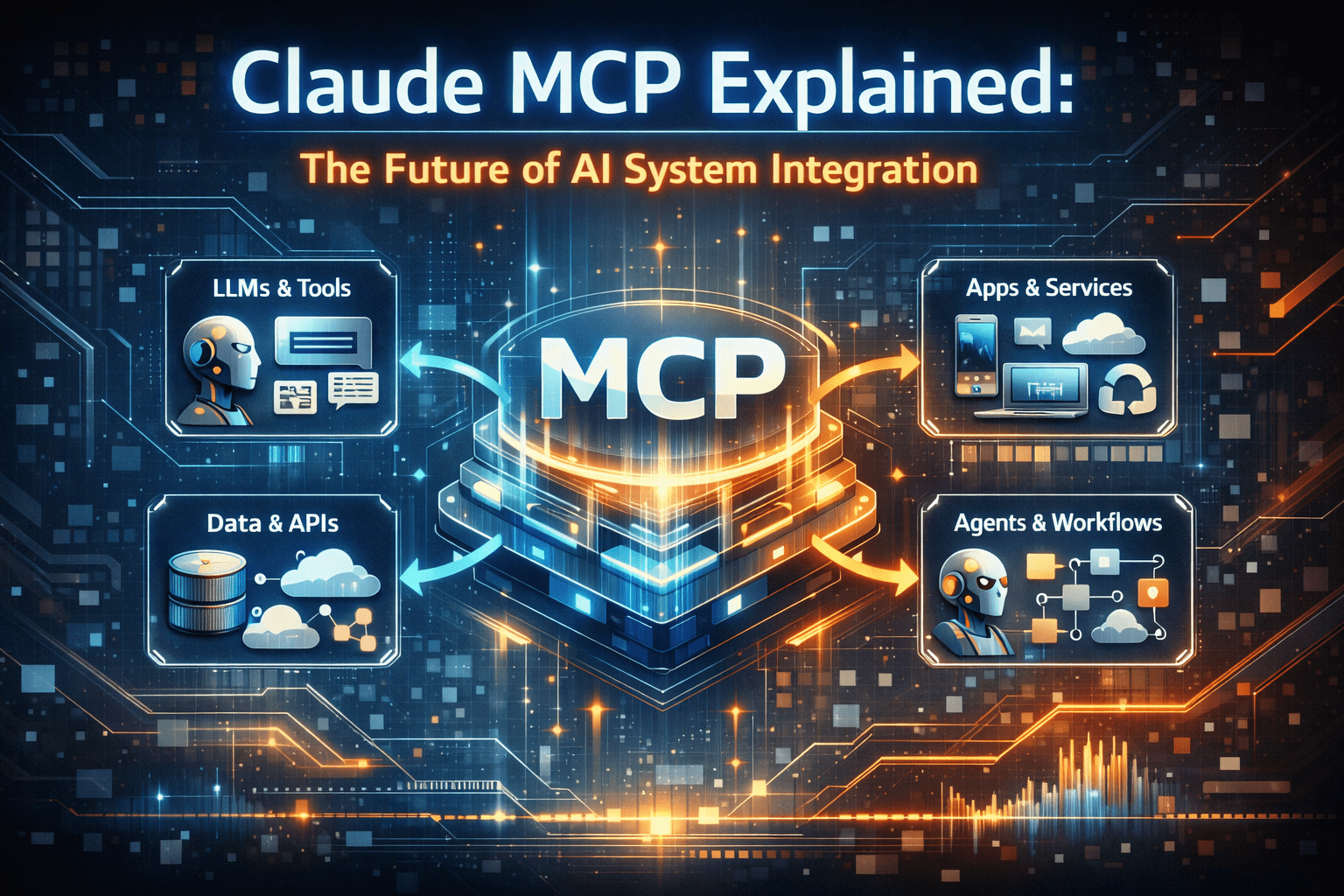
Claude MCP is a protocol — a standardized communication layer that defines how AI models connect to external systems, retrieve data, and take actions. Rather than building a custom integration between Claude and each business system individually, MCP provides a common interface that any system can implement to become accessible to Claude. The result is an integration model that scales across the enterprise without proportional increases in development cost and maintenance overhead.
- MCP is a standardized protocol, not a point-to-point integration — it defines a common interface that works across systems
- It enables Claude to access live data from business systems rather than static data brought to it manually
- Actions can be taken in connected systems through MCP, not just data retrieved from them
- The protocol design means adding new system integrations does not require building new custom APIs each time
- MCP is the infrastructure layer that enables AI to operate as a connected participant in enterprise operations, not an isolated tool
The 5 Why’s
- Why has AI system integration been a bottleneck for enterprise AI adoption? Custom API development is expensive, time-consuming, and maintenance-intensive. Every new system integration requires dedicated development work. Organizations end up with AI that works well in isolation but cannot access the operational data that would make it most useful.
- Why does a standardized protocol solve the integration bottleneck more effectively than custom APIs? A standardized protocol defines how systems communicate once. Any system that implements the protocol becomes immediately accessible through the same interface — without additional custom development per integration. The development cost is distributed once across the protocol implementation, not repeated for every new connection.
- Why does live data access change what AI can do in enterprise operations? AI working with static data produces outputs based on what was true when the data was provided. AI connected to live system data produces outputs based on what is true now — current inventory, current customer records, current project status. That difference determines whether AI outputs are actionable or require manual verification before use.
- Why is the ability to take actions in connected systems, not just read data from them, significant for enterprise AI? Reading data allows AI to inform decisions. Taking actions allows AI to execute them. MCP-connected Claude can update records, create tasks, trigger workflows, and complete multi-step processes in the systems where those processes live — without requiring manual execution of each step by an employee.
- Why is MCP described as the future of AI system integration rather than just a current capability? The protocol model is the correct architectural approach for enterprise AI integration at scale — it defines the standard that allows AI connectivity to scale across an organization’s full system landscape without indefinitely expanding custom development requirements. That is what the future of enterprise AI integration needs to look like, and MCP is where it is available today.
What MCP Actually Does
MCP operates as a communication layer between Claude and external systems. When Claude needs data or needs to take an action in a connected system, it communicates through the MCP protocol — which the external system handles through its MCP server implementation — and receives the data or confirmation it needs to continue.
The protocol handles:
- Data retrieval — Claude requests data from a connected system; the system returns it in a format Claude can use
- Action execution — Claude sends an instruction to a connected system; the system executes it and returns confirmation
- Context maintenance — Claude maintains awareness of what has been retrieved and what actions have been taken across a multi-step workflow involving multiple connected systems
- Authentication and authorization — MCP handles the security layer for system connections, ensuring Claude accesses only what the connecting user is authorized to access
For enterprise teams, the operational experience is that Claude can answer questions with live system data, take actions in connected systems directly, and complete multi-step processes across multiple systems in a single interaction — without requiring the employee to manually retrieve data from each system or execute each step independently.
Why MCP Changes the Enterprise AI Integration Architecture
The traditional enterprise AI integration model looks like this: data is extracted from business systems, processed, and provided to an AI tool as static context. The AI produces an output based on that static context. The employee takes the output and acts on it in the business systems manually.
The MCP model looks like this: Claude connects to business systems through the protocol, retrieves live data as needed, takes actions directly in connected systems, and completes multi-step processes without requiring manual data handoffs between AI and system at each step.
That architectural difference determines whether AI is a productivity tool that assists employees or an operational participant that executes work within the enterprise’s actual system landscape.
Why the Protocol Approach Scales Better Than Custom APIs
Custom API development scales linearly with the number of integrations. Each new system connection requires a new development investment. As the number of connected systems grows, the maintenance load for keeping those connections current as systems update grows proportionally.
The MCP protocol approach scales differently. The protocol is defined once. Each system implements the protocol once. After that, connecting Claude to a new MCP-enabled system does not require custom development — it requires configuration. The marginal cost of each additional system integration decreases as the protocol becomes more widely adopted.
For enterprises managing complex system landscapes, that scaling dynamic is the difference between AI integration that reaches the ten most critical systems and AI integration that reaches the full enterprise infrastructure.
What MCP Enables in Practice
- Live data access — Claude retrieves current records, statuses, and data from connected systems at the time of the query, not from a static export
- Multi-system workflows — Claude coordinates actions across multiple connected systems in a single interaction, without requiring manual handoffs between each step
- Record creation and updates — Claude creates and modifies records in connected systems directly, without requiring the employee to execute those actions manually
- Workflow triggering — Claude initiates workflows in connected systems based on defined conditions, enabling automated multi-system process execution
- Contextual assistance — Claude provides assistance that is grounded in live system data, producing outputs that reflect the current state of the business rather than a static approximation of it
A Simple MCP Readiness Assessment
Your organization is ready to evaluate MCP deployment if:
- AI tools are currently working with static data exports rather than live system data
- Employees manually retrieve data from multiple systems to provide context for AI interactions
- Custom API development has been the bottleneck preventing AI integration with key business systems
- Multi-system workflows currently require manual handoffs between AI outputs and system execution
- Leadership is evaluating AI integration architecture at the enterprise level, not just for individual use cases
Final Takeaway
The gap between AI capability and AI operational impact in most enterprises is a data access and system integration problem. AI that cannot reach live system data and cannot take actions in business systems is structurally limited to advisory functions — producing outputs that require manual verification and manual execution before they translate into operational value.
Claude MCP closes that gap. A standardized protocol that enables live data access, action execution, and multi-system workflow coordination — without the custom development overhead that has made enterprise AI integration a bottleneck rather than an enabler. The future of AI system integration is standardized, scalable, and deployable today.
Connect Claude to Your Enterprise Systems With Mindcore Technologies
Mindcore Technologies works with enterprise teams to design and deploy Claude MCP integrations — connecting Claude to the business systems where operational data lives, enabling live data access and action execution, and building the integration architecture that turns AI from an isolated tool into a connected operational participant.
Talk to Mindcore Technologies About Claude MCP Integration →
Contact our team to assess your current AI integration architecture and build the MCP deployment plan that connects Claude to the systems that matter most.