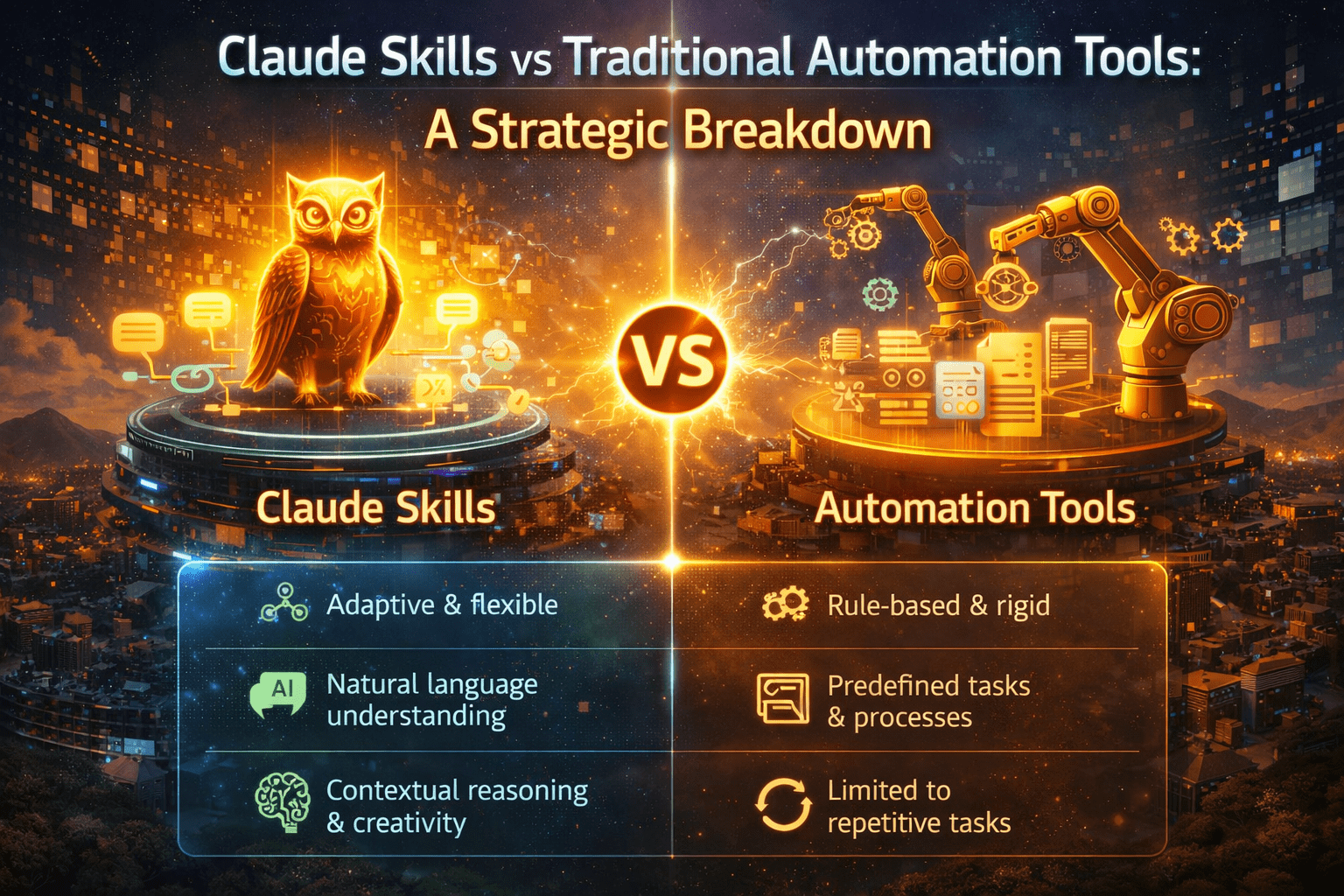
Traditional automation tools and Claude Skills are both automation. Beyond that, the similarities are limited.
Traditional automation tools — RPA platforms, workflow builders, integration frameworks — execute defined processes on structured data with deterministic logic. They are fast, reliable, and appropriate for the tasks they were designed to handle. They are also brittle at the edges, inaccessible to non-technical configurers, and structurally unsuited for the class of work that involves variable inputs, natural language, and contextually dependent outputs.
Claude Skills handle that second class. Understanding which tool is right for which task — and where they complement rather than compete — is the strategic question that enterprise leaders need to answer before committing to either.
Overview
The choice between Claude Skills and traditional automation tools is not a replacement decision. It is a task classification decision. Traditional automation tools excel at structured, rule-based, deterministic processes. Claude Skills excel at tasks involving variable inputs, natural language, contextual logic, and outputs that must meet quality criteria that cannot be reduced to a rule set. The highest-performing enterprise automation strategies use both — traditional tools where determinism and speed are the requirements, Skills where contextual intelligence is.
- Traditional automation tools operate on structured data with deterministic rules; Skills operate on variable inputs with contextual logic
- Traditional tools are fast and reliable within defined parameters; they break at the edges of those parameters
- Skills handle the middle layer of complexity that rule-based automation cannot process reliably
- The comparison is a task classification problem, not a technology selection problem
- The strategic deployment model uses both — each handling the task types it is built for
The 5 Why’s
- Why is comparing Skills to traditional automation tools the wrong frame? Comparison implies substitution. The right frame is classification — which task types does each tool handle well, and where do they complement each other? Organizations that treat this as a replacement decision end up either over-investing in Skills for tasks traditional tools handle efficiently or deploying traditional tools for tasks that require contextual intelligence.
- Why do traditional automation tools fail at the edges of their design parameters? Traditional tools are built on rule sets. Rules require inputs to be structured and processes to be fully defined in advance. When inputs vary in ways the rules do not anticipate — unusual document formats, edge case data, natural language variation — the automation breaks rather than adapting.
- Why do Claude Skills handle variable inputs more reliably than traditional tools? Skills are built with contextual understanding of what the task requires, not a rule set that must match every input variation explicitly. They apply logic appropriate to the input rather than executing a fixed rule regardless of whether the input fits it.
- Why does the maintenance cost comparison favor Skills for complex tasks? Traditional automation scripts and workflows require maintenance when underlying systems change, input formats vary, or business rules evolve. That maintenance requires technical resources. Skills require updating when task requirements change — but the update is a capability redesign, not a script repair, and it does not require the same technical depth.
- Why does the strategic deployment model require both, not one or the other? The automation landscape in any enterprise contains both structured, deterministic tasks suited for traditional tools and variable, contextually dependent tasks suited for Skills. An enterprise that deploys only traditional tools leaves the second category unautomated. An enterprise that deploys only Skills adds unnecessary complexity and cost to tasks traditional tools handle efficiently.
Where Traditional Automation Tools Win
Traditional automation tools are the right choice when:
- Inputs are fully structured — data comes in a consistent format that a rule set can process reliably
- Logic is deterministic — the same input always produces the same output; no contextual judgment is required
- Speed is paramount — traditional tools execute defined rules faster than contextual AI processing
- Integration is the primary requirement — connecting systems and moving structured data between them is what traditional tools do best
- Volume is extremely high — for millions of structured transactions per day, traditional automation tools outperform Skills on speed and cost
Where Claude Skills Win
Claude Skills are the right choice when:
- Inputs are variable — documents, communications, or data that come in different formats, structures, or expressions of the same underlying content
- Logic requires context — the correct output depends on understanding what the input means, not just what it contains
- Natural language is involved — tasks that involve reading, classifying, or generating natural language require AI capability, not rule sets
- Quality criteria cannot be reduced to rules — outputs that must meet standards of accuracy, completeness, or appropriateness that are better defined in terms of quality than in terms of specific rule matches
- Edge cases are frequent — task types where unusual inputs are common and must be handled appropriately rather than breaking the workflow
Where They Complement Each Other
The highest-value automation architectures combine both. Traditional tools handle the structured, high-speed, deterministic steps. Skills handle the variable, contextually dependent steps. The output of a traditional integration layer becomes the input for a Skill. The output of a Skill feeds into a traditional routing workflow. The combined architecture handles the full process — each tool operating in the domain it was designed for.
Strategic Breakdown: Task Classification Framework
| Task Characteristic | Traditional Automation | Claude Skills |
|---|---|---|
| Input structure | Fully structured, consistent format | Variable, natural language, mixed formats |
| Processing logic | Deterministic rule-based | Contextual, condition-dependent |
| Edge case handling | Breaks or requires exception handling | Handles appropriately within quality parameters |
| Natural language | Not suitable | Core capability |
| Configuration | Technical (developer/IT required) | Non-technical (plain language) |
| Maintenance | Script repair when systems change | Capability update when requirements change |
| Speed | Faster for structured high-volume | Appropriate for complex variable-input tasks |
| Best use cases | System integration, data movement, structured transaction processing | Document review, classification, synthesis, triage, natural language tasks |
The Strategic Deployment Decision
Enterprise leaders evaluating automation investments should classify their task portfolio before selecting tools:
- Audit the automation portfolio — identify which existing automated workflows involve variable inputs, natural language, or contextual logic that traditional tools handle poorly
- Identify the unautomated middle layer — map the tasks that are not automated because they are too complex for traditional tools but not complex enough to require full human judgment
- Classify new automation candidates — apply the structured vs. variable, deterministic vs. contextual framework to determine which tool type fits each candidate task
- Design the integration architecture — plan how traditional automation and Skills connect in the workflows that involve both structured and variable steps
- Avoid redundant investment — do not deploy Skills for tasks traditional tools already handle well; do not force traditional tools to handle tasks they were not designed for
Final Takeaway
Traditional automation tools and Claude Skills are not competitors. They are different tools for different task types — and the enterprise that understands that distinction deploys both more effectively than the enterprise trying to force one to do the job of the other.
Traditional tools handle structured, deterministic, high-speed automation. Skills handle variable, contextually dependent, natural language tasks. The combined deployment model automates the full task portfolio — not just the portion that fits the design parameters of whichever tool was adopted first.
The strategic question is not which is better. It is which handles the task in front of you — and whether your current automation architecture has answered that question for every task type in your operation.
Build the Right Automation Architecture With Mindcore Technologies
Mindcore Technologies helps enterprise leaders classify their automation portfolio, identify where traditional tools and Claude Skills each apply, and build the integrated architecture that automates the full task landscape — not just the portion either tool can handle alone.
Talk to Mindcore Technologies About Your Enterprise Automation Strategy →
Contact our team to audit your current automation coverage and identify where Claude Skills fill the gaps your traditional tools cannot reach.