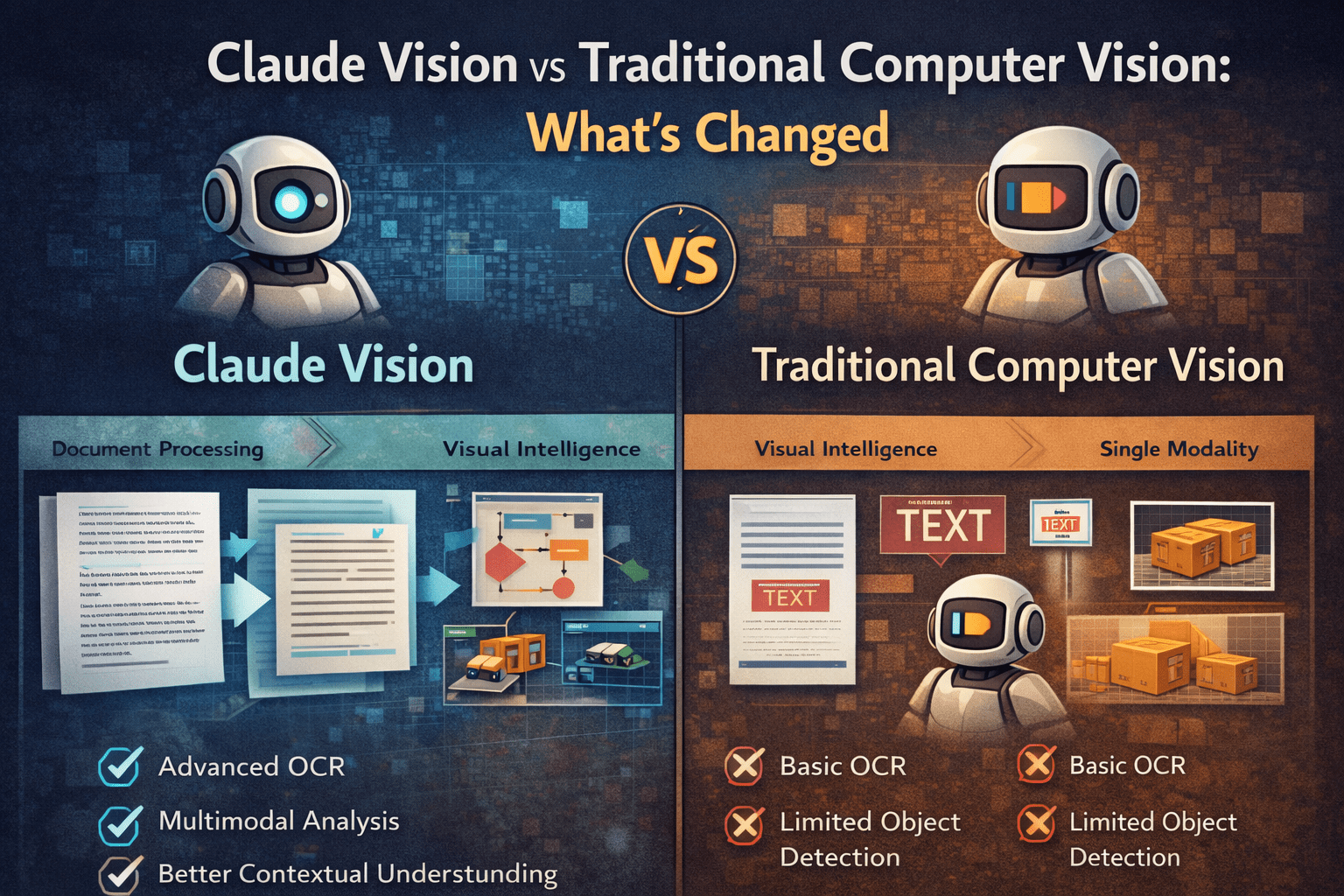
Traditional computer vision is a mature technology. It detects objects, classifies images against trained categories, identifies defects against learned patterns, and does all of this at high speed and scale. For the problems it was built for — consistent, well-defined visual classification tasks where training data is available and the answer space is bounded — it works well.
What changed is the problem space. Enterprise visual data is messier, more variable, and more context-dependent than traditional computer vision was designed to handle. Documents that do not match templates. Inspection scenarios where the specification criteria are described in natural language. Compliance checks where the visual evidence needs to be interpreted against regulatory requirements, not just matched against a pattern library.
Claude Vision handles that expanded problem space. Understanding what changed — and what traditional computer vision still does well — is what enables enterprises to deploy each correctly.
Overview
Claude Vision and traditional computer vision differ in two fundamental ways: how they understand visual content (pattern matching vs. contextual reasoning) and how they are configured for new tasks (model training vs. natural language instruction). Those differences produce dramatically different deployment economics, task flexibility, and appropriate use case ranges. The enterprise that understands both capabilities deploys each where it produces the most value.
- Traditional computer vision matches visual patterns against trained categories — accurate for consistent, well-defined visual classification at speed
- Claude Vision applies contextual reasoning to visual content — enabling analysis of variable, context-dependent visual tasks without custom model training
- Traditional CV requires training data collection and model development for each new task; Claude Vision is configured through instruction
- The deployment economics favor traditional CV for high-speed, high-volume classification of consistent visual inputs; Claude Vision for variable, context-dependent analysis
- The two are not competitors — they address different parts of the enterprise visual processing problem
The 5 Why’s
- Why is contextual reasoning the key difference between Claude Vision and traditional computer vision? Traditional computer vision learns what things look like from training data. It can identify objects and patterns it has seen before. It cannot reason about what those objects mean in context, interpret natural language descriptions of visual criteria, or handle inputs that differ significantly from its training distribution. Contextual reasoning extends visual analysis from pattern matching to understanding — enabling Claude Vision to handle the tasks traditional CV cannot.
- Why does the training requirement change the deployment economics significantly? Traditional computer vision requires collecting training data, labeling it, training a model, validating it, and retraining when the input distribution changes. That process takes weeks to months per task and requires ongoing maintenance. Claude Vision is configured through natural language instruction — describing the task and the criteria produces a functional visual analysis capability without the training pipeline. For new task deployment, the economics are dramatically different.
- Why does traditional computer vision remain the better choice for some enterprise use cases? Traditional CV systems, properly trained for their specific task, achieve very high accuracy at very high speed for consistent, bounded visual classification problems. Inspection of standardized components against a fixed defect catalogue, classification of standard document types in a controlled intake environment, object detection in consistent imaging conditions — these are tasks where trained traditional CV outperforms Claude Vision on speed and accuracy for the specific trained task.
- Why does variable input handling favor Claude Vision over traditional CV for many enterprise document and inspection scenarios? Traditional CV degrades on inputs that differ from its training distribution — a different scan angle, a different form layout, a different lighting condition. Claude Vision applies reasoning that is robust to that variation — it understands what a form is and what fields to extract even when the format is different from what it has seen before. For enterprise visual data that varies in format, condition, or content, Claude Vision’s robustness to variation is a significant operational advantage.
- Why does the comparison matter for enterprise deployment planning? Deploying Claude Vision for tasks that traditional CV handles efficiently wastes capability on over-engineering. Deploying traditional CV for tasks that require contextual reasoning produces systems that fail on the inputs that matter most. Getting the comparison right determines whether each visual processing deployment performs as expected in production.
The Comparison in Detail
What Traditional Computer Vision Does Well
- High-speed classification of consistent inputs — trained models classify images at millisecond speeds that Claude Vision cannot match for the same task
- High accuracy for well-defined bounded tasks — on the specific task and input distribution the model was trained for, accuracy exceeds what general visual reasoning can achieve
- Real-time video analysis — processing video frame-by-frame at production line or security monitoring speeds requires traditional CV or specialized video AI, not a reasoning model
- Standardized defect detection — when the defect catalogue is fixed and the imaging conditions are controlled, trained defect detection models are optimized for that specific problem
What Claude Vision Does Well
- Variable input handling — documents, forms, and images that vary in layout, condition, and format are analyzed without retraining for each variation
- Natural language task configuration — new visual analysis tasks are configured through instruction, not through model training pipelines
- Cross-domain reasoning — Claude Vision can apply reasoning that combines visual analysis with contextual knowledge — understanding regulatory requirements, specification documents, or clinical criteria that inform what the visual evidence means
- Unstructured visual data — handwritten content, mixed-media documents, and complex scene analysis where the answer space is not bounded by a predefined category set
- Rare event handling — tasks where training data for the full range of relevant inputs is not available because some inputs are rare or novel
The Deployment Decision Framework
| Use Case Characteristic | Favor Traditional CV | Favor Claude Vision |
|---|---|---|
| Input consistency | High (controlled conditions) | Variable (real-world variation) |
| Task definition | Bounded category set | Open-ended or contextual criteria |
| Speed requirement | Millisecond real-time | Minutes acceptable |
| Training data availability | High volume available | Limited or unavailable |
| Task change frequency | Stable, infrequent changes | Frequent criteria changes |
| Cross-domain reasoning required | No | Yes |
| Configuration flexibility needed | Low | High |
Where They Work Together
The most capable enterprise visual processing architectures use both. Traditional CV handles the high-speed, high-volume, consistent classification tasks at the front of the pipeline — sorting, categorizing, triaging. Claude Vision handles the variable, contextual analysis tasks deeper in the pipeline — reasoning about what the classified inputs mean, extracting structured data from the complex ones, and handling the edge cases that fall outside the trained categories.
Traditional CV produces high-speed classification. Claude Vision produces contextual understanding of what the classification means. Together, they address the full visual data processing problem.
Final Takeaway
Traditional computer vision has not been replaced by Claude Vision. It has been complemented. The tasks traditional CV was designed for — consistent, high-speed, bounded visual classification — it still does best. The tasks that require contextual reasoning, variable input handling, and natural language task configuration — Claude Vision handles those.
The enterprise that understands that distinction deploys each where it belongs — and builds visual processing pipelines that are faster, more accurate, and more capable than either alone.
Design Your Enterprise Visual Processing Architecture With Mindcore Technologies
Mindcore Technologies works with enterprise teams to assess visual data processing requirements, determine where Claude Vision and traditional computer vision each belong, and design the integrated architecture that handles the full visual processing problem — at speed and with the contextual intelligence that complex visual data requires.
Talk to Mindcore Technologies About Enterprise Visual Processing Architecture →
Contact our team to map your visual data processing requirements and design the architecture that deploys the right tool for each use case.