

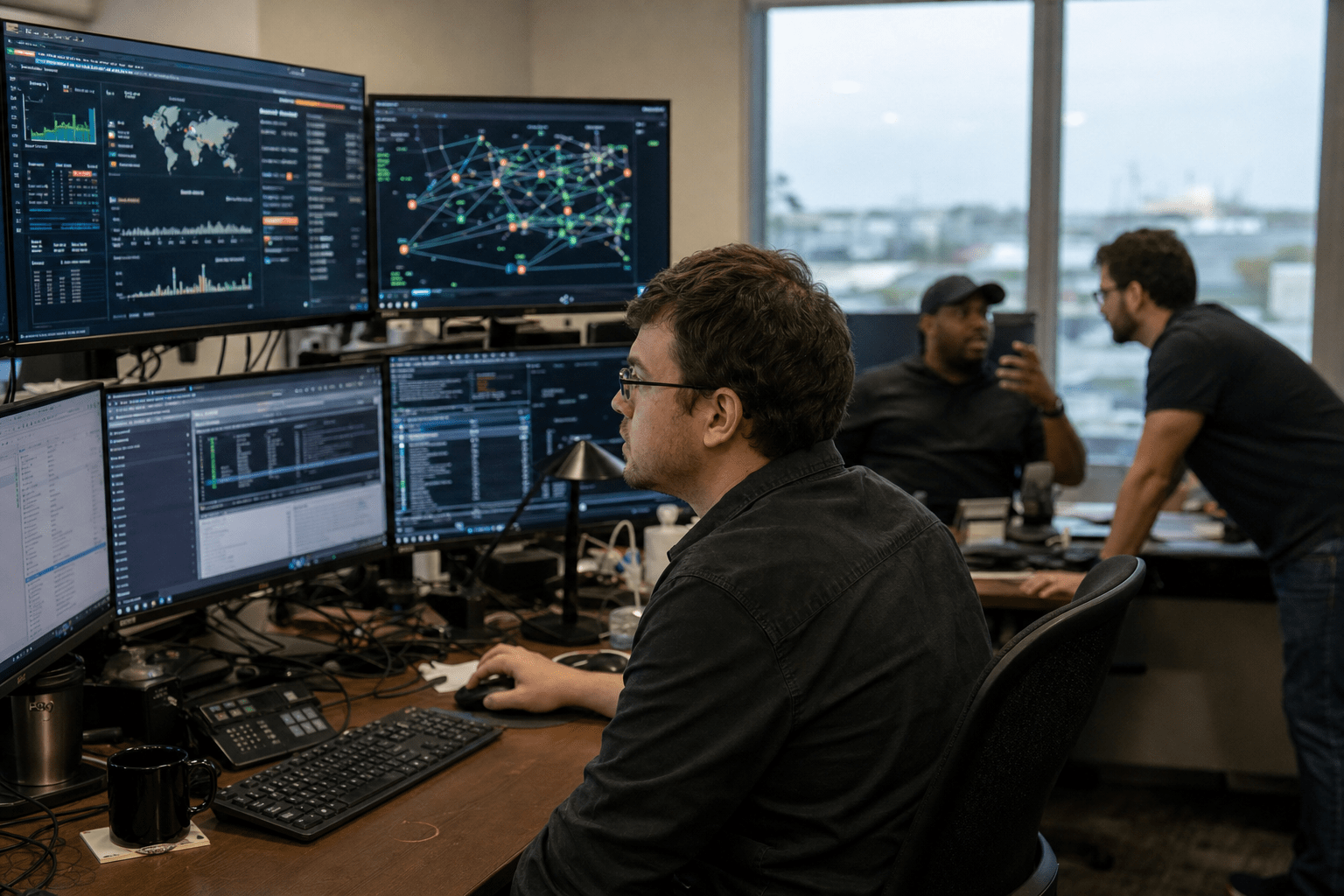
Cybersecurity Covington LA for small and midsize businesses means defending against two threats at once, including regional disaster overlap and ransomware targeting the same ransomware and phishing campaigns hitting every U.S. company, plus a Gulf-Coast pattern where hurricane-season outages and attacker activity overlap. We have watched Northshore firms treat storm recovery and cyber defense as separate budgets, then lose both when a flood-week outage became the exact window an intruder used. The right buying decision here weights disaster-recovery-integrated security over a pile of point tools, because in Covington the downtime risk and the breach risk share a season. This guide walks SMB owners and IT managers through what that actually looks like in 2026.
The 5 Things Covington SMBs Should Know First
Before you compare vendors, anchor on the realities that shape cyber risk on the Northshore. These five points summarize the rest of this guide.
- Risk stacks here. Hurricane season creates predictable downtime windows, and those windows double as attacker opportunity. A team scrambling through a power outage approves things it would normally question.
- The talent pool is thin. Covington and the wider St. Tammany Parish market has fewer dedicated security engineers than New Orleans proper, so most SMBs cannot staff a 24/7 in-house security desk affordably.
- Disaster recovery and security are one decision, not two. If your backup plan and your breach plan live in separate documents owned by separate people, you have a gap an attacker will find.
- Compliance is arriving early. Louisiana SMBs in healthcare, finance, defense supply chains, and legal work increasingly inherit security requirements from their clients, well before any law forces the issue.
- Point tools alone do not hold. Antivirus plus a firewall plus a backup drive is not a strategy. The threats we see now move laterally and wait, so coverage has to be layered and watched.
Read this guide as a buyer, not a technician. The goal is a clear-eyed choice, not a product list.
Why Cybersecurity in Covington Carries Gulf-Coast-Specific Risk
Cybersecurity Covington LA risk is shaped by geography in a way most national security advice ignores, with hurricane-season outages creating unique vulnerabilities for SMBs. The Northshore sits inside a recurring hurricane corridor, and every storm season opens a stretch of weeks where local businesses run on generators, spotty connectivity, and exhausted staff. Attackers read the same weather reports you do, which is one reason the threats Louisiana SMBs face spike around storm season.
We have responded to incidents where the breach itself happened weeks earlier, then detonated during a storm-week outage when the team was too distracted to notice the early signs. Ransomware crews specifically time pressure for moments when a victim cannot afford downtime, and a hurricane already supplies that pressure. The Cybersecurity and Infrastructure Security Agency documents this opportunistic timing as a defining trait of modern ransomware operations.
The second local factor is staffing. New Orleans and the Gulf Coast region draws most of the area’s senior security talent, which leaves smaller Covington firms competing for a short bench. That math pushes many SMBs toward a managed security partner who already carries the expertise, rather than a single overworked internal hire who disappears the moment a storm or a resignation hits.
How Hurricane Season Becomes an Attack Window
Hurricane season turns operational chaos into a security gap because normal verification habits break down under stress. When your office loses power and your team works from phones and home networks, the controls that usually catch a fraudulent wire request or a credential reset get skipped.
Some argue this overstates the link, that a storm is a physical event and a breach is a digital one, with no real overlap. There is a fair point inside that view: most outages pass without any intrusion, and treating every storm as a cyber emergency would exhaust a small team. We hold both readings honestly. The outage itself does not cause the breach, yet it reliably removes the friction that normally stops one. The practical answer is not panic during every storm, it is building verification steps that survive an outage so the stressed version of your team still has guardrails.
That means out-of-band approval for financial transactions, a written incident contact list that does not depend on the office network, and backups that restore even when the primary site is underwater. Our emergency cybersecurity and IT response services exist for exactly this overlap of physical disruption and digital threat.
Why a Thin Local Talent Pool Changes the Buying Math
A thin local talent pool makes Cybersecurity Covington LA staffing a challenge, pushing SMBs to consider managed partners for 24/7 coverage and expertise. Hiring one security engineer feels like coverage, until that person takes vacation, gets sick during an incident, or leaves for a New Orleans salary you cannot match.
The opposing case has merit: an internal hire knows your business intimately and answers only to you, which a vendor never fully matches. We do not dismiss that. Deep institutional knowledge is real value, and some firms with steady budgets do build strong internal teams. The trade-off is resilience. A single internal expert is a single point of failure, and the threats do not wait for your one specialist to come back online.
For most SMBs on the Northshore, the durable answer is a layered model: a managed partner providing round-the-clock monitoring and depth, paired with internal staff who own context and decisions. You get continuous coverage without betting your security on one person’s calendar.
How Compliance Pressure Reaches Louisiana SMBs Early
Compliance requirements now reach Covington SMBs through their customers long before regulators arrive. A local firm bidding on defense, healthcare, or financial contracts increasingly has to prove security maturity as a condition of winning the work.
One reading says smaller firms can wait, that frameworks like CMMC target larger contractors and the rules keep shifting. That caution is not baseless: timelines have moved, and over-investing ahead of a final standard wastes money a small business cannot spare. Yet the demand is already showing up in contracts, not statutes. Prime contractors push requirements down their supply chain on their own schedule. Building toward Cybersecurity Maturity Model Certification and broader cybersecurity compliance early positions you to bid, rather than scrambling after a customer asks for evidence you do not have.
What Disaster-Recovery-Integrated Security Looks Like
Disaster-recovery-integrated Cybersecurity Covington LA services ensure backups, restores, and breach-response plans operate as a single coordinated system, reducing exposure during storm-week outages rather than separate binders. For a Covington SMB, this is the single most important design choice, because the same event can trigger both a service outage and a security incident at once.
The U.S. National Institute of Standards and Technology treats recovery as a core security function, not an afterthought, in its Cybersecurity Framework. The practical version for an SMB is straightforward to describe and harder to execute. Your backups must be isolated so ransomware cannot encrypt them along with production. Your restore process must be tested on a real schedule, not assumed to work. And your incident plan must name who decides what during the chaos of a storm-week breach.
How Backups Survive Both Ransomware and Flooding
A backup strategy survives the Gulf Coast only when it defends against encryption and physical destruction together. A single on-site backup drive fails both tests: ransomware encrypts it, and floodwater destroys it.
There is a counterargument that cloud-only backups introduce their own risk, dependence on connectivity that a hurricane can sever. That concern is legitimate. A pure cloud plan with no local copy can leave you waiting on bandwidth you do not have during recovery. The balanced design most Northshore firms need is layered: an immutable cloud backup offsite from the storm zone, plus a recent local copy for fast restore when the network holds. NIST’s contingency planning guidance frames this redundancy as standard practice, not luxury.
How Incident Response Holds Up During an Outage
An incident response plan only works during a storm if it does not depend on the systems the storm took down. We have seen plans that lived on the office file server, unreachable the moment the office lost power.
The skeptical view is that incident plans are bureaucratic theater, rarely opened, quickly stale. Fair enough when a plan is a forgotten PDF. The fix is not abandoning the plan, it is making it usable: a short printed contact tree, predefined authority for who can authorize a shutdown or a ransom decision, and a relationship with a response partner already on call. The FBI New Orleans field office and CISA both advise establishing these contacts before an incident, not during one.
Why Continuous Monitoring Matters More Than Any Single Tool
Continuous monitoring matters more than any individual product because modern intrusions hide and wait rather than announce themselves. An attacker who slips in during a quiet week may sit dormant until your defenses thin during a storm.
Some owners counter that monitoring generates noise and alert fatigue, burying real signals under false ones. That is a real failure mode of poorly tuned systems. The answer is not less monitoring, it is monitoring run by people who triage it. A managed detection service filters the noise so a human only sees what matters, which is the depth most SMBs cannot build alone. Our managed cybersecurity services center on this always-watching model rather than a one-time install.
How Covington SMBs Should Evaluate a Security Partner
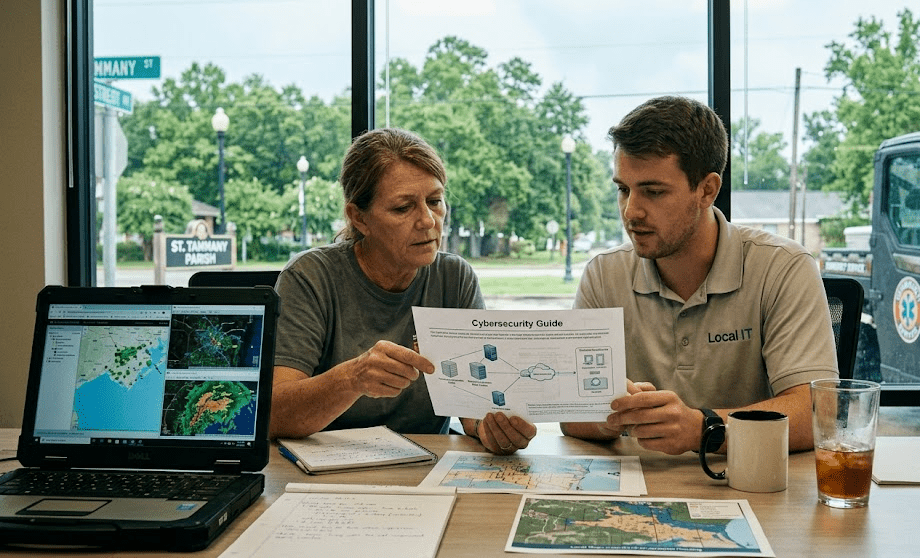
Evaluating a Cybersecurity Covington LA partner starts with one question: do they integrate storm-season downtime risk with digital security so your SMB remains protected under all conditions? A vendor selling antivirus licenses and a vendor designing integrated resilience are not the same purchase, even when the brochures look alike.
Press any candidate on local realities. Ask how their restore process performs when your primary site is offline. Ask who answers the phone at 2 a.m. during a hurricane, and whether that person can act without waiting on a ticket queue. Ask for their actual response timelines, not marketing language. The Ready.gov business continuity guidance gives a useful checklist of the recovery questions a serious partner should answer without hesitation.
Then weigh fit. A national provider may offer scale but no real grasp of the Northshore’s seasonal pattern. A purely local shop may know the geography but lack 24/7 depth. The model we have built pairs continuous monitoring and broad expertise with genuine attention to Gulf-Coast conditions, and you can review our cybersecurity resources to see how that thinking shows up in practice before you ever talk to us.
Frequently Asked Questions
What does cybersecurity in Covington, LA typically cost for an SMB?
Cybersecurity for a Covington SMB usually runs as a predictable monthly managed-service fee scaled to your employee count and risk profile, rather than a single large purchase. Most small and midsize Northshore firms find a layered managed plan costs less than the lost revenue from one serious storm-week breach. A free strategy call is the fastest way to get a number tied to your actual environment.
Do small businesses in Covington really need disaster-recovery-integrated security?
Yes, because the Gulf Coast routinely produces events that hit operations and security at the same time. A storm-week outage is exactly when attackers apply pressure, so separating backup planning from breach planning leaves a gap that this region’s weather reliably exposes. Integrating the two is the practical baseline here, not an upgrade.
How is cyber risk on the Northshore different from other regions?
Northshore cyber risk stacks geographic and staffing factors on top of normal threats. Hurricane season creates recurring downtime windows that double as attacker opportunity, and the local pool of senior security talent is thinner than in major metros. Both factors push SMBs toward managed coverage instead of a single internal hire.
Can a Covington SMB handle cybersecurity in-house?
A Covington SMB can run some security functions internally, though full coverage usually demands more depth than one or two hires can sustain. A single internal expert becomes a single point of failure the moment they are sick, on leave, or mid-incident during a storm. Most firms get stronger resilience from a managed partner paired with internal staff who own business context.
What should I ask a Covington cybersecurity provider before signing?
Ask whether they design storm recovery and breach defense as one system, how their restore process performs when your site is offline, and who can act during a 2 a.m. hurricane incident without waiting on a ticket queue. Request real response timelines and references from similar SMBs. A provider who answers these directly is taking your Gulf-Coast risk seriously.
Talk to a Team That Knows the Northshore
Cybersecurity in Covington, LA is not a product you buy once, it is a posture you maintain through every season this coast throws at you. The firms that stay standing are the ones who stopped treating storm recovery and cyber defense as separate line items and started planning for the week both arrive together. That shift, from a drawer of disconnected tools to one integrated and watched system, is what actually holds when a hurricane and an intruder show up in the same week. We have spent years helping Gulf-Coast SMBs make exactly that move, and we know the local conditions because we work in them. If you want a clear read on where your current setup would crack under that combined pressure, book a free strategy call with our team. We will walk your environment, name the real gaps in plain language, and show you what disaster-recovery-integrated security would look like for your business. Schedule it here: https://mind-core.com/schedule-a-consultation/
Covington Louisiana Cybersecurity and Gulf Coast Resilience Expertise from Matt Rosenthal
Matt Rosenthal, CEO of Mindcore Technologies, has over 30 years of experience helping Northshore Louisiana SMBs build cybersecurity programs that treat storm-season downtime risk and breach risk as one integrated problem rather than separate budgets with separate owners. He has seen firsthand how Covington firms lose both when a flood-week outage removes the verification habits that normally stop a fraudulent wire or a credential reset, handing an attacker the exact window of distraction they were waiting for. Matt leads a team that designs disaster-recovery-integrated security for Gulf Coast businesses, pairing immutable offsite backups, continuous managed monitoring, and incident response plans that work when the office is offline, with full awareness of the Northshore’s seasonal risk pattern and thin local security talent market.

