

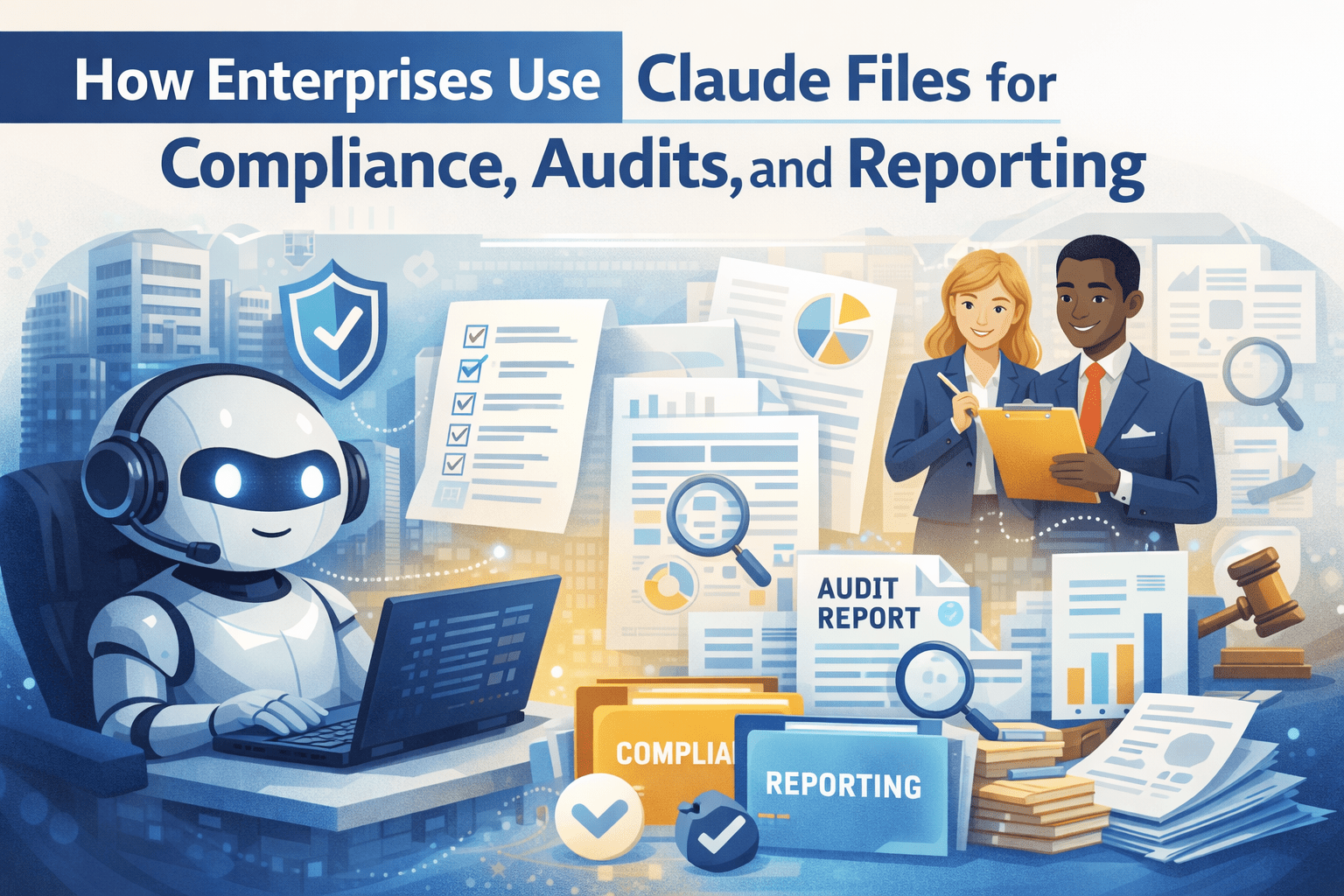
Compliance, audit, and regulatory reporting work share a common structure: large volumes of documents that must be reviewed against defined criteria to answer a specific question. Is this contract compliant with our standard terms? Does this transaction record support the audit finding? Is this regulatory filing complete and accurate?
The manual effort required to answer those questions at enterprise scale is enormous — and the consistency of the answers depends on which analyst had time to review which document on which day. Claude Files addresses that structure by applying consistent analytical attention to document review at volumes that manual analysis cannot match, producing structured outputs that support the compliance determination, audit finding, or regulatory submission without replacing the professional judgment that makes that determination final.
Overview
Claude Files enables enterprise compliance, audit, and reporting functions to handle their document review volume with AI-driven analysis that produces consistent, structured outputs at scale. The compliance professional, auditor, or regulatory specialist retains accountability for determinations. Claude Files handles the document analysis that precedes those determinations — extracting relevant provisions, flagging non-compliant conditions, verifying completeness, and generating structured review outputs that make every subsequent determination faster and better documented.
- Compliance reviews handled at full document volume rather than sampled under resource constraints
- Audit preparation document review automated for first-pass completeness and relevance assessment
- Regulatory filing verification automated for required element presence and accuracy checking
- Structured outputs from document analysis reduce the time professionals spend per determination
- Audit trail documentation of the AI-assisted review process supports compliance program defensibility
The 5 Why’s
- Why is document review the highest-value automation target in compliance, audit, and reporting workflows? Document review is the stage that consumes the most professional time in compliance, audit, and regulatory work. Automating the analytical preparation for that review — extracting relevant provisions, flagging issues, verifying completeness — reduces the time professionals spend per document without removing their judgment from the determinations that require it.
- Why does consistent analytical attention matter specifically in compliance and audit contexts? Compliance reviews and audit procedures are designed to be comprehensive. Inconsistent manual review — some documents reviewed thoroughly, others superficially due to time constraints — creates gaps in the compliance record that are difficult to defend in regulatory examinations. Consistent AI-driven first-pass review ensures the comprehensive coverage that compliance programs require.
- Why does structured output from document analysis improve compliance determination quality? A compliance professional who receives a structured AI analysis — flagged provisions, identified exceptions, referenced criteria — makes a faster and better-documented determination than one reviewing raw documents without that preparation. Structured preparation improves quality and reduces the time cost of thorough analysis.
- Why does AI-assisted review require explicit human determination for compliance and audit purposes? Regulatory compliance, audit findings, and regulatory submissions require professional accountability that AI analysis cannot provide. The determination that a contract is compliant, that an audit finding is supported, or that a filing is complete requires a qualified professional who can be held accountable for that determination. AI analysis is the preparation. Human judgment is the determination.
- Why does audit trail documentation of AI-assisted review strengthen compliance programs? Compliance programs that can demonstrate comprehensive, consistent review of relevant documents — with documented analysis methodology and professional determinations — are more defensible in regulatory examinations than programs where the review process is undocumented or inconsistently applied. Structured AI analysis with audit trails produces that documentation as a standard workflow output.
Compliance Review Applications
Contract Compliance Review
Enterprise contract portfolios — hundreds or thousands of agreements with customers, vendors, and partners — require ongoing compliance review against current standard terms, regulatory requirements, and internal policy standards. Manual review at that volume is resource-intensive and typically sampling-based rather than comprehensive.
Claude Files can analyze contract documents against defined compliance criteria — identifying deviations from standard terms, flagging non-standard provisions, verifying required clause presence, and generating structured review outputs for contract counsel review. The analysis covers the full portfolio volume. The attorney reviews the flagged items and makes the compliance determination.
Regulatory Compliance Monitoring
Organizations subject to ongoing regulatory requirements — HIPAA, financial regulations, data protection laws — must monitor their documentation continuously against applicable standards. Claude Files can review operational documents, policies, procedures, and records against defined regulatory criteria — flagging gaps, identifying required updates, and generating structured compliance status reports that support ongoing monitoring programs.
Internal Audit Document Review
Internal audit engagements require reviewing supporting documentation for the areas under examination. Claude Files can perform first-pass document review for audit samples — assessing completeness, identifying discrepancies, verifying expected documentation against actual documentation, and generating structured audit work papers that support the auditor’s testing conclusions.
Audit Preparation Applications
External Audit Document Production
External audits require assembling and reviewing documentation packages that support audit requests. Claude Files can review proposed audit response documents for completeness and relevance before they are produced — identifying documents that do not support the requested information, flagging potential issues that auditors will likely ask follow-up questions about, and generating document request response summaries that support audit team coordination.
Financial Statement Support Documentation Review
Financial statement audit support requires verifying that underlying documentation supports reported figures. Claude Files can review supporting documentation for defined financial statement line items — verifying that support documents contain the required information, identifying gaps in the documentation package, and generating structured documentation coverage reports.
Regulatory Reporting Applications
Filing Completeness Verification
Regulatory filings require specific elements, disclosures, and data points that must be present and accurate. Claude Files can review draft regulatory filings against defined completeness checklists — identifying missing required elements, flagging potentially inaccurate or inconsistent data, and generating structured completeness verification reports before filings are submitted.
Response Letter Review
Regulatory agency correspondence requires careful review before response. Claude Files can analyze incoming regulatory correspondence to identify all specific requests, questions, and deadlines — ensuring that response documents address every regulatory inquiry and that response timelines are tracked against every stated deadline.
A Simple Compliance and Audit Readiness Check
Your compliance and audit document workflows are ready for Claude Files if:
- Specific document review tasks have been identified where AI first-pass analysis would reduce professional review time
- Review criteria for each document type can be defined explicitly enough to configure Claude Files analysis
- Professional review and determination workflows are maintained — AI analysis supplements professional judgment, it does not replace it
- Audit trail requirements for AI-assisted review have been defined and infrastructure designed to meet them
- Compliance and legal leadership has reviewed and approved the AI-assisted review model for applicable use cases
Final Takeaway
Compliance, audit, and regulatory reporting workflows are among the highest-value targets for AI document analysis — high volume, defined criteria, professional accountability maintained. Claude Files applies consistent analytical attention to that volume at the depth that compliance programs require, produces structured outputs that make professional determinations faster, and generates the audit trail documentation that makes AI-assisted compliance review defensible.
The compliance professional who determines whether a contract is compliant does so faster, with better documentation, and with comprehensive coverage of the contract portfolio when Claude Files handles the analytical preparation. That is the operational value — not AI making the compliance determination, but AI ensuring the determination is made on thorough, consistent analysis rather than under resource pressure.
Accelerate Compliance and Audit Work With Mindcore Technologies
Mindcore Technologies works with enterprise compliance, audit, and legal teams to design and deploy Claude Files document analysis workflows — review criteria definition, output structure design, professional review integration, and audit trail infrastructure for compliance, audit, and regulatory reporting applications.
Talk to Mindcore Technologies About AI-Assisted Compliance Document Review →
Contact our team to assess your compliance document review volume and design the Claude Files deployment that addresses it.

