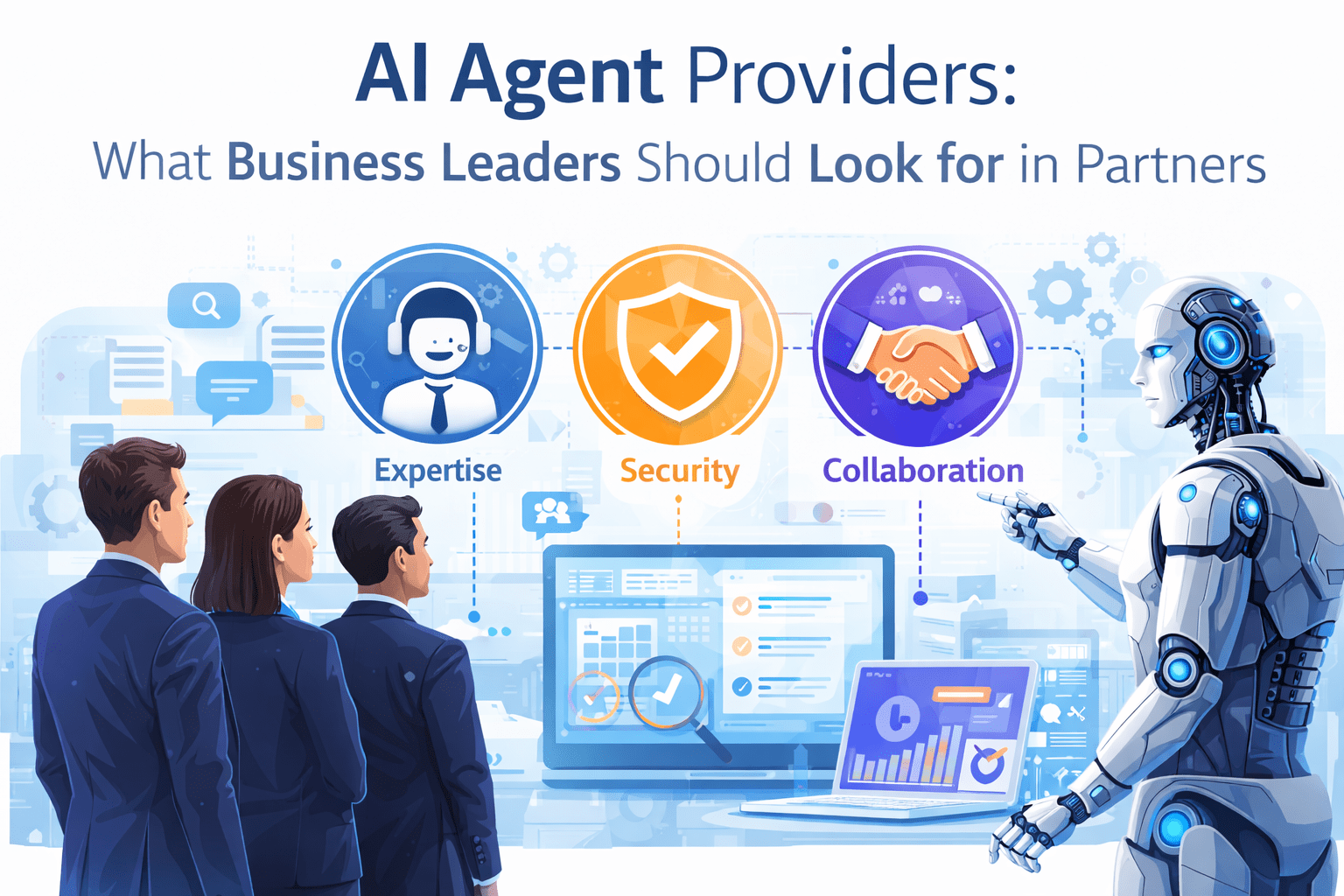
Selecting an AI agent provider is not a feature comparison exercise. It is a long-term infrastructure decision. The provider you select will influence your data governance posture, API exposure surface, operational scalability, compliance defensibility, and executive visibility.
The strategic foundation for AI adoption is introduced in The Complete Guide to AI Agents for Enterprise Business Operations, where AI agents are positioned as core operational infrastructure rather than experimental tools.
Choosing the wrong provider creates hidden technical debt. Choosing the right one creates sustainable automation discipline.
1️ Evaluate Security Architecture Compatibility
AI agents must operate within enterprise security boundaries.
Key evaluation criteria:
• Role-Based Access Control (RBAC) enforcement
Ensure agents cannot exceed scoped permissions.
• Granular API permission design
Prevent over-permissioned integrations.
• Encrypted communication channels
Protect data in transit.
• Audit logging transparency
Preserve compliance defensibility.
Security governance requirements are reinforced in Enterprise AI Compliance: Securing AI Agents in Corporate Environments.
2️ Assess Integration Depth and System Compatibility
Enterprise AI agents must integrate seamlessly across platforms.
Integration validation should include:
• ERP compatibility
Enable financial workflow automation.
• CRM integration
Support sales and client operations.
• HRIS connectivity
Coordinate workforce automation.
• BI and dashboard integration
Accelerate executive reporting.
Integration risk mitigation is further detailed in Top AI Integration Challenges Facing Enterprise Organizations Today.
3️ Validate Workflow Orchestration Capabilities
AI providers must support complex enterprise workflows.
Assessment factors include:
• Multi-step conditional logic automation
Support operational complexity.
• Cross-department workflow chaining
Enable enterprise-wide orchestration.
• Exception-handling frameworks
Preserve human oversight.
• Centralized management dashboards
Improve governance visibility.
Workflow depth is explored in AI Agents for Business: A Comprehensive Guide to Automated Operations.
4️ Confirm Scalability and Long-Term Viability
Enterprise AI must scale beyond pilot phases.
Scalability indicators include:
• Multi-agent orchestration capability
Support cross-functional expansion.
• High-volume transaction processing capacity
Maintain performance under load.
• API extensibility
Preserve future integration flexibility.
• Vendor financial and architectural stability
Reduce long-term risk.
Solution comparison frameworks are discussed in AI Agent Solutions for Enterprises: Comparing Options and Finding the Best Fit.
5️ Evaluate Governance and Advisory Support
AI agents require structured oversight.
Provider evaluation should include:
• Governance advisory guidance
Support policy alignment.
• Implementation sequencing expertise
Reduce deployment friction.
• Executive reporting customization
Improve leadership visibility.
• Compliance documentation support
Strengthen audit readiness.
Implementation sequencing guidance is reinforced in The Ultimate AI Agent Implementation Checklist for Business Executives.
6️ Examine Transparency and Data Control Policies
Enterprises must maintain ownership of their data.
Critical transparency questions:
• Who retains ownership of processed data?
• How is AI model training handled?
• Are logs exportable to enterprise monitoring systems?
• Are integration tokens revocable on demand?
Strategic alignment for AI control is outlined in How to Build AI-Powered Enterprise Operations Strategy.
7️ Identify Red Flags in AI Provider Selection
Common warning signs include:
• Overemphasis on demo features over architecture
• Lack of detailed API permission documentation
• No centralized logging export capability
• No structured governance advisory support
• Limited scalability documentation
• Vague compliance alignment statements
Provider selection discipline prevents downstream operational risk.
Enterprise Outcomes of Selecting the Right AI Partner
Organizations that select AI providers strategically observe:
• Reduced integration friction
• Stronger compliance defensibility
• Improved operational scalability
• Clear executive reporting alignment
• Lower API exposure risk
• Sustainable automation governance
Partner selection influences long-term enterprise resilience.
Key Takeaways
Business leaders evaluating AI agent providers must prioritize security architecture compatibility, scoped API governance, workflow orchestration depth, integration scalability, centralized monitoring capability, governance advisory support, and transparent data control policies. By selecting partners through structured enterprise criteria rather than feature-driven marketing, organizations build defensible AI infrastructure that enhances operational efficiency, strengthens compliance posture, and supports sustainable long-term automation growth.