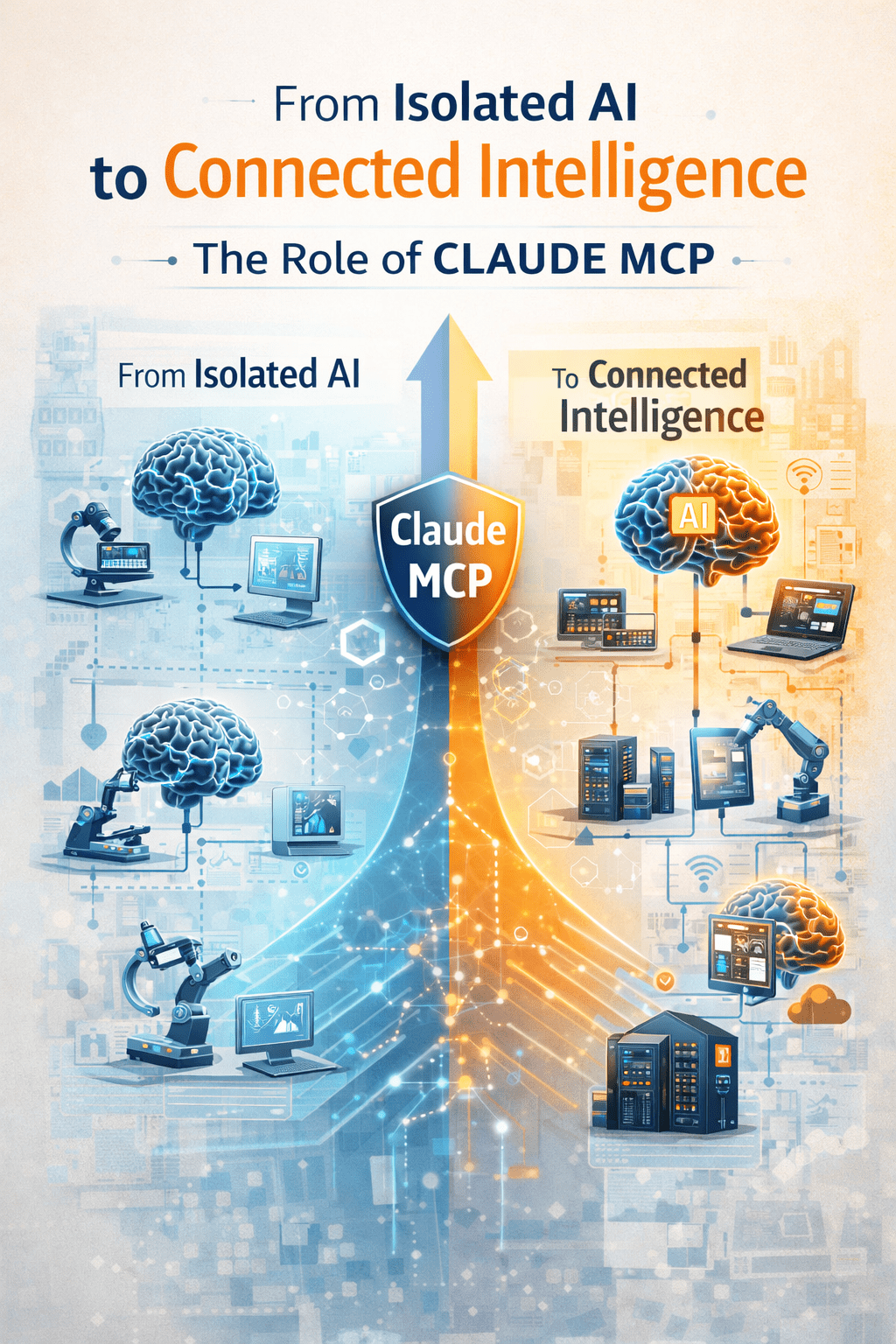
Isolated AI is useful the way a knowledgeable consultant working from emailed documents is useful. The reasoning is sound. The recommendations are well-constructed. And every output requires the person who asked for it to verify the information against current systems and execute the recommended actions manually.
Connected intelligence is different. It operates with live system context, produces outputs grounded in what is currently true, and can act in the systems where work happens — not just recommend actions for humans to execute later. The difference is not the quality of the reasoning. It is whether the AI is connected to the business or working alongside it at arm’s length.
Claude MCP — the Model Context Protocol — is what makes the transition from isolated AI to connected intelligence possible at enterprise scale.
Overview
Isolated AI has a well-defined value ceiling. It reasons well. It produces useful outputs. It cannot access the live data that makes those outputs operationally grounded, and it cannot act in the systems where those outputs need to be implemented. Claude MCP removes those constraints by providing a standardized protocol for live system connectivity, real-time data access, and direct action execution across enterprise infrastructure. The transition from isolated to connected is not a feature upgrade — it is a structural change in what AI can do inside an enterprise.
- Isolated AI produces outputs that require manual verification and manual execution to become operational
- Connected intelligence operates with live data and can act in systems directly — reducing the human intermediation between AI output and business outcome
- MCP provides the protocol layer that makes system connectivity scalable across the enterprise
- The transition changes AI’s role from advisory tool to operational participant
- Connected intelligence compounds in value as more systems are connected and more workflows become AI-addressable
The 5 Why’s
- Why does isolated AI have a structural value ceiling that connected intelligence does not? Isolated AI improves individual task speed and quality. Connected intelligence improves operational workflows — entire processes that span multiple systems, require current data, and produce outcomes through system actions. The first is a productivity improvement. The second is an operational transformation.
- Why does manual intermediation between AI output and business system execution limit AI value? Every manual step between AI recommendation and system action is a friction point — a place where the AI’s value is diluted by the effort required to implement it. As the number of those friction points increases with workflow complexity, the net value of the AI interaction decreases. Connected intelligence eliminates those friction points.
- Why is the connectivity layer the missing piece in most enterprise AI deployments? Most enterprise AI investment has gone into the reasoning layer — acquiring powerful AI models and giving employees access to them. The connectivity layer — the infrastructure that connects AI reasoning to live business systems — has been underinvested because it was expensive to build and maintain for each system connection individually. MCP changes that economics.
- Why does the transition from isolated to connected AI require a protocol, not just integrations? Integrations connect specific systems to specific other systems. A protocol connects any AI to any implementing system through a common interface. Enterprise connected intelligence requires the second model — one that scales across the full system landscape without rebuilding the integration layer for every new connection.
- Why does connected intelligence compound in value as system connections expand? Each additional system connection expands the range of workflows Claude can address with live data and direct action capability. The value of the connected network grows with each node added to it. Isolated AI adds value linearly — one capability at a time. Connected intelligence adds value exponentially — each new connection extends the reach of all the AI capabilities operating above it.
The Isolated AI vs Connected Intelligence Comparison
Isolated AI: The Current State for Most Enterprises
An employee needs to understand the status of a complex customer account. With isolated AI, the workflow looks like this:
- Employee pulls current account data from the CRM manually
- Employee retrieves recent interaction notes from the case management system
- Employee exports the billing history from the financial system
- Employee provides all of that data to Claude in a prompt
- Claude analyzes the combined data and produces a recommendation
- Employee implements the recommendation manually in each relevant system
Claude’s reasoning in step 5 is excellent. Steps 1-4 and step 6 consume employee time that the AI cannot address because it is not connected to the systems involved.
Connected Intelligence: The MCP-Enabled State
The same workflow with MCP-connected Claude looks like this:
- Employee asks Claude about the account
- Claude connects to the CRM, case management system, and financial system through MCP — retrieving current data from each
- Claude analyzes the live data and produces a recommendation grounded in current system state
- Claude implements the recommendation directly in the relevant systems through MCP action execution
Steps 1-4 and step 6 from the isolated AI workflow collapse into the MCP connectivity layer. The employee asks. Claude handles the rest.
What Changes at the Organizational Level
The difference is not one interaction. It is every interaction of this type, across every employee who handles these workflows, across every day those workflows run. The cumulative reduction in manual intermediation — across an enterprise running dozens of complex, multi-system workflows — is the operational transformation that connected intelligence produces.
The Role of MCP in the Connected Intelligence Architecture
MCP operates as the connectivity layer between Claude’s reasoning capability and the enterprise system landscape. Its role in the connected intelligence architecture is specific and structural:
- System access — MCP provides the interface through which Claude connects to any implementing system without custom API development per connection
- Data retrieval — MCP handles live data requests from Claude to connected systems, returning current information at the time it is needed
- Action execution — MCP carries Claude’s action requests to connected systems and returns confirmation, enabling direct workflow execution
- Context maintenance — MCP enables multi-system interactions where context from one system connection informs interactions with subsequent connected systems
- Authorization enforcement — MCP respects existing system access controls, ensuring connected intelligence operates within the permissions of the invoking user
Without MCP, connected intelligence requires custom integration work for every system in the enterprise. With MCP, connected intelligence scales to every system that implements the protocol.
Building the Connected Intelligence Architecture
- Start with the highest-value system connections — identify which systems, if connected to Claude, would eliminate the most manual intermediation from the workflows where it currently occurs
- Sequence connections for compounding value — systems that are part of the same workflow produce more value when connected together than when connected independently; sequence MCP implementation to build connected workflow coverage, not just individual system access
- Design for action execution, not just data retrieval — the full value of connected intelligence requires both reading from systems and writing to them; include action execution requirements in the integration design from the start
- Govern AI actions in live systems — connected intelligence operating in production systems requires defined scope, approval workflows for high-impact actions, and complete audit trails
- Expand progressively — each new system connection extends the reach of connected intelligence; expand the connection landscape systematically as the architecture matures
A Simple Connected Intelligence Readiness Check
Your organization is ready to move from isolated AI to connected intelligence if:
- Employees regularly perform manual data retrieval from multiple systems before AI interactions can provide relevant context
- AI recommendations regularly require manual execution in business systems after the AI interaction ends
- The value of AI in operational workflows is currently limited by the manual steps required on either side of each AI interaction
- System connectivity investment has been limited by the cost of custom API development per integration
- Leadership is evaluating AI’s operational role and sees the gap between what AI can do with live system access and what it currently does with static data
Final Takeaway
Isolated AI has delivered real value. It has also hit a ceiling defined by the manual work required to connect AI reasoning to the business systems that hold live operational data and execute operational outcomes. That ceiling is not a model limitation. It is a connectivity limitation — and MCP removes it.
The transition from isolated AI to connected intelligence is the transition that determines whether AI becomes a productivity tool at the margins or an operational participant at the center of how the business runs. Claude MCP is the protocol that makes that transition possible at enterprise scale. The organizations making it now are building the connected intelligence infrastructure that defines what competitive AI operations look like for the next decade.
Build Connected Intelligence With Mindcore Technologies
Mindcore Technologies works with enterprise teams to design and deploy the connected intelligence architecture — identifying the highest-value MCP integration targets, building the system connectivity that eliminates manual intermediation from complex workflows, and deploying Claude as an operational participant in the systems where your business actually runs.
Talk to Mindcore Technologies About Building Connected Enterprise Intelligence →
Contact our team to map the manual intermediation costs in your current AI workflows — and build the MCP connectivity that eliminates them.